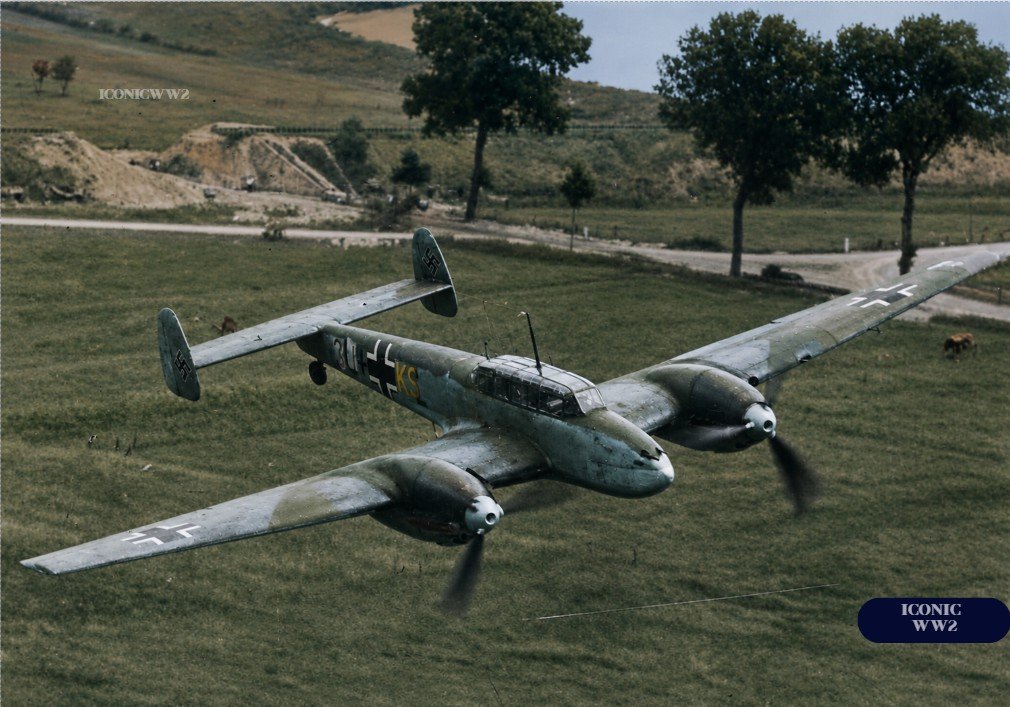
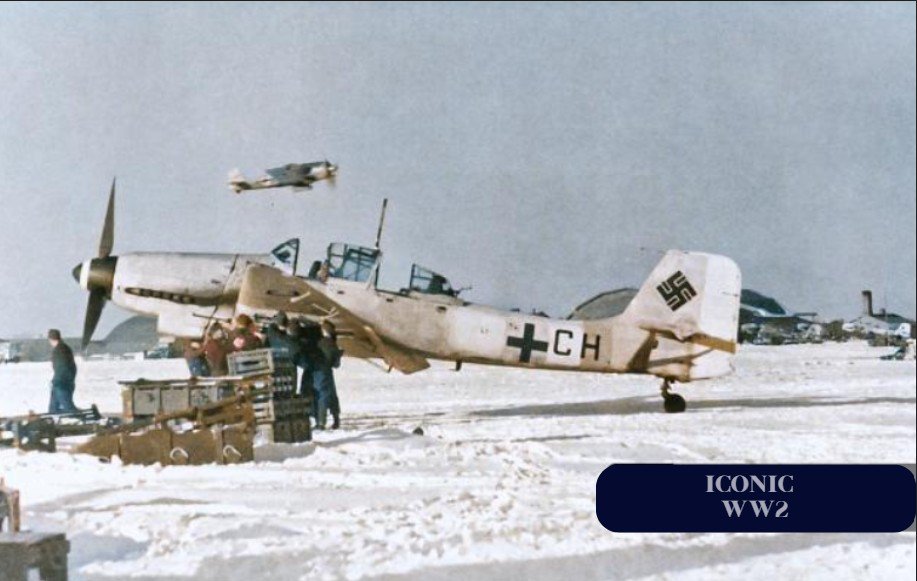
In 1934 the still-secret Luftwaffe issued a requirement for a modern single-seat monoplane fighter to replace its open-cockpit biplanes. The contest drew Germany’s leading firms, but it was the entry from Bayerische Flugzeugwerke, designed by Willy Messerschmitt and his colleague Robert Lusser, that swept the field. First flown in May 1935 — ironically powered at first by a British Rolls-Royce Kestrel, the only suitable engine then available — the Bf 109 was unlike anything its rivals offered.
Messerschmitt’s philosophy was ruthless: take the smallest, lightest possible airframe and wrap it around the most powerful engine available. The result combined an all-metal stressed-skin monocoque, a retractable undercarriage, an enclosed cockpit and automatic leading-edge slats that delayed the stall in a tight turn. Blooded with the Condor Legion in the Spanish Civil War — where its pilots also worked out the loose “finger-four” formation that every air force would later copy — the design entered the war as the most advanced fighter in widespread service anywhere in the world.
Few aircraft evolved so relentlessly across a single war. The E “Emil”, powered by the fuel-injected Daimler-Benz DB 601, was the version that carried the Luftwaffe through 1940, while the beautifully streamlined F “Friedrich” of 1941 is widely judged the high point of the breed’s handling and aerodynamic balance.
From 1942 the G “Gustav” — by far the most-produced version — adopted the heavier, more powerful DB 605 and an ever-growing burden of armament and equipment to meet the demands of the bomber-defence and Eastern-Front battles, and by the war’s end the final K “Kurfürst” pushed top speed beyond 710 km/h. But the steady addition of cannon and equipment gradually eroded the light, nimble qualities of the early marks, and two original sins endured to the very last: the cramped cockpit and the narrow-track undercarriage.
The early B/C/D marks proved the design over Spain. The E “Emil” carried it through 1940; the F “Friedrich” refined it in 1941; and the G “Gustav” became the definitive mid- and late-war version, built in vast numbers and in a bewildering array of sub-types — fighters, bomber-destroyers with underwing cannon, high-altitude variants and reconnaissance machines.
The final wartime model was the K “Kurfürst” of 1944. Production did not stop in 1945: the type continued to be built in Spain (as the Hispano Aviación HA-1112) and Czechoslovakia (as the Avia S-199) for years afterward, and a handful of the latter flew with the fledgling Israeli Air Force in 1948.
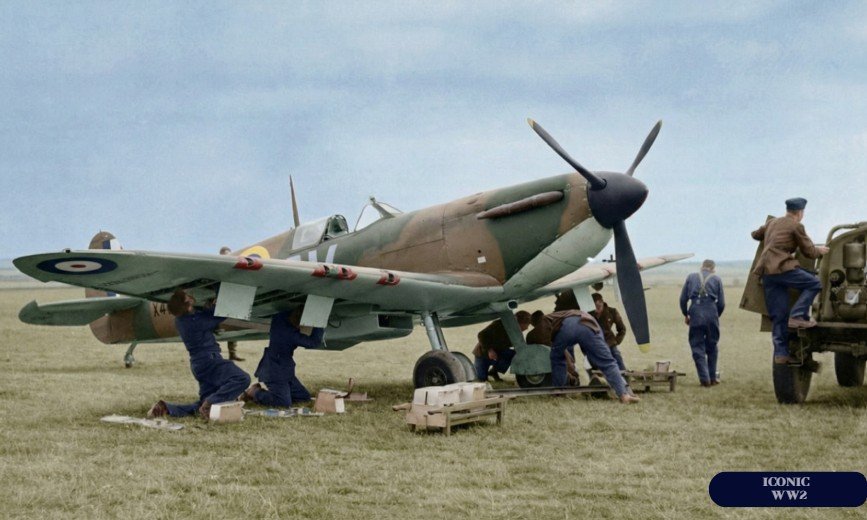
The Bf 109’s greatest early test came in the summer of 1940, when the E “Emil” faced the RAF over southern England. Against the Spitfire it was a near-equal — broadly matched in speed and climb, out-turned by the British fighter but blessed with one decisive trick: its fuel-injected engine kept running when a pilot shoved the nose down to escape, while the carburettor of the early Merlin choked and cut out, letting a 109 break off a fight simply by diving away.
But the campaign exposed the flaw that would dog the design forever: range. Tied to shepherding the bombers, a 109 arriving over London had barely ten minutes of fighting fuel before it had to turn for France, and Göring’s insistence on close escort stripped the fighters of the freedom to hunt. The Luftwaffe lost the Battle of Britain holding the best interceptor in the world — a fighter that simply could not stay where the battle was.
In the right hands the Bf 109 became the deadliest scoring machine in the history of air combat. It was the mount of the Experten — the Luftwaffe’s elite aces — and it claimed more aerial victories than any fighter ever built. Erich Hartmann scored all 352 of his kills on the type, a record that will almost certainly never be broken; Gerhard Barkhorn ran up 301, and more than a hundred German pilots passed a century of victories — the great majority flying the 109 against the vast numbers of Soviet aircraft over the Eastern Front, though the desert threw up its own legend in Hans-Joachim Marseille, the “Star of Africa.”
But the very traits that rewarded a master punished the beginner. Heavy controls at high speed, a punishing little cockpit and above all the narrow-track undercarriage — which swung and tipped aircraft on take-off and landing — cost a grim tally of pilots in accidents alone. As the German training system collapsed in 1944–45 and half-trained boys were sent up in the heavy late-model Gustavs, those losses turned catastrophic. The 109 was a thoroughbred that demanded a thoroughbred’s rider.
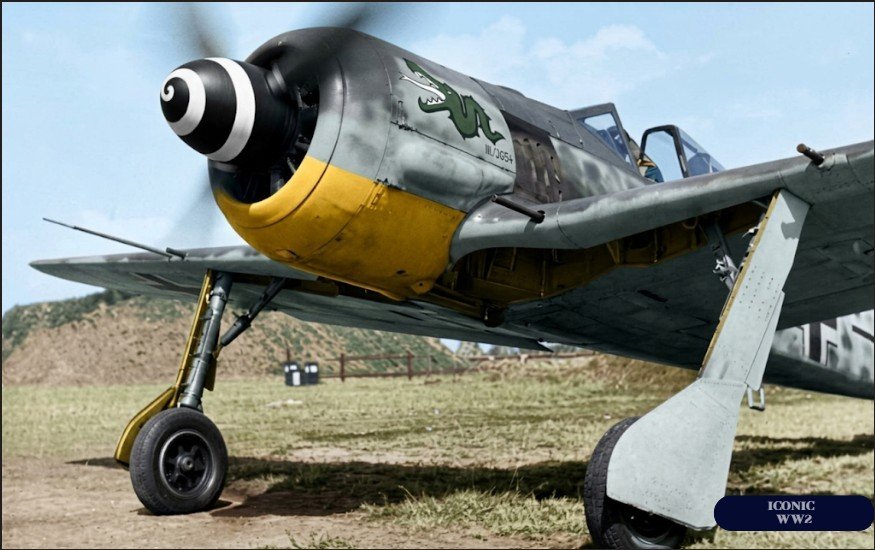
The 109’s longest and bitterest battle was fought over Germany itself. From 1943 the Gustav was thrown against the American day-bomber fleets, and shooting down a four-engined B-17 demanded ever-heavier weapons — a 30 mm cannon, underwing gondola guns, rockets — that turned the nimble fighter into a laden bomber-destroyer. That extra weight proved fatal in another way: so burdened, the 109 was easy prey for the enemy fighters.
And from early 1944 those fighters were the long-ranged P-51 Mustang, waiting over the Reich in growing numbers. Caught between the firepower it needed against the bombers and the agility it needed against the escorts, the Bf 109 was ground down in a war of attrition it could not win, its irreplaceable veterans dying alongside the novices rushed up to replace them. Alongside the Fw 190 it fought the defence of Germany to the very last day, hopelessly outnumbered.
With more than 34,000 built, the Messerschmitt Bf 109 is the most-produced fighter aircraft in history and one of the defining weapons of the Second World War. It pioneered the modern fighter formula, equipped the highest-scoring aces of all time, and remained competitive — through constant, ingenious development — across a decade of breakneck aeronautical progress.
Its weaknesses were real and never fully cured, and by 1945 it was being asked to do too much on too little. But as a measure of design longevity and combat achievement the Bf 109 has few equals in aviation history: a small, light fighter, conceived in the mid-1930s, that fought hard to the very end and beyond.
- Willy Radinger & Walter Schick, Messerschmitt Bf 109: The World’s Most Produced Fighter (Schiffer).
- Jochen Prien & Peter Rodeike, Messerschmitt Bf 109 F, G & K Series (Schiffer).
- Raymond F. Toliver & Trevor J. Constable, The Blond Knight of Germany — the biography of Erich Hartmann, 352 victories.
- John Weal, Bf 109 Aces of the Russian Front (Osprey, Aircraft of the Aces).
Iconic WW2 is free, ad-free and tracker-free — kept going only by the time it takes to research, restore and colorize each machine. If this profile was worth your read, you can help the archive grow.
| Manufacturer | Messerschmitt (BFW) |
| Designer | Willy Messerschmitt |
| Nation | Germany |
| Role | Fighter |
| First Flight | 28 May 1935 |
| In Production | 1936 – 1945+ |
| Units Built | ~34,000 (all marks) |
| Bf 109 B/C/D | Early marks, Spanish Civil War |
| Bf 109 E “Emil” | Battle of Britain, 1940 |
| Bf 109 F “Friedrich” | Aerodynamic refinement, 1941 |
| Bf 109 G “Gustav” | Most-produced, 1942 |
| Bf 109 K “Kurfürst” | Final wartime variant, 1944 |
| Early marks | Junkers Jumo 210 (V-12) |
| Main marks | Daimler-Benz DB 601 / DB 605 |
| Power | 680 – 1,475 hp |
| Layout | Inverted V-12, liquid-cooled |
| Max Speed | 640 km/h @ 6,300 m |
| Service Ceiling | ~12,000 m |
| Range | ~560 km |
| Climb Rate | ~17 m/s |
| Wingspan | 9.92 m |
| Length | 8.95 m |
| Height | 2.60 m |
| Wing Area | 16.05 m² |
| Empty Weight | 2,247 kg |
| Max Takeoff | 3,148 kg |
| Engine cannon | 1× 20mm MG 151 or 30mm MK 108 |
| Cowl guns | 2× 13mm MG 131 |
| Optional | underwing 20mm gondolas |