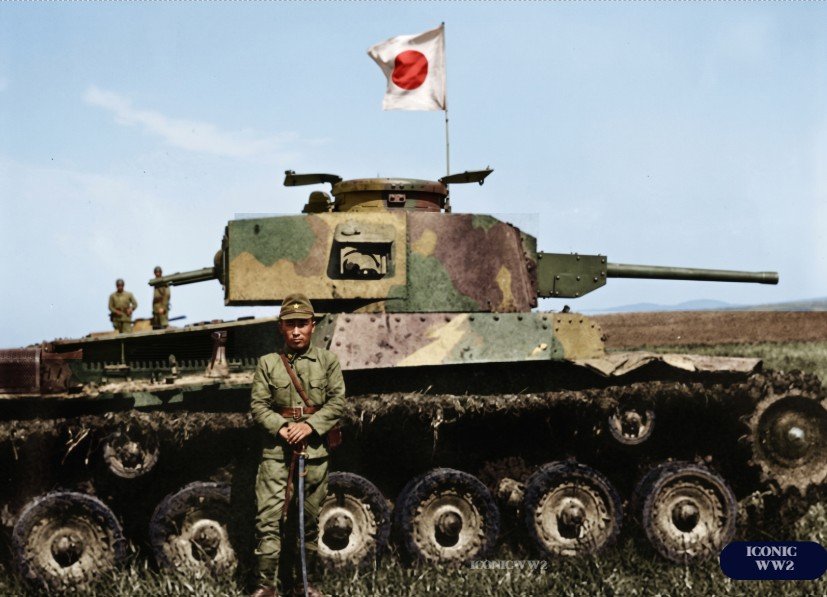
The Type 95 was designed in the early 1930s to give Japan's fast-moving formations a tank that could keep pace with motorised infantry and mechanised cavalry. Existing light tanks were too slow, and the Army wanted a vehicle for reconnaissance, infantry support and exploitation in the wide-open spaces of Manchuria and China — speed and range mattered far more than armour or gun power.
Developed by Mitsubishi and accepted in 1935, the Ha-Go was a compact, lightly built machine weighing only about 7.5 tonnes. It suited Japan's strategic situation perfectly: cheap to build, easy to ship across a vast maritime empire, and ideal for colonial warfare against enemies with little armour. It went on to become the most-produced Japanese tank of the war.
The Ha-Go was fast and nimble, with a reliable air-cooled diesel engine and good range, and it could go where heavier tanks could not. It was armed with a 37 mm gun and two machine guns — adequate against infantry and the light opposition it was built to face. For reconnaissance and pursuit it was a genuinely useful little tank.
Its fatal flaw was protection. The armour was at most around 12 mm — enough to stop rifle and machine-gun fire but nothing more — and the tank could be knocked out by virtually any anti-tank weapon, including the heavy machine guns and small cannon carried by Allied infantry and vehicles. The cramped one-man turret also overloaded the commander, who had to spot, aim, load and fire the gun while directing the tank.
Attempts were made to improve it, including up-gunned and amphibious derivatives for the Navy's island campaigns, but the basic vehicle was simply too small and too lightly built to be developed into anything that could survive on a modern battlefield.
Several variants of the Ha-Go appeared. There were versions adapted for the cold of Manchuria, experimental up-gunned models, and — most distinctively — the Type 2 Ka-Mi amphibious tank, based on Ha-Go components and fitted with detachable pontoons, developed for the Imperial Japanese Navy's amphibious landings in the Pacific.
The chassis and running gear also influenced and shared components with other light Japanese designs. But the standard Type 95 remained the principal version throughout, serving from the late 1930s right to the end of the war with only modest changes — a sign both of its essential soundness for its role and of Japan's limited capacity to replace it.
The Ha-Go served across the whole sweep of Japan's war. It fought the Soviets at Khalkhin Gol in 1939, ranged through China, and spearheaded the lightning conquests of Malaya, the Philippines, Burma and the Dutch East Indies in 1941–42, where its speed and the near-total absence of Allied armour let it run almost unchecked.
The Ha-Go was the most-produced Japanese tank of the war — some 2,300 built — and for the fast, lightly-opposed campaigns of 1941–42 its speed and reliability were real virtues. But it had been designed in the mid-1930s to fight infantry and other light tanks: its 37 mm gun and thin armour left it hopelessly behind once it met the tanks and anti-tank weapons of a modern army.
In the island fighting of the central Pacific the story changed completely. Against American Shermans, bazookas and anti-tank guns, the thin-skinned Ha-Go was desperately vulnerable, and Japanese light-tank attacks were often destroyed within minutes. As on land elsewhere, many were eventually dug in as fixed firing points rather than risked in mobile battle.
Ha-Gos remained in service to the very end, fighting on Pacific islands, in Burma, and finally against the overwhelming Soviet armoured columns that poured into Manchuria in August 1945. Everywhere it met modern tanks the result was the same — a fast, willing machine hopelessly outclassed by the firepower ranged against it.
The Type 95 Ha-Go was a good light tank for its time and purpose, and a telling illustration of Japan's whole approach to armoured warfare. Fast, reliable and well-suited to reconnaissance and colonial campaigns, it did valuable work in China and in the early Pacific victories where it faced little serious opposition.
But like the Chi-Ha that fought beside it, the Ha-Go was overtaken by a war it was never built for. Against the modern armour of the United States and the Soviet Union its thin protection and light gun left it almost defenceless, and it ended the war as a symbol of how far Japanese tank design — starved of priority behind the fleet and the air arm — had been left behind by its enemies.
- Steven J. Zaloga, Japanese Tanks 1939–45 (Osprey, New Vanguard).
- Peter Chamberlain & Chris Ellis, Tanks of the World 1915–1945 (Cassell).
Iconic WW2 is free, ad-free and tracker-free — kept going only by the time it takes to research, restore and colorize each machine. If this profile was worth your read, you can help the archive grow.
| Manufacturer | Mitsubishi |
| Nation | Japan |
| Role | Light / reconnaissance tank |
| Designation | Type 95 Ha-Go (Ke-Go) |
| Service Entry | 1935 |
| Crew | 3 (commander/gunner, driver, hull MG) |
| Units Built | ~2,300+ |
| Engine | Mitsubishi NVD 6120 diesel |
| Type | 6-cyl air-cooled diesel |
| Power | ~120 hp |
| Fuel | Diesel |
| Road Speed | ~45 km/h |
| Range (road) | ~250 km |
| Suspension | Bell-crank (Hara) type |
| Length | 4.38 m |
| Width | 2.06 m |
| Height | 2.18 m |
| Combat Weight | ~7.4 t |
| Main Gun | 37 mm Type 94 / Type 98 |
| Secondary | 2× 7.7 mm Type 97 MG |
| Front Armour | ~12 mm |
| Side / Rear Armour | ~9–12 mm |
| Limitation | Very thin armour; one-man turret |