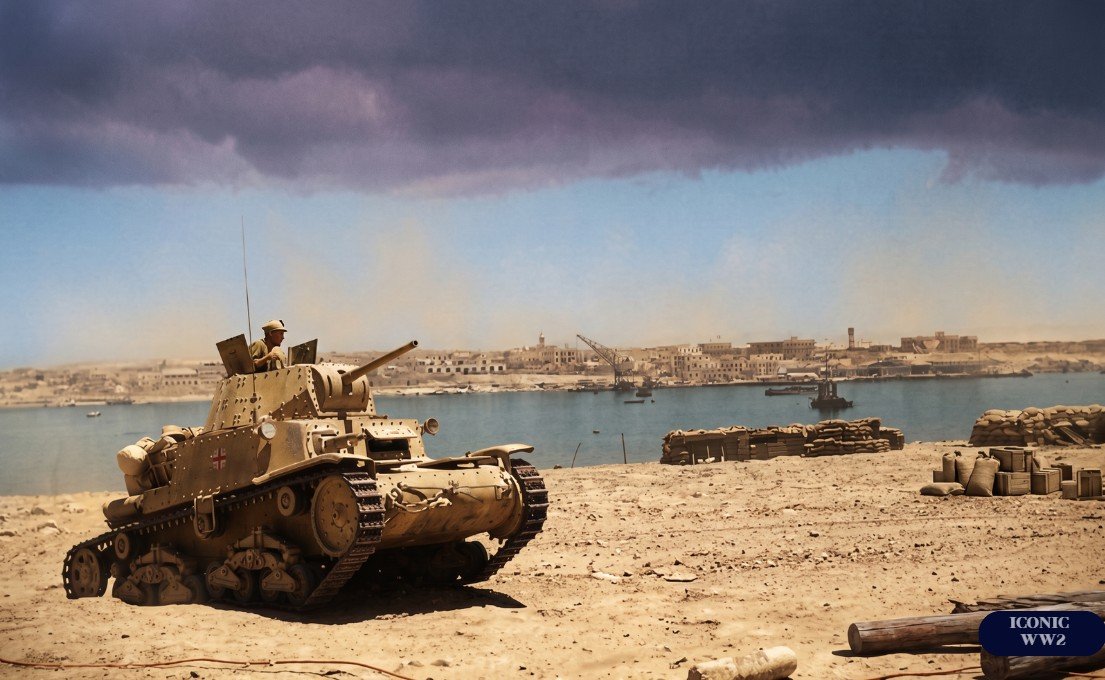
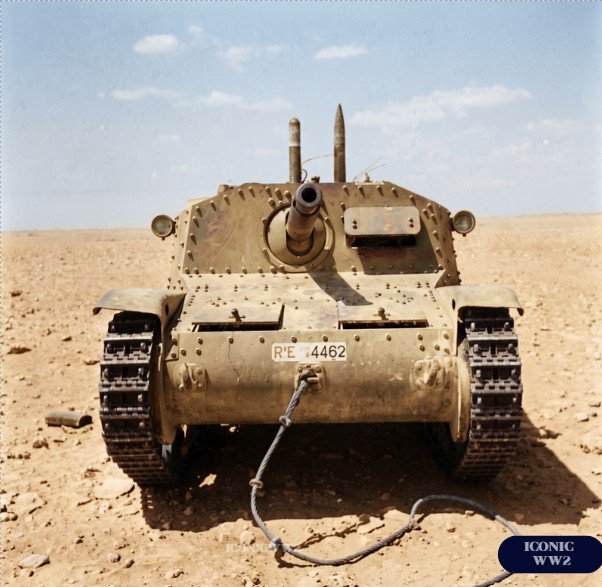
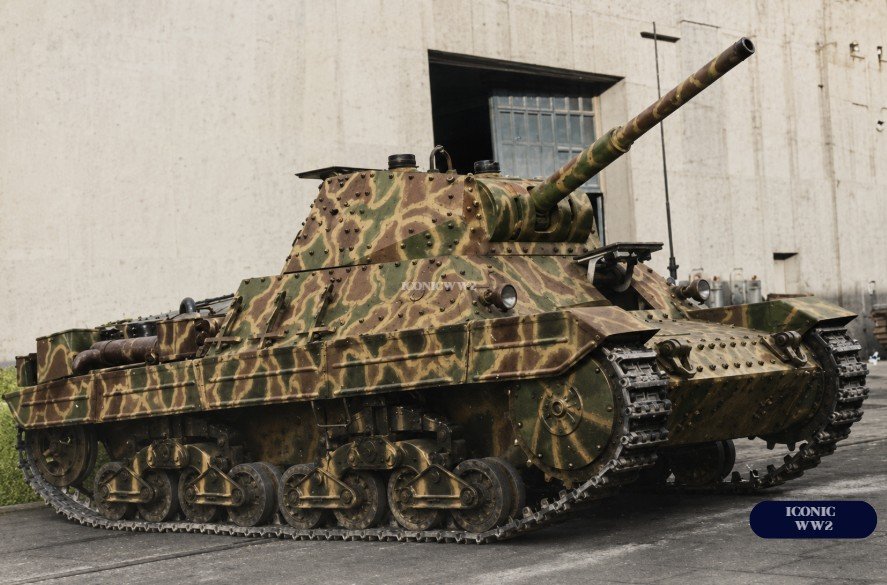
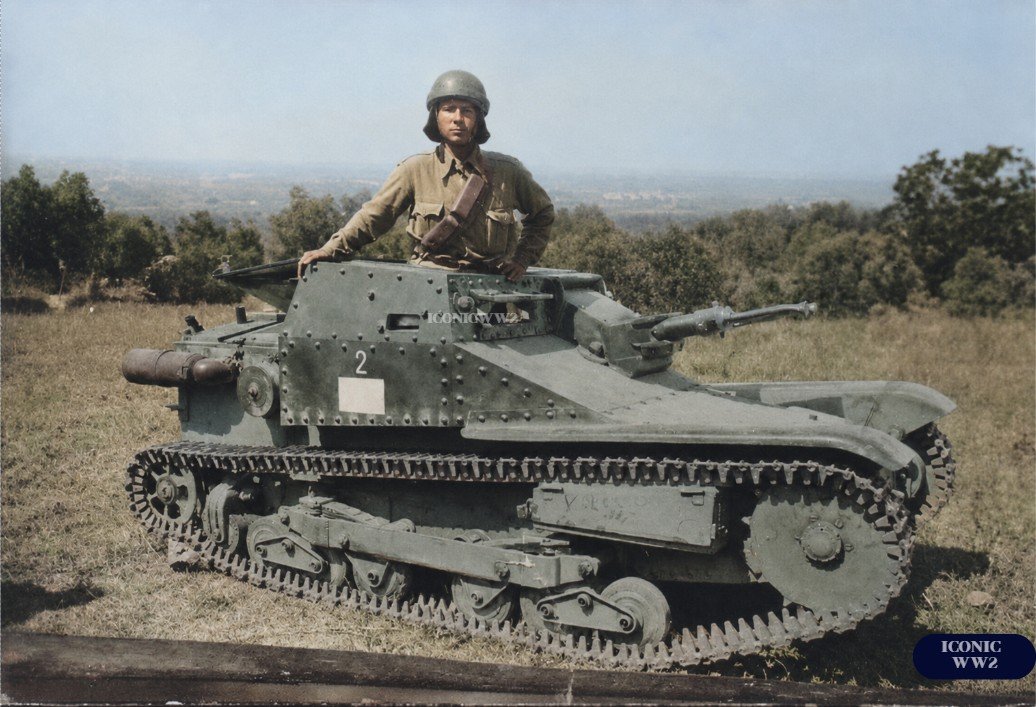
By 1942 the Regio Esercito had run headlong into the same problem that haunted every army of the war: its tanks could not kill the enemy’s. The M13/40 and its cousins carried only a feeble 47 mm gun, and reports filtering back from the Eastern Front of the Soviet T-34 and KV — shrugging off shot after shot — made the danger unmistakable. Italy needed a mobile gun powerful enough to destroy any tank on the battlefield, and it needed it quickly.
The answer already existed in the artillery park. The Cannone da 90/53 was a superb 90 mm anti-aircraft gun, high-velocity and hard-hitting — Italy’s equivalent of the famous German “88,” and just as lethal against armour. In early 1942 Mussolini personally ordered the gun mounted on a tracked chassis to create a self-propelled tank destroyer. Only 30 were to be built, and every one of them would end up in Sicily.
There was no Italian hull big enough to carry the 90 mm comfortably, so the engineers at Ansaldo improvised. They took the chassis of the M14/41 medium tank — the up-engined successor to the M13/40 — moved the engine to the centre, and mounted the long gun at the rear in an open, three-sided shield. The result was tall, ungainly and unmistakable: a big gun perched over a small tank.
The compromises were brutal. Armour was minimal — a shield of about 30 mm and an open top that left the crew exposed to shell splinters, air-burst and even small arms from above. Worse, there was almost no room for ammunition: the vehicle carried only about six rounds, so each Semovente had to be shadowed by a separate ammunition carrier built on the little L6/40 light-tank chassis. It was a weapon system that could hardly fight alone.
For all its fragility, the gun at its heart was magnificent. The 90/53 fired its shot at around 840 m/s and could defeat the frontal armour of any Allied tank in service — the Sherman, the Grant, the Churchill — at ranges well beyond a kilometre, far outreaching the guns firing back at it. In the hands of a good crew, dug in and firing first, a single Semovente could dominate a stretch of open ground.
The same excellent weapon was pressed into service in other forms. Mounted on heavy Lancia and Breda trucks as the autocannone da 90/53, it had already served as an improvised tank-hunter and anti-aircraft gun in North Africa. But the tracked Semovente was the purest expression of the idea — a mobile 90 mm that could go where the towed guns could not.
All thirty Semoventi went to the defence of Sicily, where they were parcelled out in small independent batteries scattered across the island rather than massed for a decisive blow. When the Allies came ashore on 10 July 1943, some were in action almost at once around the Gela beachhead, where the 90 mm guns knocked out American tanks at long range and briefly made themselves felt among the confusion of the landings.
But thirty thin-skinned vehicles, split up and starved of ammunition, could not turn a battle. Exposed on their open mounts, they were picked off by return fire, aircraft and naval gunnery, or abandoned when their handful of rounds ran out and their carriers could not reach them. Within the five weeks of the Sicilian campaign, virtually the entire production run was destroyed or captured.
The Semovente 90/53 was, in concept, ahead of its time — and the Germans would build almost exactly the same idea. Their Nashorn, an 88 mm gun on an open-topped medium-tank chassis, entered service in 1943 to the same logic: mount the biggest available anti-tank gun on tracks and accept thin armour as the price. The Italian vehicle had got there first, in 1942.
What Italy could not match was quantity or doctrine. The Germans built hundreds of Nashorns and used them as massed, long-range tank-hunting battalions; Italy built thirty Semoventi and frittered them away in penny packets. The vehicle was not a failure of engineering but of scale — a glimpse of what Italian industry could do, arriving far too late and in far too few numbers to matter.
The Semovente da 90/53 is the most powerfully armed armoured vehicle Italy fielded in the Second World War, and one of the rarest — far scarcer even than the excellent Semovente 75/18 that was its stablemate. It married a genuinely first-class gun to a hasty, fragile platform, and it was thrown into the one campaign — the defence of Sicily — where its handful of vehicles could be overwhelmed almost as soon as they appeared.
It survives now only in a few museum pieces and in the story it tells: of an Italian army that could still design a weapon to frighten any tank on the battlefield, but could no longer build it in the numbers, or wield it with the doctrine, that might have made it count.
- Nicola Pignato & Filippo Cappellano, Gli Autoveicoli da Combattimento dell’Esercito Italiano (Ufficio Storico SME).
- Filippo Cappellano & Pier Paolo Battistelli, Italian Medium Tanks 1939–45 (Osprey, New Vanguard 195).
Iconic WW2 is free, ad-free and tracker-free — kept going only by the time it takes to research, restore and colorize each machine. If this profile was worth your read, you can help the archive grow.
| Manufacturer | Ansaldo |
| Nation | Italy |
| Role | Self-propelled anti-tank gun / tank destroyer |
| Chassis | M14/41 (modified) |
| Built | 1942 (in service 1943) |
| Crew | 2 on vehicle (+ separate ammo carrier) |
| Units Built | only 30 |
| Gun | Cannone da 90/53 (90 mm L/53) |
| Origin | Dual-purpose AA / anti-tank gun |
| Muzzle Velocity | ~840 m/s |
| Ready Rounds | only ~6 carried |
| Engine | SPA 15TM V8 diesel |
| Power | ~145 hp |
| Max Speed | ~35 km/h |
| Range | ~200 km |
| Layout | Gun at rear, open superstructure |
| Gun Shield | ~30 mm |
| Hull | ~15–25 mm |
| Weakness | Open-topped, splinter-vulnerable |
| Length | ~5.21 m (hull) |
| Width | ~2.20 m |
| Height | ~2.15 m |
| Weight | ~17 t |
| Deployment | All 30 to Sicily, 1943 |
| Key Action | The Gela beachhead, July 1943 |
| Tactics | Split into small independent batteries |
| Fate | Almost all lost in the Sicily campaign |