By the late 1930s Soviet heavy-tank thinking was still dominated by enormous multi-turreted land battleships such as the T-35 — slow, tall, mechanically fragile machines that bristled with guns but could barely move. The fighting in the Spanish Civil War, where fast anti-tank guns shredded lightly armoured vehicles, taught the Red Army a brutal lesson: what a tank needed above all was armour thick enough to shrug off those guns, concentrated behind a single main weapon rather than spread across a fleet of turrets.
The answer, developed at the Kirov Plant in Leningrad under Zhozef Kotin, was a compact single-turret heavy tank with armour of unprecedented thickness. It was named the Kliment Voroshilov, after Stalin's Defence Commissar — a politically prudent choice in the Soviet Union of the 1930s. Blooded against the Finns during the Winter War of 1939–40, the KV proved its concept immediately: Finnish anti-tank rounds simply bounced off it.
The KV-1's defining feature was its armour. With around 75mm on the frontal plates — far thicker than anything on a German tank of 1941 — it was, for a time, very nearly invulnerable to the standard German anti-tank weapons. Its main gun, eventually the reliable 76.2mm F-34, gave it a useful punch against both armour and soft targets, and it shared this gun and much of its mechanical philosophy with the medium T-34, easing production and supply.
But that protection came at a heavy price. The KV-1 was ponderously slow, its transmission and clutch were notoriously weak and prone to failure, and its great weight strained bridges, broke down on the march and made it exhausting to drive. The two-man turret overloaded the commander, who had to aim and fire the gun as well as direct the tank, and early optics and radios were poor. The KV could survive almost anything the enemy threw at it — but it too often defeated itself.
As the war went on, the design's central problem grew acute. The Germans rapidly fielded better anti-tank guns and the long-gunned Panzer IV, eroding the KV's invulnerability, while the cheaper, faster T-34 could do almost everything the KV could — for far less weight and cost. Soviet designers tried to address the sluggishness with the lightened, faster KV-1S, but in doing so they thinned the armour, blurring the very distinction between heavy and medium tank that justified the KV's existence.
The baseline KV-1 appeared in a steady progression of models with progressively heavier cast and bolt-on armour and the improved 76.2mm gun. The KV-1S (skorostnoy, “fast”) of 1942 cut weight and armour to restore mobility and fix the chronic transmission troubles, while the KV-85 mounted a powerful 85mm gun in a new turret as an interim answer to the Tiger.
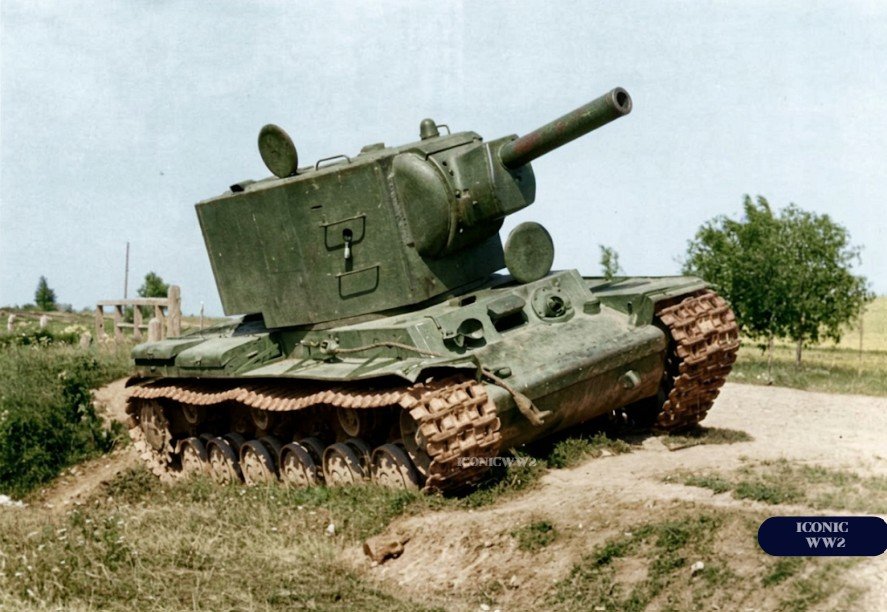
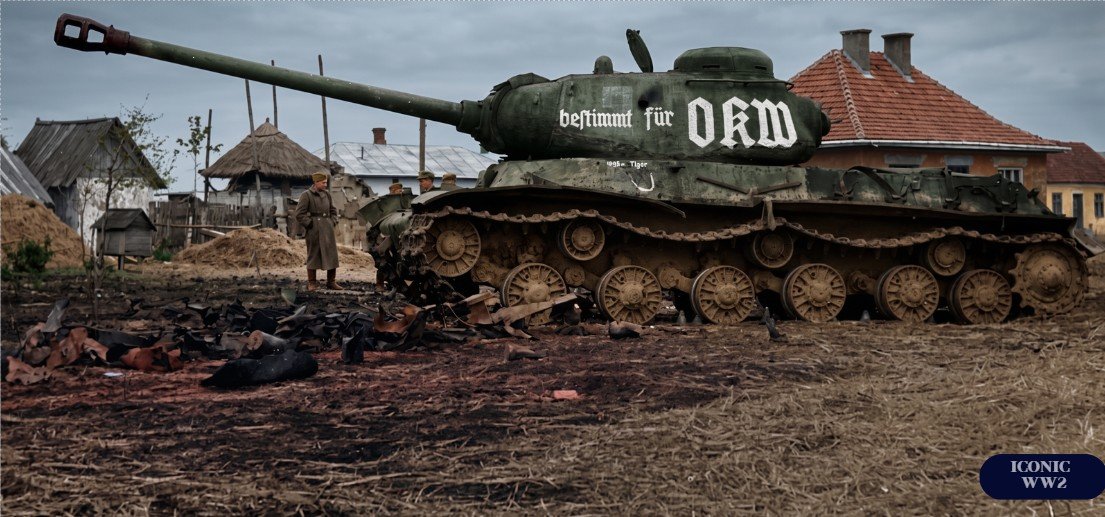
Two notable offshoots stand out. The KV-2 was a startling assault version carrying a massive 152mm howitzer in a towering slab-sided turret, intended to smash bunkers in the Finnish war. And the entire KV line ultimately gave rise to the superb IS (Iosif Stalin) series of heavy tanks that would carry the Red Army to Berlin.
When Germany invaded in June 1941, the KV-1 delivered one of the great shocks of the campaign. German gunners watched in disbelief as their anti-tank rounds ricocheted harmlessly off its hull. In the most famous episode, near Raseiniai in Lithuania, a single KV is said to have blocked a key road for an entire day, shrugging off round after round and holding up a German division until it was finally silenced by an 88mm gun firing at point-blank range and a close assault.
The KV owed its near-invulnerability to armour far thicker than the Germans had planned for: 75–90 mm of plate that the standard 37 mm and 50 mm anti-tank guns of 1941 simply could not defeat. For a few weeks that summer it was, quite literally, one of the most heavily protected tanks in the world — and the Wehrmacht had no ready answer to it but the 88 mm flak gun pressed into an anti-tank role.
Such episodes proved that the KV could dominate a battlefield — when it worked. But its mechanical unreliability, the chaos and poor training of the Soviet armoured force in 1941, and a chronic shortage of armour-piercing ammunition meant that huge numbers were lost not to enemy fire but to breakdowns and abandonment. As the Tiger and improved German guns arrived, the KV's invulnerability faded, and its battlefield advantage over the cheaper T-34 shrank to almost nothing.
By 1943 the writing was on the wall. Production wound down in favour of the T-34 and the new IS heavies, and the KV-1 passed out of front-line service — its day of dominance brief, but its influence on Soviet heavy-tank design profound and lasting.
The KV-1 was, for one extraordinary summer, the most formidable tank in the world — a machine the German Army of 1941 simply could not reliably destroy. It announced a new philosophy of the heavily armoured single-turret battle tank, and it gave the hard-pressed Red Army a desperately needed symbol of resistance in its darkest hour.
Yet it was a flawed giant, undone by its own weight, a fragile transmission and an awkward fighting compartment, and quickly overshadowed by the cheaper and more balanced T-34. Around 5,200 were built before production ceased. The KV-1's true legacy lies less in its own short career than in what it began: the line of Soviet heavy tanks that, through the KV-85 and the IS series, would roll all the way to Berlin.
- Steven J. Zaloga & Jim Kinnear, KV-1 & 2 Heavy Tanks 1939–45 (Osprey, New Vanguard).
- Maxim Kolomiets, KV-1 & KV-2 Heavy Tanks (Frontline / Eksmo).
- Robert Michulec, KV (Armor PhotoGallery).
Iconic WW2 is free, ad-free and tracker-free — kept going only by the time it takes to research, restore and colorize each machine. If this profile was worth your read, you can help the archive grow.
| Manufacturer | Kirov Plant, Leningrad |
| Also built by | Chelyabinsk (“Tankograd”) |
| Designer | Zhozef Kotin |
| Nation | Soviet Union |
| Role | Heavy tank |
| Service Entry | 1939 |
| Crew | 5 (commander/gunner, loader, driver, hull MG, mechanic) |
| Units Built | ~5,200 |
| KV-1 | Baseline heavy tank, 76.2 mm |
| KV-1S | Lightened, faster, reworked transmission |
| KV-2 | 152 mm howitzer assault tank |
| KV-85 | 85 mm gun, interim anti-Tiger |
| IS series | Direct successor heavy tanks |
| Engine | Kharkiv V-2K |
| Type | V-12 diesel |
| Power | ~600 hp |
| Transmission | 5-speed (notoriously weak) |
| Road Speed | ~35 km/h |
| Cross-country Speed | ~10–15 km/h |
| Range (road) | ~180 km |
| Combat Weight | ~45 t |
| Length | 6.75 m |
| Width | 3.32 m |
| Height | 2.71 m |
| Combat Weight | ~45 t |
| Main Gun | 76.2 mm F-34 |
| Secondary | 3× 7.62 mm DT MG |
| Hull Front Armour | ~75 mm |
| Turret Armour | ~75 mm |
| Engine | V-2K diesel (fire-resistant) |