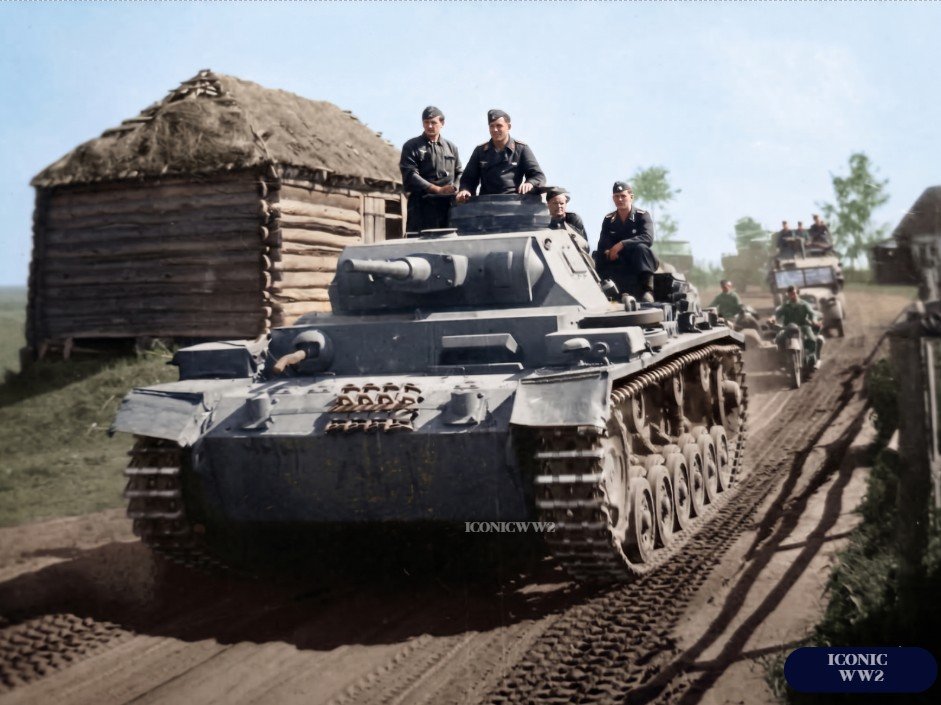
When the German Army began secretly rebuilding its armoured force in the early 1930s, its theorists — chief among them Heinz Guderian — envisaged two complementary battle tanks working side by side. One, the Panzer III, would be the principal anti-tank fighting vehicle, armed with a high-velocity gun to engage other tanks. The other, larger and carrying a bigger but lower-velocity weapon, would be the support tank, lobbing high-explosive shells to crush the machine-gun nests, anti-tank guns and field fortifications that threatened the advance. That second vehicle became the Panzerkampfwagen IV.
Designed by Krupp and entering production in the late 1930s, the Panzer IV was conceived for an infantry-support role that, on paper, made it the junior partner in the German tank fleet. No one foresaw that this stopgap support vehicle would outlast, outgrow and ultimately replace the Panzer III, becoming the true backbone of the Wehrmacht's armour and the only German tank to remain in continuous production from the first day of the war to the last.
The early models — the Ausführungen A through F1 — carried a short-barrelled 7.5 cm KwK 37 L/24 gun, ideal for hurling high-explosive but almost useless against armour. Through the opening campaigns in Poland, France and the Low Countries this was no great handicap: the Panzer IV's job was to support, while the Panzer III and the enemy's own weakness did the rest.
Everything changed in the deserts of North Africa and, above all, on the Eastern Front. The appearance of the Soviet T-34 and KV-1 in 1941 was a profound shock — well-armoured, well-armed machines that German guns could barely scratch. The response was to give the Panzer IV a far more powerful weapon. The Ausf. F2 of 1942 introduced the long-barrelled 7.5 cm KwK 40, a high-velocity gun that could defeat the T-34 at normal combat ranges, and at a stroke the humble support tank was transformed into Germany's standard medium battle tank.
From there the design was steadily refined and toughened. Frontal armour thickened to 80mm, and bolt-on Schürzen — thin steel side-skirts — were added to defeat anti-tank rifles and shaped-charge rounds. The chassis, rugged and endlessly adaptable, proved one of the great virtues of the design: it could absorb more weight, more armour and bigger guns than its designers had ever intended, and it could be built in quantity by a war economy that struggled to mass-produce its more exotic tanks.
The Panzer IV's career divides cleanly in two. The short-gun support versions (A–F1) dominated the early Blitzkrieg years, while the long-gun battle versions — F2, G, H and J — formed the backbone of the Panzer divisions from 1942 to the end of the war. The Ausf. H is often regarded as the definitive model, and the final Ausf. J was simplified for ease of mass production as Germany's situation grew desperate.
Yet the chassis's greatest legacy lay in the vast family of vehicles built upon it. It became the basis for the formidable Jagdpanzer IV tank destroyer, the open-topped Nashorn with its 88mm gun, the Hummel self-propelled howitzer, the heavily armoured Brummbär assault gun, and the Wirbelwind and Möbelwagen self-propelled anti-aircraft mounts. Few tank designs of the war proved so versatile a foundation.
The Panzer IV fought in every theatre the German Army entered: the plains of Poland, the breakthrough in France, the sands of North Africa with Rommel's Afrika Korps, the vast steppes of Russia, the hills of Italy and the hedgerows of Normandy. Through six years of war it was the one constant of the Panzerwaffe — present at the high tide of conquest in 1941–42 and still fighting in the rubble of the Reich in 1945.
Although it would be eclipsed in glamour by the heavier Tiger and Panther, the Panzer IV did far more of the actual fighting. The big cats were always too few, too thirsty and too unreliable to be everywhere; it was the dependable, available Panzer IV that equipped the bulk of the armoured divisions and bore the daily burden of combat. In the up-gunned versions a well-handled Panzer IV could meet a Sherman or a T-34 on roughly equal terms, and in skilled hands it remained dangerous to the very end.
That long service was possible because the Panzer IV never stopped evolving. It was the only German tank in continuous production from the first day of the war to the last, and around 8,500 were built. Repeatedly up-gunned and up-armoured — from the short support howitzer of 1939 to the long, hard-hitting 7.5 cm KwK 40 and the skirt-armoured late models — it kept pace with its enemies well enough to hold the front line to the end.
After 1945 the tank's story did not quite finish. Surplus Panzer IVs were supplied to several armies in the Middle East, and a number saw action with Syria as late as the 1960s — a remarkable afterlife for a design first drawn up before the war began.
The Panzerkampfwagen IV is the quiet hero of German armour. It lacked the menace of the Tiger and the elegance of the Panther, and it began the war cast as a mere supporting player. But through constant, intelligent development it grew into the indispensable workhorse of the Panzer divisions — the only German tank good enough, and buildable enough, to serve from the first shot to the last.
With around 8,500 completed, it was Germany's most-produced tank, and its adaptable chassis underpinned a whole generation of tank destroyers, assault guns and self-propelled artillery. If the Tiger and Panther are remembered for what German engineering aspired to, the Panzer IV is remembered for what it actually achieved — the steel backbone that carried the Wehrmacht's armoured war from beginning to end.
- Thomas L. Jentz & Hilary L. Doyle, Panzer Tracts No. 4: Panzerkampfwagen IV.
- Walter J. Spielberger, Panzer IV & Its Variants (Schiffer).
- Anthony Tucker-Jones, Panzer IV: The Workhorse of the Panzerwaffe (Pen & Sword).
- Hilary L. Doyle & Thomas L. Jentz, Panzerkampfwagen IV Ausf.G, H and J 1942–45 (Osprey, New Vanguard).
Iconic WW2 is free, ad-free and tracker-free — kept going only by the time it takes to research, restore and colorize each machine. If this profile was worth your read, you can help the archive grow.
| Manufacturer | Krupp (design) |
| Also built by | Krupp · Vomag · Nibelungenwerke |
| Nation | Germany |
| Role | Medium tank |
| Service Entry | 1939 |
| Crew | 5 (commander, gunner, loader, driver, radio/bow MG) |
| Units Built | ~8,500 |
| Ausf. A–F1 | Short 7.5 cm L/24 support gun |
| Ausf. F2 | First long 7.5 cm KwK 40 L/43 |
| Ausf. G / H / J | Definitive battle tanks, L/48 |
| Jagdpanzer IV | Tank destroyer on the chassis |
| Hummel / Nashorn / Brummbär | SP artillery & assault derivatives |
| Engine | Maybach HL 120 TRM |
| Type | V-12 petrol |
| Power | ~300 hp |
| Transmission | ZF 6-speed (SSG 77) |
| Road Speed | ~42 km/h |
| Cross-country Speed | ~16 km/h |
| Range (road) | ~200 km |
| Range (cross-country) | ~130 km |
| Length (with gun) | 7.02 m |
| Hull Length | 5.92 m |
| Width | 2.88 m |
| Height | 2.68 m |
| Combat Weight | ~25 t |
| Main Gun | 7.5 cm KwK 40 L/48 |
| Secondary | 2× 7.92 mm MG 34 |
| Hull Front Armour | up to 80 mm |
| Turret Front Armour | 50 mm |
| Side Skirts | Schürzen (5 mm) |