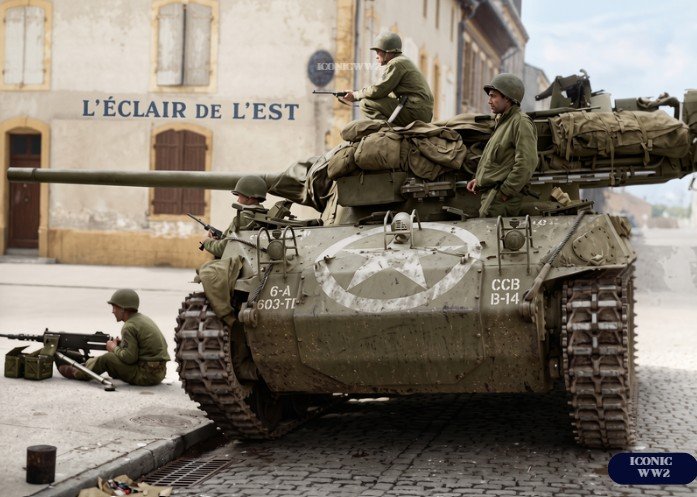
The M10 was the fullest expression of a distinctly American idea: tank-destroyer doctrine. Shaped by General Lesley McNair, it held that an enemy armoured breakthrough should be met not by friendly tanks but by dedicated, fast, hard-hitting and lightly armoured vehicles, massed and held in reserve to “seek, strike and destroy”. To carry it out the US Army raised a separate Tank Destroyer Force with its own vehicles, and the M10 became its standard mount.
Formally the 3-inch Gun Motor Carriage M10, it mated the reliable M4A2 Sherman chassis (the M10A1 used the petrol M4A3 hull) to a new, thinly armoured hull and an open-topped rotating turret. Built by General Motors and Ford from September 1942 to December 1943, it ran to 4,993 M10s and 1,413 M10A1s — about 6,400 vehicles, enough to equip the tank-destroyer battalions on every Western front.
Its weapon was the 3-inch (76.2 mm) Gun M7, developed from an anti-aircraft gun, which drove standard armour-piercing shot through some 90–100 mm of armour at 1,000 m — enough to kill most German tanks of 1943, though it struggled against the frontal plate of the Panther and Tiger.
To buy speed the M10 gave up protection. Its armour ran only about 9–57 mm, and the open-topped turret — balanced by a distinctive pointed counterweight at the rear — left the crew exposed to shell-bursts, snipers and grenades, a constant danger in close country. Twin GM 6-71 diesels of around 375 hp gave a useful ~51 km/h on roads. The great flaw was the turret: it traversed by hand, and a full rotation took about two minutes — an age when a panzer appeared on the flank. But the M10 was reliable, mobile and available in quantity, and in 1943 that counted for more than armour on paper.
The M10 first went into action in Tunisia in the spring of 1943, and its defining early battle came at El Guettar on 23 March 1943. There the 601st and 899th Tank Destroyer Battalions, firing from hull-down positions dug into the valley floor, met a thrust by the 10th Panzer Division head-on.
It was tank-destroyer doctrine put to its first real test — and it half-worked. The dug-in M10s broke the attack and left around 30 German tanks burning on the valley floor, a genuine defensive victory. But the cost was heavy: the 601st alone lost more than 20 of its vehicles, a foretaste of how exposed these thin-skinned machines became once the fighting closed in.
In the mountains of Italy the doctrine largely fell apart, because the massed panzer attacks it was built to stop rarely came. Instead M10 crews spent the long campaign from Salerno to the Gothic Line doing work the manuals never foresaw: direct-fire assault-gun support against bunkers and strongpoints, and even indirect fire as supplementary artillery, lobbing shells over the ridgelines.
In that role the 3-inch gun’s high-explosive shell — not its armour-piercing shot — became its most-used ammunition. The experience taught the US Army a lesson it was slow to accept: that segregating tank destroyers from tanks made little sense when both ended up fighting the same close, grinding war.
From Normandy onward the M10 equipped US tank-destroyer battalions and served with British, Canadian, French and Polish units across the campaign. In practice it was used much as a tank — for direct fire support and defensive anti-armour work in the hedgerows and towns — while the Army steadily converted its old towed-gun battalions to self-propelled ones.
By now its limits were plain: against the frontal armour of a Panther the 3-inch gun could do little at range, and the slow manual turret and open top were serious liabilities in the close country of the bocage. The M10 needed a harder punch — and the British had already found one.
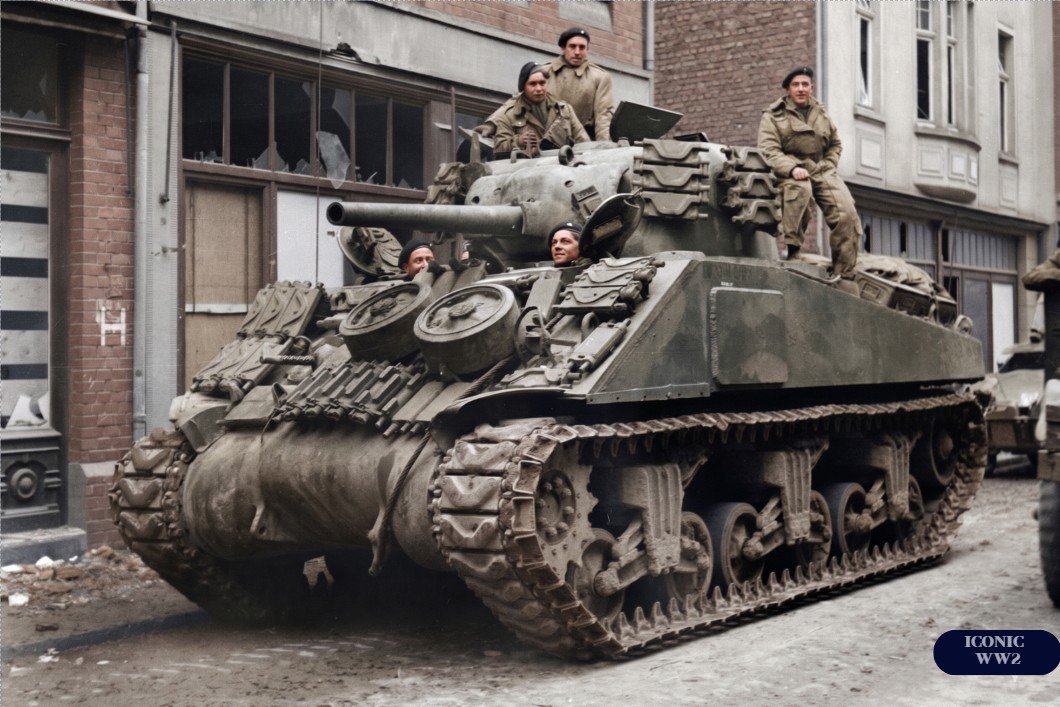
That answer was the 17-pounder. British ordnance crews rearmed the M10 with the superb Ordnance QF 17-pounder anti-tank gun to create the “Achilles”, converting on the order of 1,100 vehicles. Firing APDS tungsten shot, the 17-pounder could smash through around 190 mm of armour at 1,000 yards — roughly triple the punch of the American gun.
That made the Achilles one of the very few Allied vehicles able to kill a Panther or Tiger frontally at ordinary combat range. Distinguished by its long barrel and muzzle counterweight, it served with British and Commonwealth anti-tank regiments from Normandy to the Rhine, and was arguably the most dangerous version of the M10 ever fielded.
The M10 spawned a family. Fifty-two went to the Soviet Union under Lend-Lease; Free French M10s of the 2e Division Blindée fought through the Liberation, one famously duelling German armour in the streets of Paris in August 1944; and when the 3-inch gun finally aged, the same layout was rebuilt around a 90 mm gun as the M36 Jackson. As for the name, wartime American crews just called it a “TD” — the now-universal “Wolverine” is of uncertain, probably postwar origin, never an official wartime designation.
The M10 was a sound machine built on a flawed idea. The doctrine of segregating tank destroyers from tanks proved largely mistaken, but the vehicle itself — rugged, reliable, mass-produced, and lethal in Achilles form — earned its place as one of the workhorses of the Western Allied armies.
- Steven J. Zaloga, M10 and M36 Tank Destroyers 1942–53 (Osprey, New Vanguard).
- Harry Yeide, The Tank Killers: A History of America’s World War II Tank Destroyer Force (Casemate).
- Charles M. Baily, Faint Praise: American Tanks and Tank Destroyers During World War II (Archon).
Iconic WW2 is free, ad-free and tracker-free — kept going only by the time it takes to research, restore and colorize each machine. If this profile was worth your read, you can help the archive grow.
| Base Chassis | M4A2 Sherman (M10A1: M4A3) |
| Manufacturer | Fisher Body / Ford |
| Nation | United States |
| Role | Tank destroyer |
| Crew | 5 |
| Units Built | ~6,406 (4,993 + 1,413 M10A1) |
| Type | 3-inch (76.2 mm) Gun M7 |
| Penetration | ~90–100 mm @ 1,000 m (AP) |
| Turret | Open-topped, hand-traversed |
| British Rearm | 17-pdr = "Achilles" (~1,100) |
| Engine | 2× GM 6-71 (M10) |
| Type | Twin inline diesels |
| Power | ~375 hp |
| Road Speed | ~51 km/h |
| Range (road) | ~320 km |
| Combat Weight | ~29.6 t |
| Suspension | VVSS |
| Main Gun | 76.2 mm M7 |
| Secondary | 1× 12.7 mm Browning (AA) |
| Hull/Turret Armour | ~9–57 mm (sloped) |
| Weakness | Open-top turret |