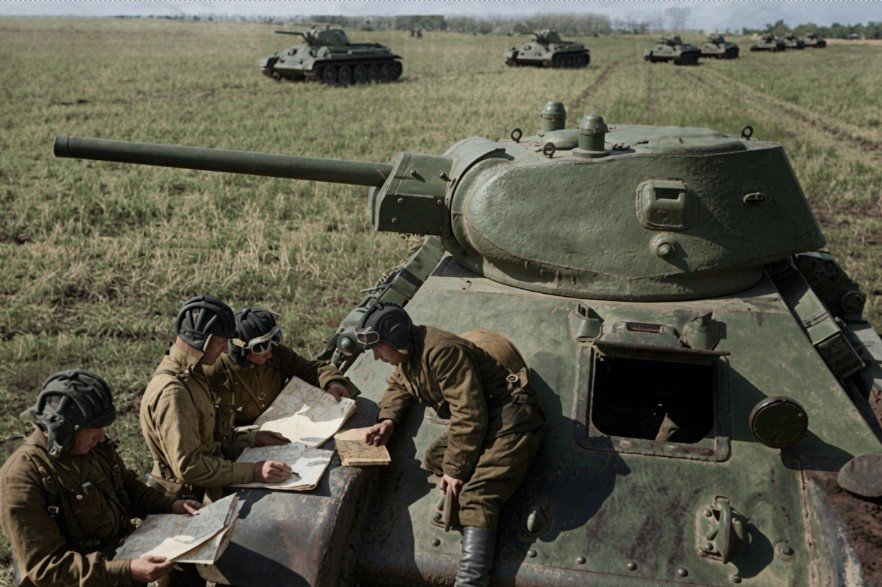
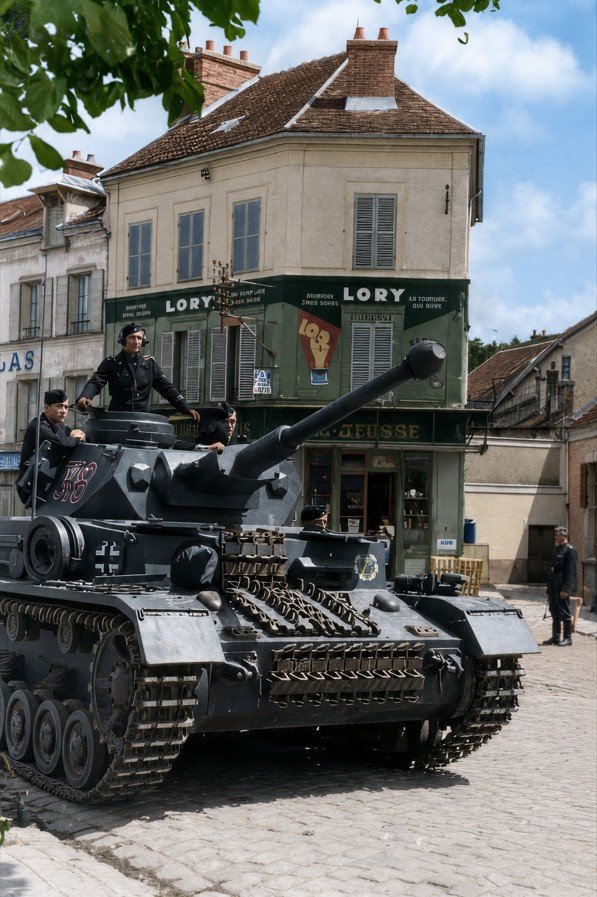
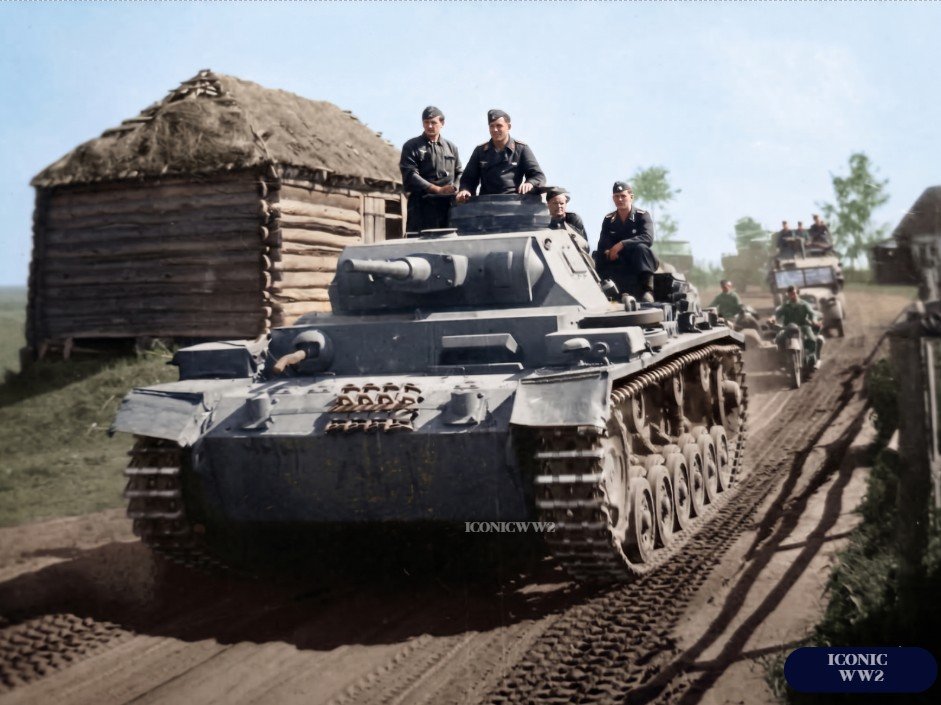
The Panther was born directly out of shock and humiliation. When German tanks met the Soviet T-34 in the summer of 1941, they found a machine whose sloped armour their guns could barely penetrate and whose own weapon could destroy them with ease. A panicked investigation commission sent to the Eastern Front recommended the most radical solution imaginable: copy the T-34 outright. German pride — and German industry, ill-suited to the Soviet tank's rough simplicity — recoiled from a straight copy, but the lesson was taken to heart.
Instead, firms were ordered to design a new medium tank that answered the T-34 on German terms: sloped armour for protection, a long high-velocity gun for hitting power, and a mobility to match. MAN's design was chosen over Daimler-Benz's more overtly T-34-like proposal, and was rushed into production as the Panzerkampfwagen V Panther — a tank that many consider the best balance of firepower, protection and mobility of the entire war, had it only been reliable.
On paper the Panther was magnificent. Its 7.5 cm KwK 42 L/70 was one of the finest tank guns of the war — a long, high-velocity weapon whose flat trajectory and superb armour penetration could destroy a Sherman or T-34 at ranges well beyond those at which they could reply. Its sloped frontal armour gave excellent protection against head-on fire, and at around 46 km/h it was genuinely fast and, when running well, nimble for its 45-tonne weight.
But the Panther was rushed into service before it was ready, and it paid a heavy price. The early Ausf. D models were mechanically immature and dangerously unreliable — overstrained final drives that failed under hard use, overheating engines prone to fire, and a host of teething faults. The tank's great weight had been crammed onto a drivetrain designed for something lighter, and the chronic weakness of those final drives was never fully solved across its whole career.
There were tactical flaws too. While its frontal armour was excellent, the Panther's side armour was thin, leaving it vulnerable to flanking fire, and the complex design was slow and costly to build at a time when Germany desperately needed numbers. The Panther was a thoroughbred — fast, hard-hitting and well-protected from the front — but a temperamental one, demanding skilled crews and constant maintenance to keep it in the fight.
The troubled Ausf. D of 1943 was followed by the improved Ausf. A, which fixed many faults and added a better commander's cupola and ball-mounted hull machine gun, and then the definitive Ausf. G of 1944 — the most-produced version, with simplified, better-sloped hull sides and numerous refinements. A planned Ausf. F with a new, smaller "Schmalturm" turret never reached full production before the war's end.
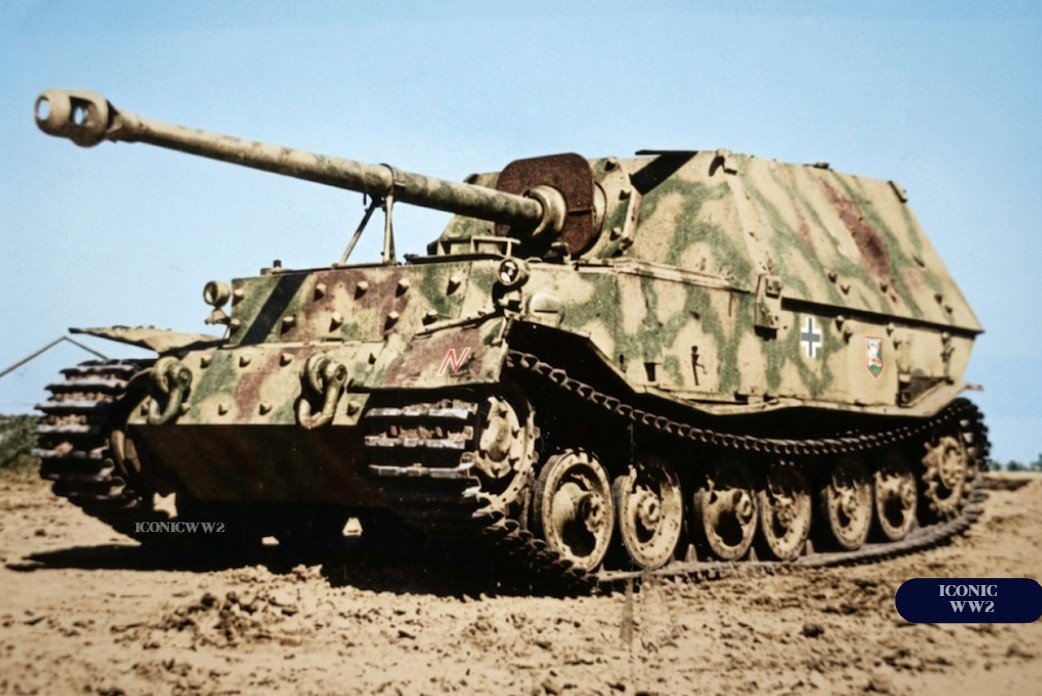
The excellent chassis spawned two important offshoots. The Jagdpanther tank destroyer mounted the devastating 8.8 cm Pak 43 in a low, well-sloped casemate and is widely rated one of the finest tank-hunters of the war. The Bergepanther was a powerful armoured recovery vehicle — fittingly, since recovering broken-down Panthers was a constant and arduous task for German units.
The Panther’s combat debut was a near-disaster. Committed prematurely and in haste to the great offensive at Kursk in July 1943, the ~200 Panthers of Panzer-Abteilungen 51 and 52 broke down in droves — many lost to engine fires and final-drive failures before they could even reach the enemy. It was an inauspicious beginning that exposed every flaw of the rushed early models.
The trouble ran deeper than teething. The powerful Maybach HL 230 engine was overstressed by the tank’s weight and prone to catching fire; the final drives, too weak for a 45-tonne machine, wore out and shattered. By the end of the first day at Kursk only a fraction of the force was still running, the rest scattered and burning across the steppe. The Panther had arrived — but it had arrived broken.
Once the worst faults were addressed and crews learned the tank’s ways, the Panther became a formidable weapon. In the defensive battles on the Eastern Front, in Normandy and across North-West Europe, a well-handled Panther firing from a prepared position or hull-down could dominate the battlefield, picking off Shermans and T-34s at long range before they could close. Its sloped armour and superb 7.5 cm KwK 42 L/70 gun made it, in a straight duel, arguably the finest medium tank of the war.
But the Panther could never escape the twin curses of too few and too fragile. Germany built around 6,000 — a respectable number, but never enough to replace losses or stem the Allied and Soviet tide — and a great many were lost not in battle but to breakdown, abandonment and fuel shortage. Magnificent in a duel, the Panther was worn down by the same attrition that destroyed the rest of the German army.
The Panther is one of the great might-have-beens of armoured warfare. In its mature form it combined a war-winning gun, excellent frontal protection and real mobility in a package that influenced tank design for a generation after 1945 — the conceptual ancestor of the post-war main battle tank. In the hands of a skilled crew it was as dangerous an opponent as existed on any battlefield.
And yet it never quite escaped its origins as a hurried answer to the T-34. Rushed into service half-developed, plagued to the end by a fragile drivetrain, and always too complex and too few, it could win battles but not the war. The Panther stands as the perfect emblem of late-war German armour: superb engineering, conceived in crisis and fielded in numbers far too small, brilliant in the duel and beaten by the flood.
- Thomas L. Jentz & Hilary L. Doyle, Germany’s Panther Tank: The Quest for Combat Supremacy (Schiffer).
- Walter J. Spielberger, Panther & Its Variants (Schiffer).
- Steven J. Zaloga, Panther vs Sherman: Battle of the Bulge 1944 (Osprey, Duel).
- Roman Johann Jarymowycz, Tank Tactics: From Normandy to Lorraine (Lynne Rienner).
Iconic WW2 is free, ad-free and tracker-free — kept going only by the time it takes to research, restore and colorize each machine. If this profile was worth your read, you can help the archive grow.
| Manufacturer | MAN (design) |
| Also built by | Daimler-Benz · MNH · Henschel |
| Nation | Germany |
| Role | Medium tank |
| Designation | Sd.Kfz. 171 |
| Service Entry | 1943 |
| Crew | 5 (commander, gunner, loader, driver, radio/bow MG) |
| Units Built | ~6,000 |
| Ausf. D | First model, mechanically immature |
| Ausf. A | Improved, new cupola & hull MG |
| Ausf. G | Definitive, most-produced |
| Jagdpanther | 8.8 cm tank destroyer on the chassis |
| Bergepanther | Armoured recovery vehicle |
| Engine | Maybach HL 230 P30 |
| Type | V-12 petrol |
| Power | ~700 hp |
| Weak point | Overstrained final drives |
| Road Speed | ~46 km/h |
| Cross-country Speed | ~24 km/h |
| Range (road) | ~250 km |
| Suspension | Interleaved double torsion-bar |
| Length (with gun) | 8.66 m |
| Hull Length | 6.87 m |
| Width | 3.27 m |
| Height | 2.99 m |
| Combat Weight | ~45 t |
| Main Gun | 7.5 cm KwK 42 L/70 |
| Secondary | 2× 7.92 mm MG 34 |
| Glacis Armour | 80 mm at 55° |
| Turret Front | 100 mm (mantlet) |
| Side Armour | 40–50 mm (vulnerable) |