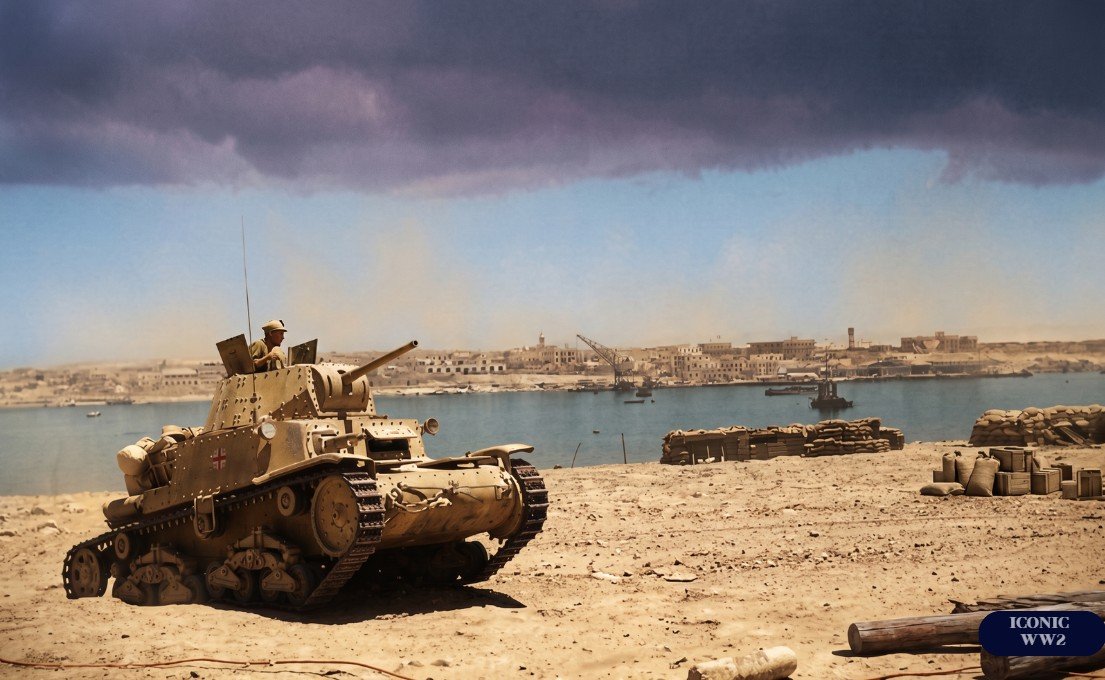
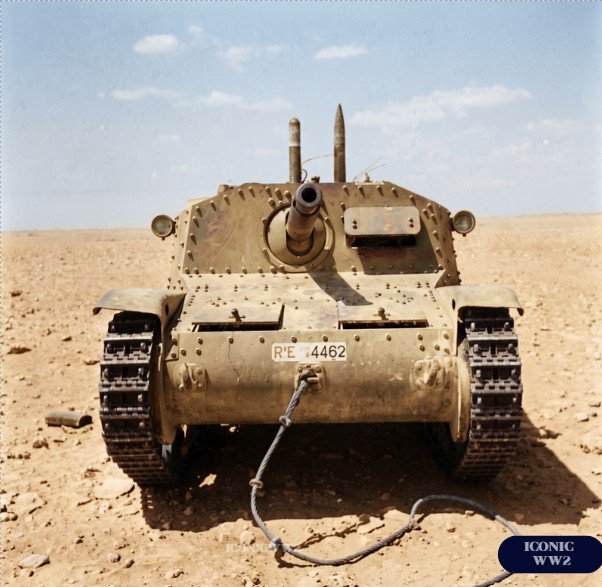
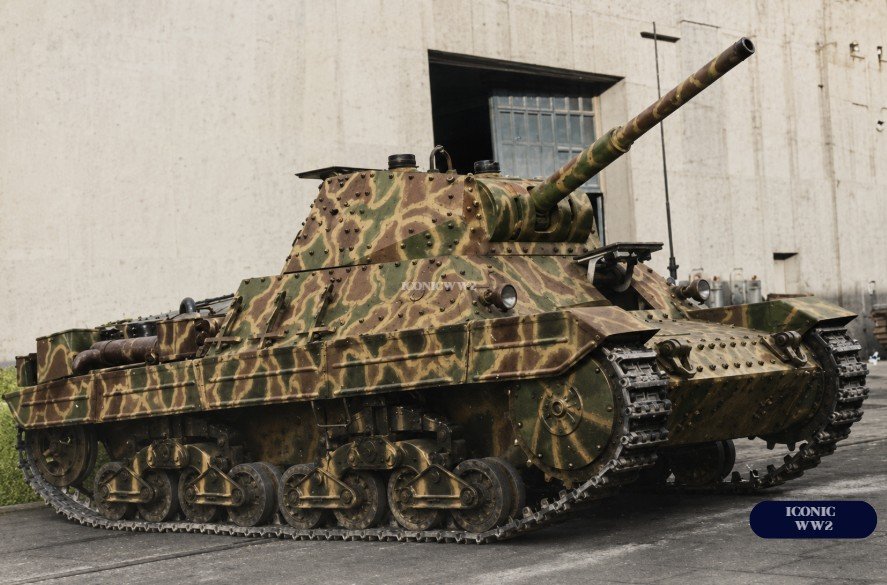
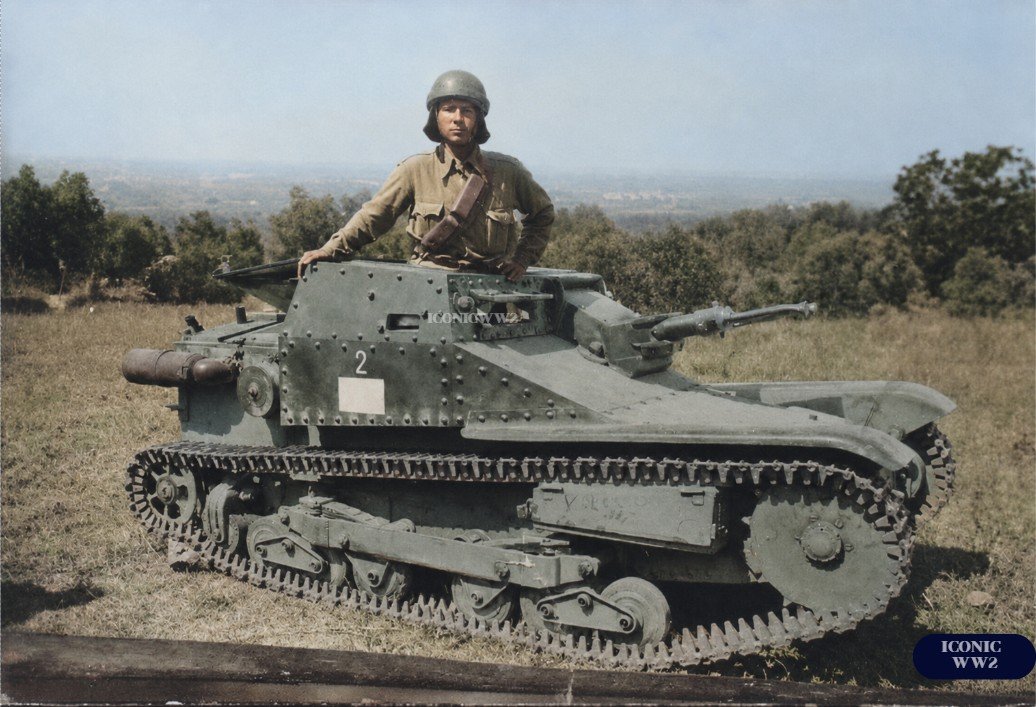
By 1942 the Italian medium tank had reached the end of a straight line of descent. It began with the M11/39, ran through the M13/40 and M14/41, and finished with the M15/42 — each one heavier and a little more powerful, but built on the same fundamental hull and the same riveted box the Regio Esercito had drawn up in the late 1930s. The designation told the whole story in a handful of characters: “M” for medio (medium), 15 for its roughly fifteen tonnes, 42 for the year it was designed.
Fiat-Ansaldo built it because it was what Italy could build. The country had no engine, no gun and no production line for a modern 30-tonne tank, and it knew it — the M15/42 was an honest attempt to squeeze the last useful improvements out of an old design rather than the clean-sheet machine the war by then demanded. Production began in January 1943, at the precise moment the Axis was losing North Africa and the initiative on every front.
Two real changes separated the M15/42 from the M14/41 before it. The first was the gun: out went the short 47/32 and in came the 47/40, a 47 mm weapon with a longer L/40 barrel that gave a higher muzzle velocity and could punch through around 45 mm of armour at 500 m. It was still a 47 mm gun in a world of 75s, but it was the hardest anti-tank punch an Italian medium ever carried.
The second change was under the engine deck. Where earlier M-series tanks used diesel — safer, and unusual for the period — the M15/42 reverted to petrol, a Fiat-SPA 15TB of about 190 hp. The extra power lifted road speed to roughly 38 km/h and range to about 220 km, and to fit the bigger engine the hull was stretched some 15 cm longer than the M14/41. The price was a more flammable fuel inside a thinly armoured box.
None of it changed what the M15/42 fundamentally was. Its armour — a maximum of about 42 mm at the front, thinning to 25 mm on the sides — was riveted and bolted rather than welded, so even a non-penetrating hit could shear rivets and send them flying around the crew compartment. Against the Sherman’s 75 mm gun, or the six-pounders and anti-tank guns it would meet in Italy, it offered almost no protection.
The layout was dated too: a four-man crew in which the commander also had to lay and fire the main gun, a tall 2.39 m silhouette, and the same leaf-spring bogie suspension the series had carried since 1940. By 1943 the standard of comparison was the T-34 and the Sherman — 30-tonne tanks with sloped armour and 75–76 mm guns. The M15/42 weighed half as much and hit far lighter; it was, in every meaningful sense, still a 1940 tank wearing a slightly better gun.
The numbers show how marginal it was. Only about 112 gun-tank M15/42s were completed, and barely 90 are thought to have reached the army before Italy’s armistice — a rounding error next to the thousands of Shermans and T-34s leaving Allied and Soviet lines in the same months. Fiat-Ansaldo’s medium-tank line was, by mid-1943, an anachronism kept alive out of necessity.
Even the Italians had worked out where the value lay. The same M15/42 hull was far more useful carrying a fixed gun than a turret, and production was already swinging toward the Semovente self-propelled guns built on that chassis. The gun tank was being quietly superseded by its own derivatives before it had fought a single major battle in Italian hands.
That single battle came in the most unexpected way — against the Germans. Most M15/42s went to the reforming 135ª Divisione corazzata “Ariete II”, stationed north of Rome. When Italy announced its armistice on 8 September 1943, these tanks and the division’s Semoventi found themselves fighting the very ally they had served days earlier, as German paratroop and Panzergrenadier units moved to seize the capital.
For two days the M15/42s of the Ariete II fought delaying actions along the approaches to Rome — around Monterotondo, on the Via Cassia and near Bracciano — while other troops and armed civilians held the southern gate at Porta San Paolo. It was a hopeless stand against a stronger, better-equipped enemy, and the city fell on 10 September 1943. It was also, ironically, the only time the best Italian medium tank fought a pitched battle as an Italian weapon.
After the armistice the Germans simply took over. Fiat-Ansaldo went on building M15/42s under occupation, and captured and new-built vehicles were pressed into service as the Panzerkampfwagen M15/42 738(i). With no place on the main fronts, they were used for what obsolete armour was still good for — occupation and anti-partisan duty, garrisoning towns and escorting columns where a 47 mm gun and thin plate were enough.
These tanks served across northern Italy, in the Balkans against Yugoslav partisans, and with the armoured units of Mussolini’s rump Repubblica Sociale Italiana (RSI). It was an inglorious second career, but it kept the M15/42 in action until the end of the war — no longer as Italy’s front-line tank, but as a policeman’s weapon in someone else’s occupation.
The M15/42’s real legacy was not the tank at all but the hull beneath it. Widened and adapted, that chassis carried the Semovente 75/18, the longer-barrelled 75/34 and the potent 105/25 ‘bassotto’ — self-propelled guns that were the most effective armoured vehicles Italy fielded in the war, precisely because they abandoned the turret and mounted a real gun on reliable running gear.
As a gun tank the M15/42 was obsolete on the day it appeared: too light, too thinly armoured and too lightly gunned for 1943, and built in numbers too small to matter. Yet it holds an odd, poignant place in the story of Italian armour — the last and best of a doomed line, remembered less for any battle it won than for the day it turned its little 47 mm gun against its former allies in the streets outside Rome.
- Nicola Pignato & Filippo Cappellano, Gli Autoveicoli da Combattimento dell’Esercito Italiano (Ufficio Storico SME).
- Filippo Cappellano & Pier Paolo Battistelli, Italian Medium Tanks 1939–45 (Osprey, New Vanguard 195).
- Nicola Pignato, Italian Armoured Vehicles of World War Two (Squadron/Signal).
- Ralph Riccio, Italian Armour in German Service 1943–1945.
Iconic WW2 is free, ad-free and tracker-free — kept going only by the time it takes to research, restore and colorize each machine. If this profile was worth your read, you can help the archive grow.
| Manufacturer | Fiat-Ansaldo |
| Nation | Italy |
| Role | Medium tank |
| Service Entry | 1943 |
| Crew | 4 (commander/gunner, loader, driver, hull gunner) |
| Units Built | ~112 (before the armistice) |
| M15/42 | Baseline — longer 47/40, petrol engine |
| Semovente 75/18 | 75 mm assault gun on the chassis |
| Semovente 75/34 | Longer 75 mm on the M15/42 hull |
| Semovente 105/25 | 105 mm ‘bassotto’ on the widened hull |
| Engine | Fiat-SPA 15TB |
| Type | Petrol (reverting from diesel) |
| Power | ~190 hp |
| Note | More power, but more flammable |
| Road Speed | ~38 km/h |
| Range (road) | ~220 km |
| Combat Weight | ~15.5 t |
| Suspension | Leaf-spring bogies |
| Length | 5.06 m |
| Width | 2.23 m |
| Height | 2.39 m |
| Combat Weight | ~15.5 t |
| Main Gun | 47 mm Cannone da 47/40 |
| Secondary | 3–4× 8 mm Breda 38 MG |
| Hull Front Armour | ~42 mm (max) |
| Construction | Riveted/bolted (rivet-shear hazard) |