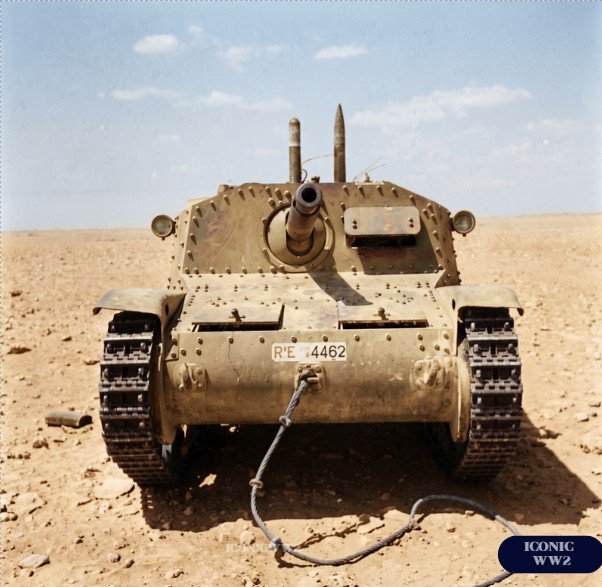
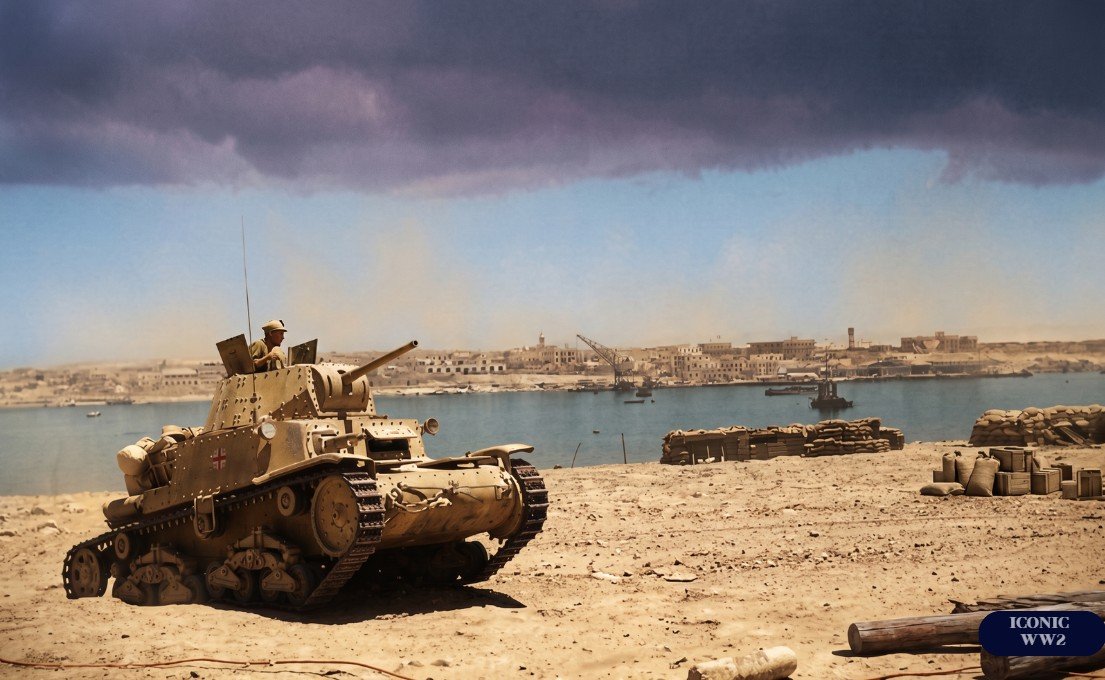
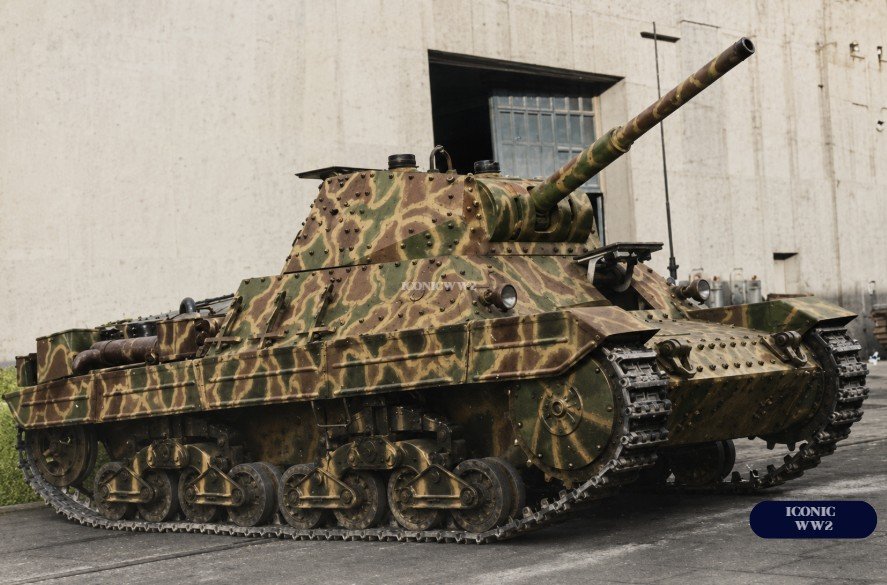
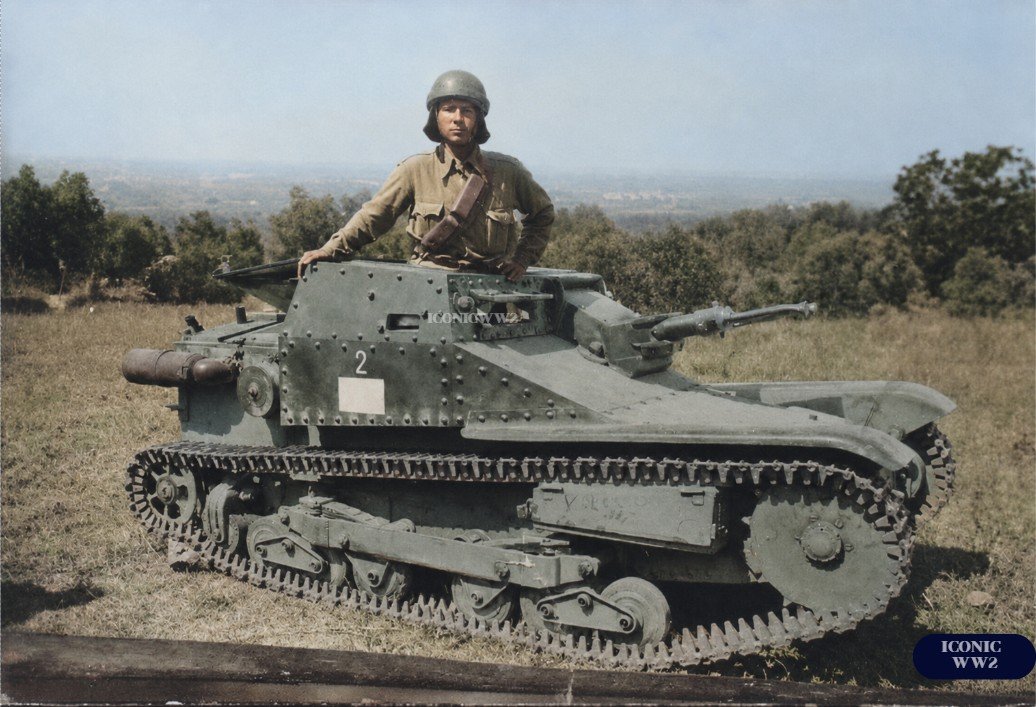
For all the trouble Italy had building competitive tanks, it had stumbled onto something that worked: the Semovente. By taking an M-series tank hull, removing the turret and bolting a real gun into a fixed casemate, Ansaldo produced cheap, low, hard-hitting assault guns that consistently outperformed the turreted tanks they were based on. The line began with the 75/18 in 1942 and climbed steadily in calibre — 75/32, 75/34 — until it reached its summit in the 105/25.
The 105/25 was the most powerful armoured fighting vehicle Italy ever designed. Nicknamed the «Bassotto» — the dachshund — for its long, low silhouette, it married the biggest gun the Italians could mount to the best-protected hull they ever built. Where the M15/42 gun tank was obsolete on arrival, its self-propelled cousin was, briefly, genuinely dangerous.
A 105 mm gun would not fit the standard M-tank hull, so Ansaldo widened it. The result was the M43 chassis — derived from the M15/42 but broadened by around 30 cm to open up the fighting compartment and lowered. It kept the M15/42’s petrol Fiat-SPA 15TB engine of about 190 hp, hauling roughly 15.8 tonnes to about 35 km/h on a road.
The same M43 hull was designed to take a small family of weapons — the anti-tank 75/46 and the 75/34 as well as the 105 — but it is the 105/25 that is remembered. With a crew of just three and a height of only about 1.75 m, it was a compact, purposeful machine built around a single job: putting a heavy shell into whatever it was pointed at. The type was designated M43 for the year it appeared — the same industrial shorthand that had named every Italian medium before it.
The gun was the Cannone da 105/25, a 105 mm weapon 25 calibres long. Firing a heavy high-explosive shell it was a formidable infantry-support and bunker-busting weapon, far more destructive than the 47 mm and 75 mm guns that had come before. But its real menace lay in a special round. With a good stock of high-explosive it doubled as mobile artillery, dropping shells on strongpoints and infantry that the lighter Semoventi could only scratch.
The EPS (effetto pronto speciale) was a shaped-charge, hollow-charge shell that punched through roughly 100 mm of armour regardless of range — because a hollow charge’s penetration does not fall off with distance the way solid shot does. That gave the little Bassotto the power to knock out an M4 Sherman, or almost any Allied tank in Italy, from ambush — something no earlier Italian vehicle could reliably claim.
Protection finally caught up with firepower — through sheer thickness. The M43 casemate carried around 75 mm of frontal armour, nearly double the 42 mm of the M15/42 gun tank. Period photographs show the front plate standing almost vertical, in the plain, boxy Italian style — there was no sloped glacis here. For the first time, though, an Italian vehicle could take a hit from a medium anti-tank gun and stand a fair chance of shrugging it off.
Combined with a silhouette barely 1.75 m tall, that armour made the Bassotto an excellent defensive weapon. Dug in on a reverse slope or hidden in the rubble of an Italian village, low and hard to spot, it could let an enemy column come on and then destroy the leading tanks with its hollow-charge rounds — exactly the kind of fighting the Italian campaign would demand. The price of that low, protected shape was a fixed casemate: the gun could traverse only a few degrees, so the whole vehicle had to be turned to aim — a fair trade for an ambush weapon, a handicap in a fast-moving fight.
As with every good Italian design, there were never enough. Only about 30 Semoventi 105/25 had been completed by Ansaldo when Italy signed its armistice on 8 September 1943 — a tiny handful against the tide of Shermans and T-34s. Italy’s own use of its finest gun carriage was measured in mere dozens. What few existed had barely reached their units when the armistice swept the whole picture away.
But unlike so many wartime designs, the Bassotto’s story did not end at the armistice. The Germans seized the production line and kept it running, and it was in their hands that the vehicle fought its real war — the total built swelling well beyond the Italian figure, on the order of a hundred or more (exact numbers are disputed).
In German service the Bassotto became the Sturmgeschütz M43 mit 105/25 853(i), and it slotted neatly into the Wehrmacht’s assault-gun doctrine. Low, well-armoured and carrying a hollow-charge punch, it was ideally suited to the defensive, mountainous, village-to-village grind of the Italian campaign of 1943–45.
German units fielded the 105/25 against the Allied beachhead at Anzio in early 1944 and along the Gothic Line, where its ability to kill a Sherman from a concealed position made it a respected opponent. The best armoured vehicle Italy ever built spent its combat life fighting against Italy’s new co-belligerent allies, in the hands of its former partner. Allied tank crews in Italy learned to treat any low, boxy shape in the rubble with respect, and the type soldiered on in German and RSI service until the war in Italy ended in 1945.
The Semovente 105/25 is the great “what if” of Italian armour. It combined a hard-hitting gun, a workable hollow-charge anti-tank round, solid frontal protection and a low, survivable shape — everything the M-series gun tanks had lacked. Had it arrived in 1941 and in quantity, it might have changed the character of the desert war.
Instead it came in 1943, in the low dozens, just as Italy left the Axis — and so its finest hours were fought under German command. The Bassotto stands as the high point of Italian armoured engineering and, at the same time, as the sharpest illustration of the war Italy’s industry could never win: the right weapon, built well but too late, in numbers far too small to matter.
- Nicola Pignato & Filippo Cappellano, Gli Autoveicoli da Combattimento dell’Esercito Italiano (Ufficio Storico SME).
- Filippo Cappellano & Pier Paolo Battistelli, Italian Medium Tanks 1939–45 (Osprey, New Vanguard 195).
- Nicola Pignato, Italian Armoured Vehicles of World War Two (Squadron/Signal).
- Ralph Riccio, Italian Armour in German Service 1943–1945.
Iconic WW2 is free, ad-free and tracker-free — kept going only by the time it takes to research, restore and colorize each machine. If this profile was worth your read, you can help the archive grow.
| Manufacturer | Ansaldo |
| Nation | Italy |
| Role | Assault gun / self-propelled gun |
| Chassis | M43 (widened M15/42) |
| Service Entry | 1943 |
| Crew | 3 (commander/gunner, loader/radio, driver) |
| Units Built | ~30 pre-armistice (more under German control) |
| Semovente 105/25 «Bassotto» | 105 mm on the widened M43 hull |
| StuG M43 105/25 853(i) | German-service designation |
| Semovente 75/34 su M43 | 75 mm L/34 on the same hull |
| Semovente 75/46 su M43 | High-velocity 75 mm anti-tank |
| Engine | Fiat-SPA 15TB |
| Type | Petrol (benzina) |
| Power | ~190 hp |
| Base | M43 chassis (from M15/42) |
| Road Speed | ~35 km/h |
| Range (road) | ~200 km |
| Combat Weight | ~15.8 t |
| Suspension | Leaf-spring bogies |
| Length | ~5.1 m |
| Width | ~2.4 m (widened) |
| Height | ~1.75 m (very low) |
| Combat Weight | ~15.8 t |
| Main Gun | 105 mm Cannone da 105/25 L/25 |
| Anti-tank Round | EPS hollow-charge (~100 mm pen.) |
| Secondary | 8 mm Breda 38 MG |
| Hull Front Armour | ~75 mm (near-vertical plate) |
| Limitation | Fixed casemate — limited gun traverse |