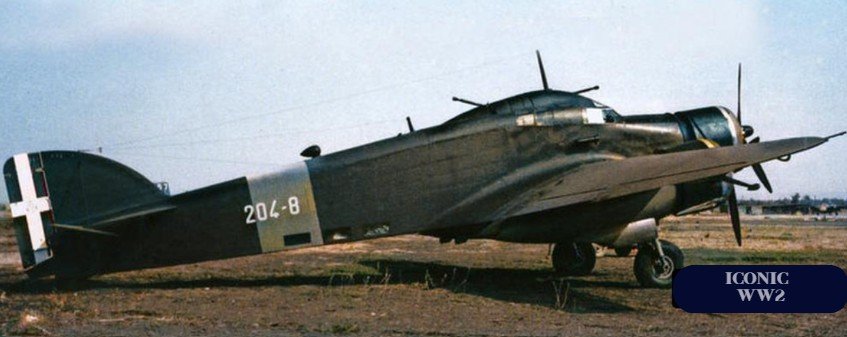
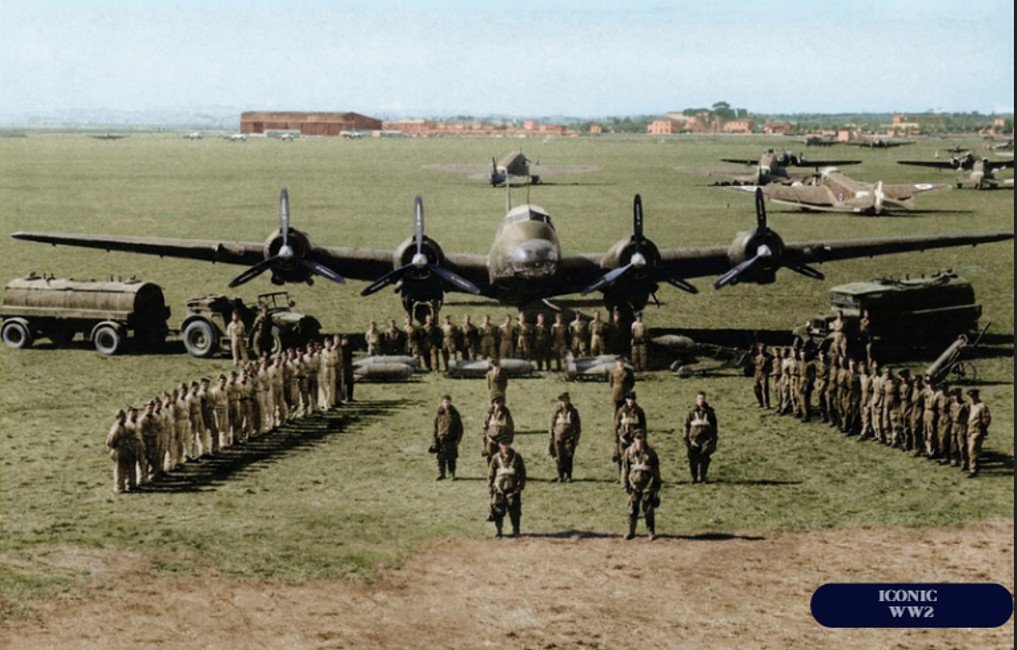
The BR.20 Cicogna (“Stork”) came from Celestino Rosatelli at Fiat and first flew on 10 February 1936. It was a modern machine for its moment: an all-metal twin-engine monoplane at a time when much of the Regia Aeronautica still flew fabric and struts, and one of the first such bombers in the world to reach service.
Two Fiat A.80 R.C.41 eighteen-cylinder radials of 1,000 hp each drove it to 440 km/h, with a range of 2,750 km and a ceiling of 8,000 m. It carried 1,600 kg of bombs and a crew of five, defended by just three 12.7 mm Breda-SAFAT machine guns. That last figure — three guns for a bomber of this size — reflected a specific belief: that a bomber fast enough did not need to fight.
The theory was tested in Spain. Italy sent six BR.20s to Tablada, outside Seville, in June 1937 for the Aviazione Legionaria, and from 15 November they flew daily missions against Republican targets — usually without fighter escort. Seven more followed in July 1938, and the type flew through the Battle of the Ebro.
It worked. At an operating altitude of about 4,000 m the Cicogna was fast enough to generally avoid interception, and losses were very low: nine of the thirteen sent to Spain survived to the end of the war and were handed to the Spanish State. The conclusion Italy drew — that the unescorted fast bomber was viable — was correct about Spain and wrong about everything that came after it.
The correction arrived early, and from an unexpected direction. In late 1937 Japan ordered 72 BR.20s and then ten more — one of the very few cases of a European combat aircraft being bought in quantity by the Japanese. Shipped to Dalian and assembled in Japanese-held Manchuria, they entered service as the I-Type with the 12th and 98th Sentai, and later received the Allied reporting name “Ruth.”
Through the winter of 1938–39 they flew long-range raids against Chinese cities and supply centres, and there the Spanish lesson reversed: operating with no fighter cover at the extremes of their range, they took heavy losses to Chinese fighters. When that phase ended in September 1939 the Japanese progressively withdrew them in favour of the Ki-21. The evidence that a fast bomber still needed an escort existed, in Italian-built airframes, a full year before Italy entered the war.
When Italy declared war, 172 Cicogne were in Regia Aeronautica service, though only four wings flew them against fourteen equipped with the S.M.79: the 7°, 13°, 18° and 43° Stormo, all based in northern Italy. Their war against France lasted days.
On the night of 12 June 1940, eight bombers of 13° Stormo attacked the dockyard at Toulon. The next day ten BR.20s bombed the airfields at Hyères and Fayence, losing two aircraft shot down and one badly damaged; the same day twenty-eight more from 43° and 7° Stormo returned to Toulon without loss. At the end of the French campaign the type had lost five aircraft and nineteen airmen.
On 10 September 1940 Italy formed the Corpo Aereo Italiano to take part in the Battle of Britain, sending the 13° and 43° Stormi with 80 brand-new BR.20M to bases in Belgium. The deployment went wrong before it began: during the ferry flight from Italy five aircraft crash-landed from technical failures and a lack of navigational training, and seventeen more were forced down en route by poor visibility.
The first mission came on the night of 24 October, sixteen bombers against Harwich: one crashed on take-off with engine failure, and two more became lost on the return and were abandoned by their crews. A daylight raid on Ramsgate by fifteen aircraft on 29 October passed without loss. Then, on 11 November, ten BR.20s of 43° Stormo went to Harwich in daylight escorted by CR.42 biplanes — the monoplane G.50s did not go — and met Hurricanes. Three bombers were shot down and three damaged, together with three of the escorting CR.42s. The Hurricanes lost nothing.
After 11 November the Cicogne went over to night raids, bombing Ipswich and Harwich on the nights of 5, 17, 20 and 29 November, three times in December and twice in early January — with no losses. On 10 January 1941 the 43° Stormo flew home to Italy, and the 13° followed before the end of the month.
The final accounting of the Italian contribution to the Blitz is contained in one comparison. Across twelve days of bombing missions the BR.20s dropped 54,320 kg of bombs, and fifteen airmen were killed. Of the aircraft lost, three fell to enemy fire — and seventeen were lost to other causes.
The Cicogna’s heaviest bill came at Malta. Units rotated through Sicilian bases from May 1941, flying nearly nightly against the island; the 31° Gruppo lost twelve of its eighteen bombers in under three months, and across sixteen months of the Malta campaign 41 Cicogne were shot down or lost in accidents. In North Africa, where it replaced the SM.81 as a night bomber from March 1941, desert sand caused persistent mechanical failures and fifteen more were lost by April 1942.
Others went to Greece and Yugoslavia — a detachment of 131 aircraft for the April 1941 invasion, then anti-partisan work — and to Russia with the expeditionary corps from August 1941, flying lone sorties with baskets of incendiaries until their withdrawal in spring 1943. At the armistice of September 1943, 67 remained with front-line units, most of the rest relegated to training. The last BR.20 was retired on 7 June 1946; none survives today.
- Chris Dunning, Courage Alone: The Italian Air Force 1940–1943 (Hikoki Publications).
- Jonathan W. Thompson, Italian Civil and Military Aircraft 1930–1945 (Aero Publishers).
- William Green, Warplanes of the Second World War (Macdonald).
- Bill Gunston, The Illustrated Encyclopedia of Combat Aircraft of World War II (Salamander Books).
Iconic WW2 is free, ad-free and tracker-free — kept going only by the time it takes to research, restore and colorize each machine. If this profile was worth your read, you can help the archive grow.
| Manufacturer | Fiat |
| Designer | Celestino Rosatelli |
| Nation | Italy |
| Role | Medium bomber |
| Crew | 5 |
| First Flight | 10 February 1936 |
| Units Built | 500+ (233 BR.20 · 264–279 BR.20M) |
| Engines | 2× Fiat A.80 R.C.41 |
| Type | 18-cylinder air-cooled radial |
| Power | 2× 1,000 hp |
| Propellers | 3-blade variable-pitch |
| Max Speed | 440 km/h |
| Cruise Speed | 340 km/h |
| Service Ceiling | 8,000 m |
| Range | 2,750 km |
| Wingspan | 21.56 m |
| Length | 16.68 m |
| Wing Area | 74 m² |
| Empty Weight | 6,500 kg |
| Max Takeoff | 10,100 kg |
| Bomb load | 1,600 kg |
| Defensive guns | 3× 12.7 mm Breda-SAFAT |
| Design assumption | Speed in place of defensive armament |
| Result | Adequate in Spain; not against modern fighters |
| Spain (1937–39) | 13 sent · 9 survived — usually unescorted |
| Japan (1937–39) | 82 sold — the I-Type “Ruth”, heavy losses over China |
| France (June 1940) | 172 in service · 5 lost, 19 airmen killed |
| Britain (CAI, 1940–41) | 80 sent · 54,320 kg dropped · 3 lost to the enemy, 17 to other causes |
| Malta (1941–43) | 41 lost in 16 months |
| North Africa · Russia | 15 lost to sand and combat · CSIR to spring 1943 |