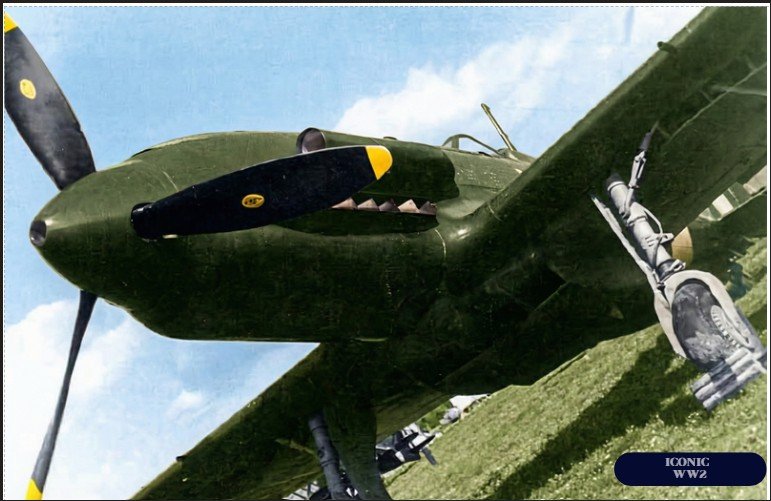
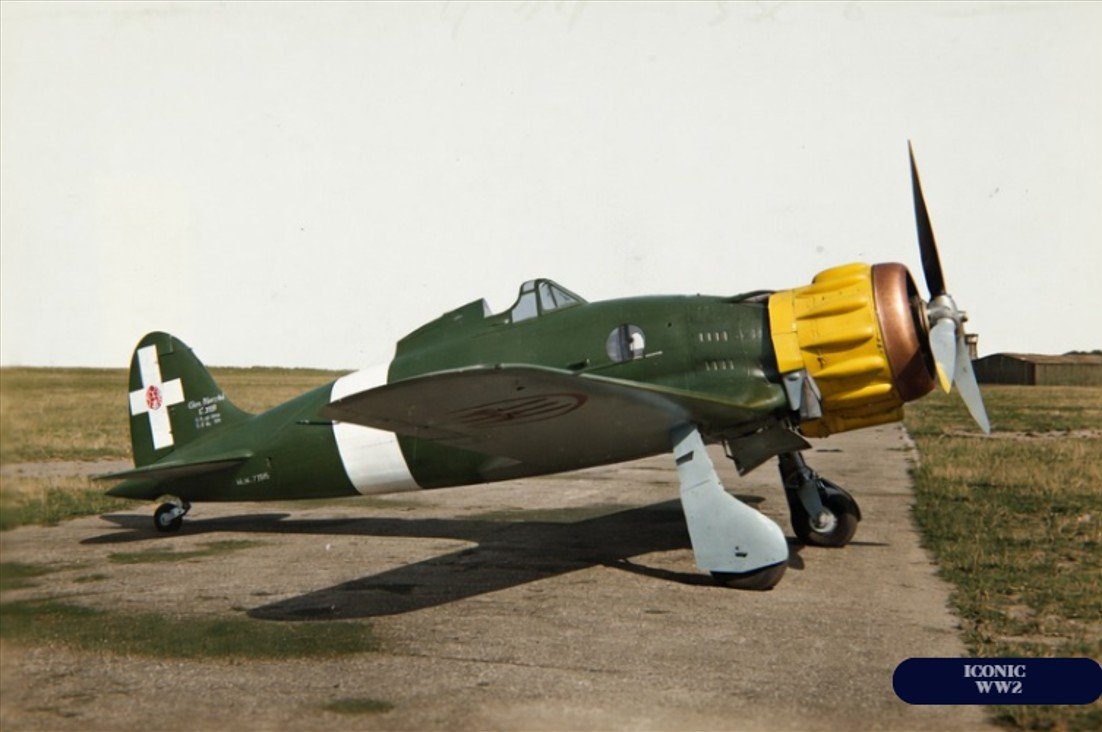
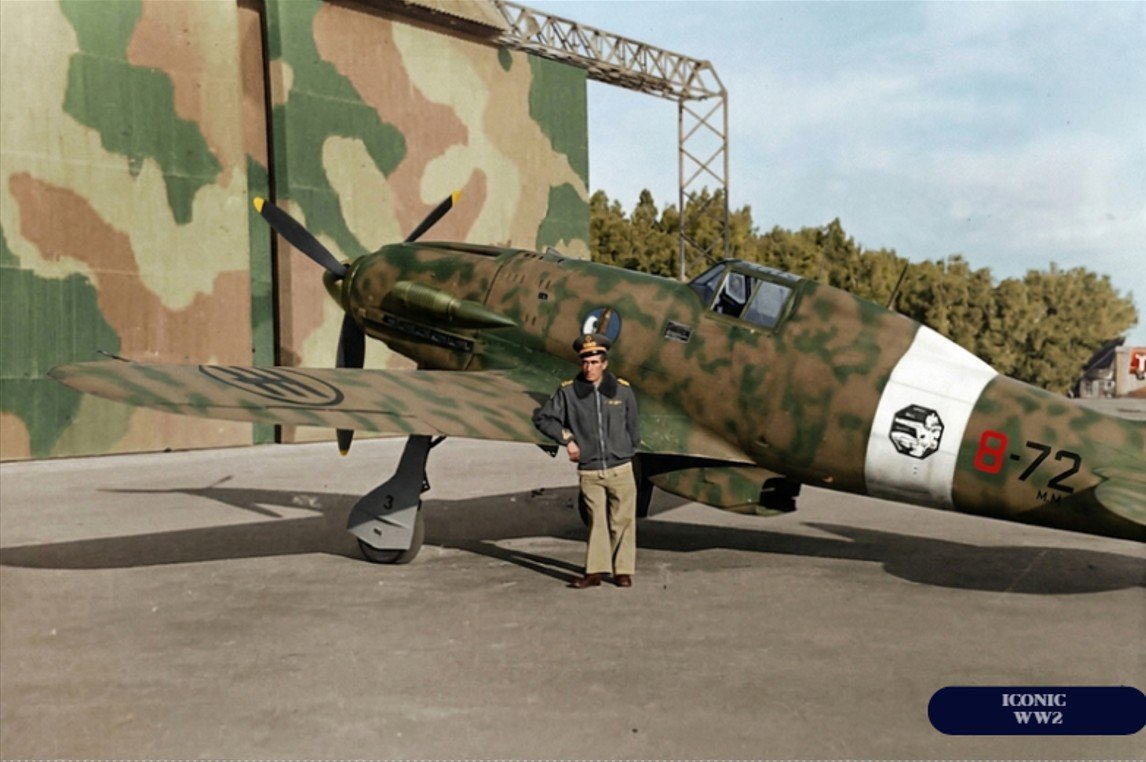
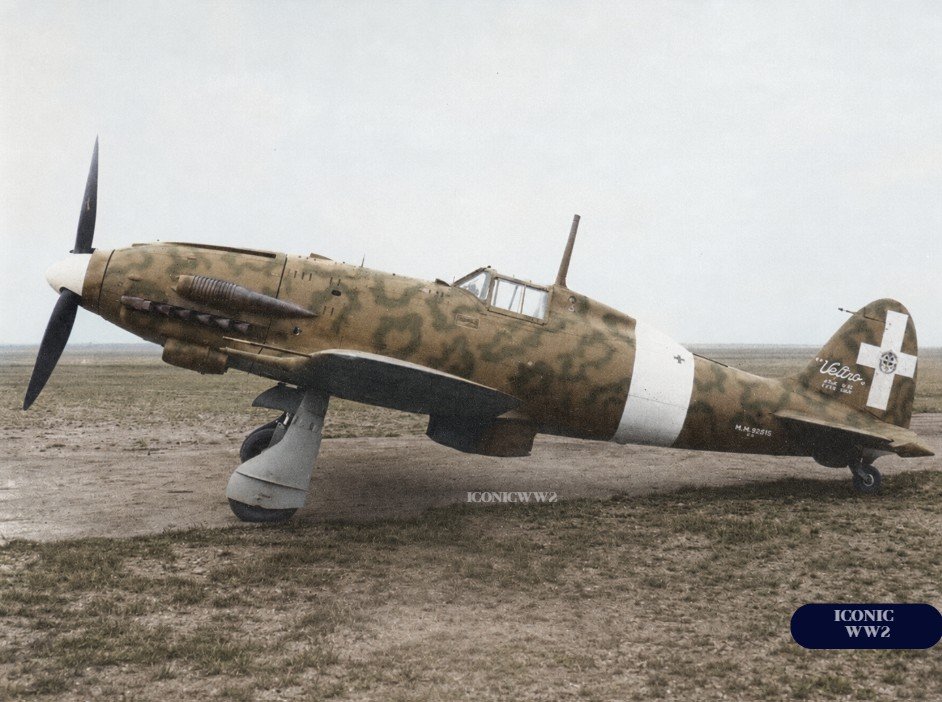
By the mid-1930s the biplane fighter was, almost everywhere, a dying breed. The future plainly belonged to the fast, clean monoplane — and yet in Italy one designer remained unconvinced. Celestino Rosatelli, Fiat's veteran fighter engineer, had built a line of agile, much-loved biplanes through the 1920s and early '30s, and he believed there was life in the formula yet. The Fiat CR.42 Falco (“Falcon”) was his final, most refined statement of that belief.
Drawing directly on the earlier CR.32 that had made its name in the Spanish Civil War, Rosatelli produced a sleek all-metal sesquiplane — a biplane whose lower wing was much smaller than the upper — with a neat radial engine, fixed but carefully faired landing gear and superb handling. It first flew in May 1938, at the very moment when monoplanes like the Bf 109 and Spitfire were already entering service elsewhere.
The Falco was powered by the same dependable Fiat A.74 RC.38 radial that drove the Macchi C.200, giving around 840 hp. What it offered was not speed but agility: in a turning fight it was close to peerless, and Italian pilots schooled in the open-cockpit, dogfighting tradition adored it. It was strong, beautifully balanced and forgiving, a thoroughbred of a design born a generation too late.
Its weaknesses were structural to the whole concept. With its biplane wings, struts and bracing wires it could not approach the level speed of a modern monoplane, and its armament of two machine guns was light. Italy persisted with it partly through genuine affection for the type's qualities and partly because the monoplanes meant to replace it were slow to arrive in numbers — so the Falco soldiered on far longer than anyone had intended.
Beyond the standard day fighter, the Falco was adapted to a remarkable range of roles. The tropicalised CR.42 AS carried sand filters and bomb racks for the desert war, serving as a fighter-bomber. A dedicated night-fighter version, the CR.42 CN (Caccia Notturna), was fitted with underwing searchlights and exhaust flame-dampers to intercept night raiders.
There was even a single floatplane prototype, the ICR.42, and a one-off high-speed experiment, the CR.42 DB, fitted with a German Daimler-Benz inline engine that pushed it past 520 km/h — proof of how good the airframe was, even as the biplane layout held it back. After the armistice a number were taken over and used by the Luftwaffe as night ground-attack and liaison machines.
The CR.42 fought everywhere the Regia Aeronautica did. It saw heavy combat over Greece, the Balkans, East Africa, Malta and across North Africa, where its agility made it a dangerous opponent in a close dogfight even against more modern enemies. In the skies over the Western Desert, Falco pilots tangled with Gladiators and Hurricanes and gave a good account of themselves at low level.
It was an anachronism that refused to die. By 1940 the biplane fighter was obsolete everywhere else, yet the nimble little Falco could still out-turn almost anything it met — and in the confused, low-level scrambles of the early Mediterranean war, a pilot who could bring his guns to bear in a turning fight was still dangerous, whatever he flew.
Its most famous — and most poignant — appearance came in the autumn of 1940, when the Corpo Aereo Italiano deployed Falco squadrons to Belgium to take part in the closing stages of the Battle of Britain. Sending open-cockpit biplanes against Hurricanes and Spitfires over the cold North Sea was a gesture of allied solidarity that bordered on the quixotic, and losses were heavy. One CR.42 brought down over Kent survives almost intact to this day, a museum exhibit and a relic of that strange episode.
As front-line fighting moved beyond it, the Falco found a long second career in ground attack and night-fighting, harassing convoys and shipping by night when its low speed mattered less. It remained in service, in one role or another, right to the end of the war — one of the last biplane fighters anywhere still flying combat missions in 1945.
With around 1,780 built, the Fiat CR.42 was the most-produced Italian aircraft of the Second World War and the last biplane fighter anywhere to be manufactured in large numbers. It was, by any rational measure, obsolete the day it entered service — too slow and too lightly armed to live with the monoplanes it was sent to fight.
And yet it endures in memory as one of the finest flying machines of its kind ever built: strong, agile, lovely to handle and bravely flown to the very limits of what an out-dated design could achieve. The Falco is the magnificent anachronism of the air war — the last falcon of a vanished age, fighting on with grace long after its time had passed.
- Håkan Gustavsson & Ludovico Slongo, Fiat CR.42 Aces of World War 2 (Osprey, Aircraft of the Aces 90).
- Chris Dunning, Courage Alone: The Italian Air Force 1940–1943 (Hikoki Publications).
- Jonathan W. Thompson, Italian Civil and Military Aircraft 1930–1945 (Aero Publishers).
Iconic WW2 is free, ad-free and tracker-free — kept going only by the time it takes to research, restore and colorize each machine. If this profile was worth your read, you can help the archive grow.
| Manufacturer | Fiat Aviazione |
| Designer | Celestino Rosatelli |
| Nation | Italy |
| Role | Fighter / fighter-bomber |
| Configuration | Sesquiplane biplane |
| First Flight | 23 May 1938 |
| Service Entry | 1939 |
| Units Built | ~1,780 |
| CR.42 (standard) | Day fighter |
| CR.42 AS | Tropicalised fighter-bomber |
| CR.42 CN | Night fighter, searchlights |
| CR.42 DB | Daimler-Benz engine, >520 km/h |
| Engine | Fiat A.74 RC.38 |
| Type | 14-cyl air-cooled radial |
| Power | ~840 hp |
| Feature | Air-cooled radial, low maintenance |
| Max Speed | 441 km/h @ 6,000 m |
| Service Ceiling | ~10,200 m |
| Range | ~780 km |
| Climb Rate | ~13 m/s |
| Wingspan | 9.70 m |
| Length | 8.27 m |
| Height | 3.59 m |
| Wing Area | 22.40 m² |
| Empty Weight | 1,785 kg |
| Max Takeoff | 2,415 kg |
| Machine Guns | 2× 12.7mm Breda-SAFAT |
| Bombs (CR.42 AS) | 2× 100 kg |