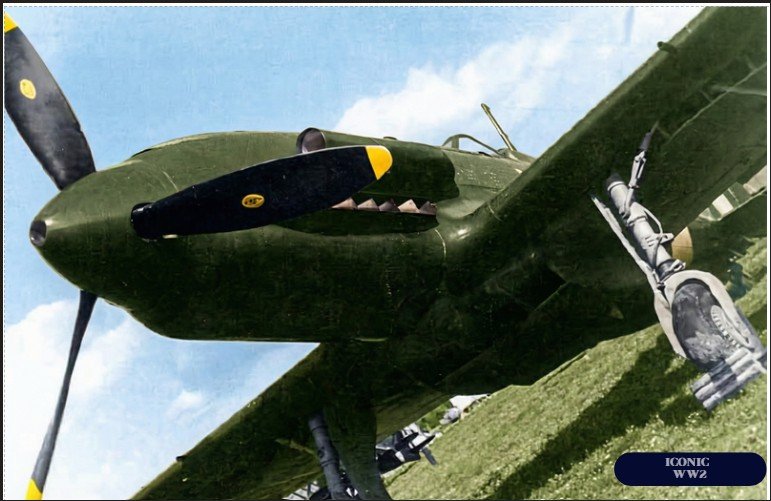
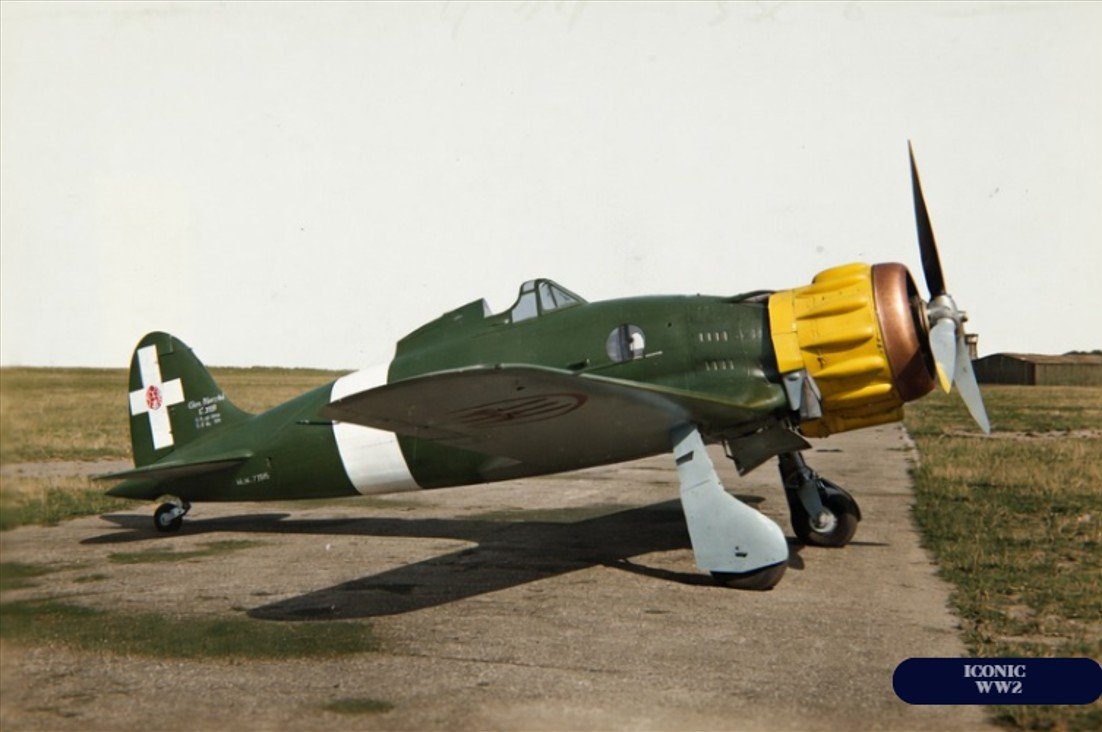
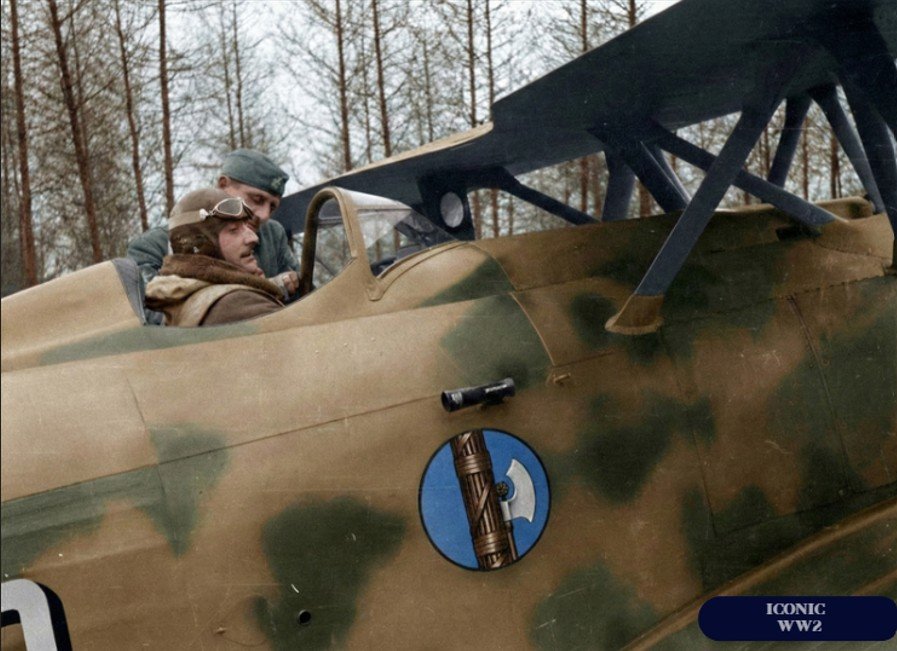
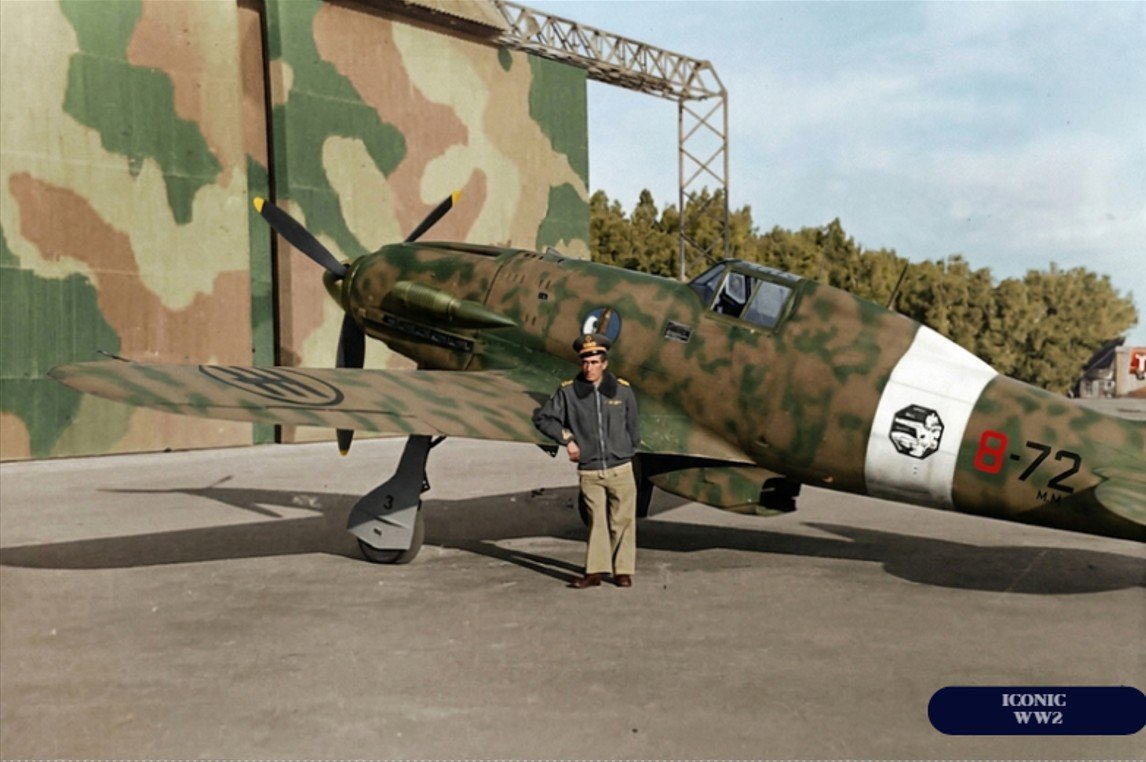
The Macchi C.202 Folgore had given Italy a world-class airframe, but it was held back by two stubborn faults: it was under-gunned, and its Alfa Romeo-built engine was already being eclipsed by newer German designs. The cure was obvious the moment it became available. In 1942 the more powerful Daimler-Benz DB 605 entered licence production in Italy, and Mario Castoldi moved at once to fit it to the Folgore's structure.
The result, first flown on 19 April 1942, was the C.205 Veltro — the Greyhound. Outwardly almost identical to the Folgore, it was a far more potent machine: faster, harder-hitting and able to fight at the high altitudes where the American bomber streams now operated. Many in the Regia Aeronautica regarded it, with the rival Reggiane Re.2005 and Fiat G.55, as one of the three superb Serie 5 fighters that finally gave Italy aircraft the equal of anything in the sky.
At the Veltro's heart was the Fiat R.A.1050 RC.58 Tifone, the Italian licence version of the DB 605A, delivering some 1,475 hp — a decisive 300-horsepower advance over the Folgore. The extra power lifted top speed to 642 km/h and transformed the climb, while Castoldi's clean, well-balanced airframe carried the new weight without losing the sweet handling for which the line was famous.
Just as important was the armament. The early C.205V Serie I retained the Folgore's gun fit, but the definitive Serie III added two 20mm MG 151/20 cannon in the wings alongside the two 12.7mm Breda-SAFAT guns in the nose — at last giving an Italian fighter the firepower to destroy, not merely damage, a four-engined bomber. In trials at Guidonia the Veltro outperformed a captured Spitfire Mk.V at every altitude above 3,000 m, and later comparison against a P-51 showed it at least an equal at medium height.
Two principal sub-types reached service. The C.205V Serie I was essentially a re-engined Folgore and was rushed into action in mid-1943; the cannon-armed Serie III was the true production Veltro and the version on which the type's reputation rests. A further refined development, the C.205N Orione, with a lengthened fuselage, greater span and still heavier armament, was flown as a prototype but never entered production before events overtook it.
The Veltro's tragedy was numbers. Just as it was hitting its stride, Allied bombing of the northern factories, chronic engine shortages and then the armistice of 8 September 1943 tore Italian industry apart. Only about 262 aircraft were ever completed — a tiny output for so fine a design, and the reason the Veltro is remembered more for its quality than for any decisive effect on the war.
The Veltro first saw combat in the summer of 1943 in the defence of Sicily and southern Italy, where its handful of pilots threw themselves against the USAAF’s heavy-bomber formations and their swarming escorts. In those battles the type proved everything its trials had promised — fast, tough and, with its 20 mm cannon, genuinely deadly to a bomber — the equal of the Spitfire IX and the Bf 109G it flew alongside.
But performance was never the problem. There were simply never remotely enough of them: barely more than a couple of hundred were built before the armistice, a rounding error against the thousands of Allied aircraft over Italy. The best Italian fighter of the war arrived just as Italy ran out of time to build it.
The armistice split the survivors. In the south a few flew with the Italian Co-Belligerent Air Force alongside the Allies; in the north the larger share equipped the Aeronautica Nazionale Repubblicana, which fought on against American raids over the Po valley until 1945, often in bitter combat against overwhelming numbers.
The design outlived the war. A small batch went to Germany for evaluation and captured examples were tested by the USAAF, and afterwards refurbished Veltros were exported to Egypt — proof of a fighter still viable years after its debut, and of how sound the Serie 5 airframe had always been.
By the verdict of the Allied and Axis test pilots who flew it, the Macchi C.205 Veltro was one of the finest single-engine fighters of the entire Second World War — the apex of Italian piston-engine design, combining the Folgore's exquisite handling with the power and firepower it had always lacked. Where a good pilot in a Veltro met the enemy on anything like equal numbers, the aircraft could hold its own against the best the Allies fielded.
It arrived too late and in far too few numbers to matter to the outcome, a magnificent machine overwhelmed by the industrial reality of 1943. But the Veltro stands as the crowning achievement of Macchi and of Mario Castoldi, the brilliant culmination of the line that had begun with the humble radial-engined Saetta — Italy's last and greatest piston-engined fighter.
- Håkan Gustavsson & Ludovico Slongo, Macchi C.202/C.205V Aces 1941–45 (Osprey, Aircraft of the Aces 106).
- Chris Dunning, Courage Alone: The Italian Air Force 1940–1943 (Hikoki Publications).
- Jonathan W. Thompson, Italian Civil and Military Aircraft 1930–1945 (Aero Publishers).
Iconic WW2 is free, ad-free and tracker-free — kept going only by the time it takes to research, restore and colorize each machine. If this profile was worth your read, you can help the archive grow.
| Manufacturer | Aeronautica Macchi |
| Nation | Italy |
| Role | Fighter / Interceptor |
| First Flight | 19 April 1942 |
| Service Entry | July 1943 |
| Units Built | ~262 |
| Engine | Fiat RA.1050 RC.58 Tifone |
| Type | V-12 liquid-cooled |
| Power | 1,475 hp |
| Basis | Licence-built DB 605A |
| Max Speed | 642 km/h @ 7,200 m |
| Service Ceiling | 11,500 m |
| Range | 1,040 km |
| Climb Rate | ~1,100 m/min |
| Wingspan | 10.58 m |
| Length | 8.85 m |
| Height | 3.49 m |
| Wing Area | 16.82 m² |
| Empty Weight | 2,581 kg |
| Max Takeoff | 3,408 kg |
| Cannon (wings) | 2× 20mm MG 151/20 |
| Machine Guns | 2× 12.7mm Breda-SAFAT |
| Bombs (optional) | 1× 320 kg |