Like the Heinkel He 111, the Do 17 was born under the fiction of civil aviation. Dornier drew it up in 1933 as a fast six-passenger mail and express aircraft for Lufthansa and the German railways — but the airline took one look at the needle-thin fuselage, with its cramped cabin barely wide enough for two passengers abreast, and rejected it as useless for carrying people. The three prototypes were left sitting at Löwental.
They might have been scrapped had a former Lufthansa pilot not spotted their potential in a different role. Stripped of any pretence of passenger work and fitted with a bomb bay and defensive guns, the slender airframe re-emerged as a Schnellbomber — a bomber fast enough to outrun contemporary fighters. The prototype had first flown on 23 November 1934, and by 1937 the Do 17 was entering Luftwaffe service alongside the He 111.
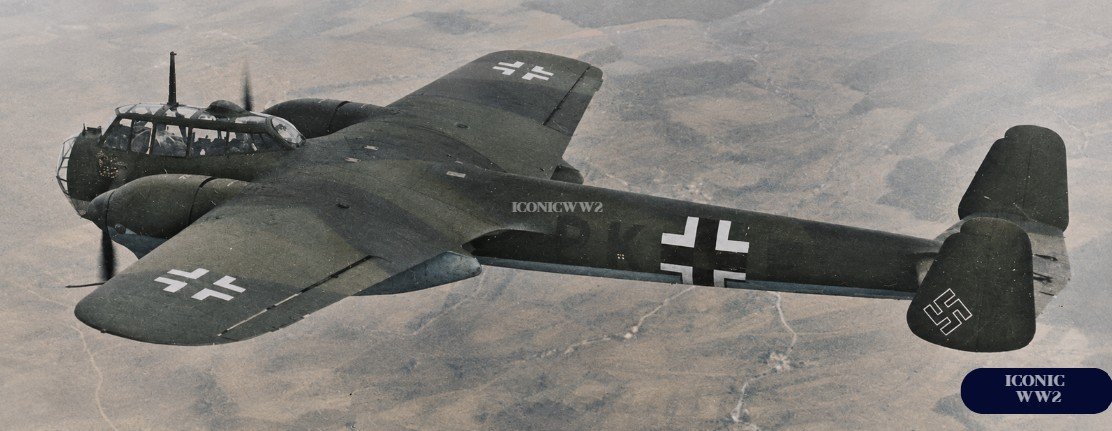
The Do 17 owed everything to its shape. The fuselage was so slender that the aircraft was nicknamed the “fliegender Bleistift” — the flying pencil — and the twin tail fins, set at the ends of the tailplane, gave it an unmistakable silhouette. That slimness bought speed and cut drag, but it came at a permanent price: the bomb bay was small, and the Do 17 could never carry the loads its rivals managed.
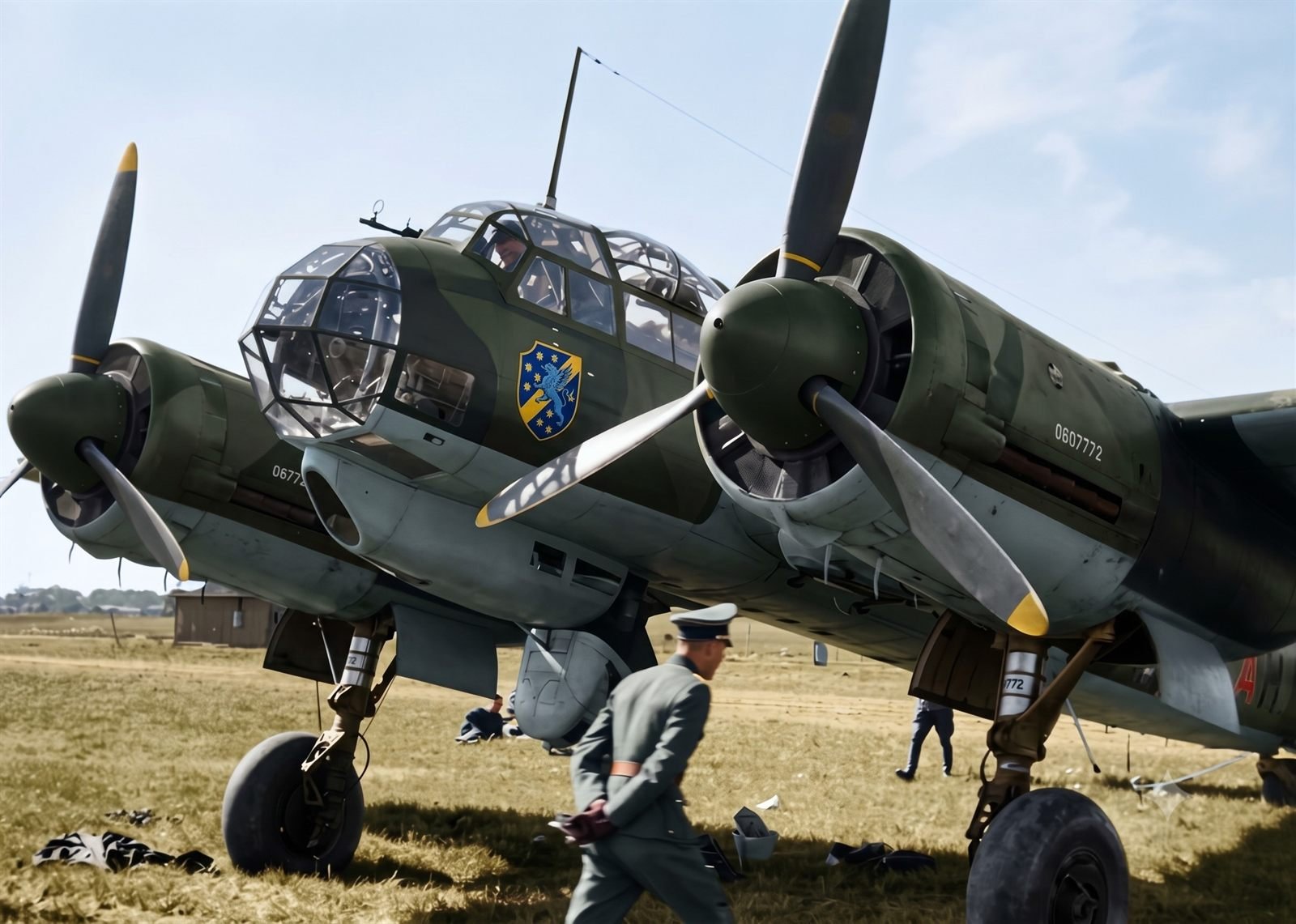
The definitive Do 17 Z of 1939 traded the earlier slim nose for a deeper, fully glazed “beetle-eye” cockpit that housed the whole four-man crew together, and swapped inline engines for two Bramo 323 Fafnir radials of about 1,000 hp each. It could reach roughly 410 km/h and carry up to 1,000 kg of bombs — but only over a short radius, and defended by a scatter of hand-aimed 7.92 mm MG 15 machine guns that left it badly exposed to modern fighters.
The Do 17 went to war early, flying with the Condor Legion in Spain from 1937, where — like the He 111 — its speed kept it ahead of most Republican fighters and taught the Luftwaffe the comfortable, mistaken lesson that a fast bomber needed little protection. A racing version even carried off a prize at the 1937 Zürich international flying meeting, humiliating the fighters present.
When the real war came, the Do 17 was in the thick of the opening campaigns. Its bombers helped shatter the Polish air force and rail network in September 1939, ranged over the Low Countries and France in May 1940, and by that summer equipped a third of the Luftwaffe’s bomber force massing on the Channel coast — the smallest and shortest-legged of the three types that would be sent against Britain.
In the Battle of Britain the Do 17’s weaknesses came due. It was slower than the Ju 88, carried less than the He 111, and its light defensive armament made it desperately vulnerable once the fighter escort fell away. On 18 August 1940 — “the Hardest Day” — nine Do 17s of KG 76 pressed home a daring low-level attack on the fighter airfield at RAF Kenley, screaming in at rooftop height; the raid did real damage but ran into anti-aircraft fire and Hurricanes, and few of the nine came home unscathed.
It was a pattern repeated across the summer. The Do 17 could still hurt its targets, but it bled for every raid, and the campaign made plain that its day as a frontline bomber was ending. One of those shot down that August would become the type’s most famous survivor.
Around 2,100 Do 17s were built, and by 1942 the type had been withdrawn from frontline bombing, displaced by the far more capable Ju 88 and by Dornier’s own enlarged development, the Do 217. Surviving airframes soldiered on as trainers, glider tugs and target-tugs, and a handful became Do 17 Z-10 “Kauz” night fighters with a solid gun nose and early infrared sensors. Exported Do 17 K versions had been built under licence in Yugoslavia, a few of which flew out to Egypt when their country was overrun in 1941.
Of the thousands built, not one remained — until 2013. A Do 17 Z of 7./KG 3, ditched on the Goodwin Sands after being hit on 26 August 1940, was located under the sea and raised after seventy-three years, the only surviving Dornier Do 17 in the world, now undergoing conservation at the RAF Museum. That single salt-eaten wreck is all that is left of the aircraft that had opened Germany’s war in the air.
The Do 17 was a design that peaked at the start of the war. Fast and elegant when it first flew, it embodied the seductive Schnellbomber idea — and, like that idea, it did not survive contact with the eight-gun monoplane fighter. Everything that made it quick in 1934 made it inadequate by 1940: too little bomb load, too little range, too little defence.
Yet it earned its place in history as one of the three bombers whose engines were the soundtrack of 1940, and as the rarest of them by far. Where the He 111 and Ju 88 survive in numbers on museum floors, the Flying Pencil is represented by a single machine dragged from the sea — a fitting end for the sleekest and most fragile of the Luftwaffe’s early bombers.
- William Green, Warplanes of the Third Reich (Macdonald & Co.).
- J. R. Smith & Antony L. Kay, German Aircraft of the Second World War (Putnam).
- Chris Goss, The Luftwaffe Bombers’ Battle of Britain (Crécy).
Iconic WW2 is free, ad-free and tracker-free — kept going only by the time it takes to research, restore and colorize each machine. If this profile was worth your read, you can help the archive grow.
| Manufacturer | Dornier-Werke |
| Nation | Germany |
| Role | Medium bomber |
| First Flight | 23 November 1934 |
| Service Entry | 1937 |
| Crew | 4 |
| Units Built | ~2,100 (all versions) |
| Do 17 Z | Definitive bomber, glazed “beetle” nose |
| Do 17 Z-10 Kauz | Night fighter with solid gun nose |
| Do 17 K | Yugoslav licence-built export version |
| Do 215 / Do 217 | Export and enlarged developments |
| Engines | 2× Bramo 323P Fafnir |
| Type | 9-cylinder air-cooled radial |
| Power | ~1,000 hp each |
| Note | Early marks: inline / BMW engines |
| Max Speed | ~410 km/h |
| Range | ~1,160 km |
| Service Ceiling | ~8,200 m |
| Weakness | Short range, small bomb bay |
| Length | 15.79 m |
| Wingspan | 18.00 m |
| Height | 4.56 m |
| Max Take-off | ~8,600 kg |
| Bomb Load | up to ~1,000 kg |
| Defensive | up to 6× 7.92 mm MG 15 |
| Position | Hand-aimed from the glazed nose section |
| Note | Light defence — vulnerable without escort |