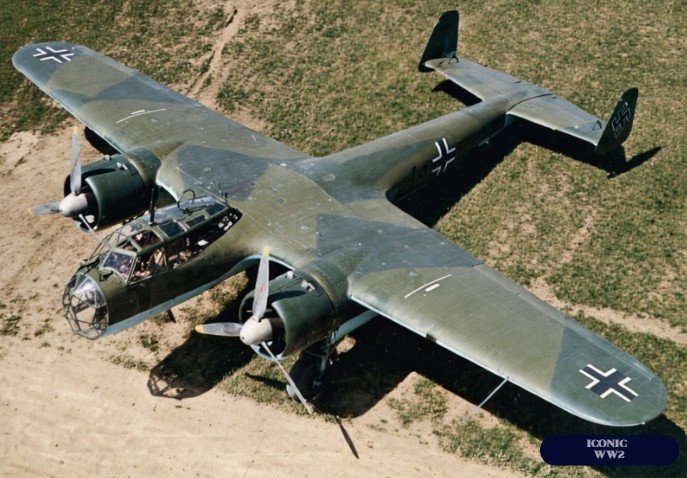
The Dornier Do 217 began as a bigger, heavier answer to a simple problem: the Luftwaffe’s early bombers could not carry enough. Dornier took the slim “Flying Pencil” Do 17 and its successor the Do 215, and scaled the design up into a far larger aircraft with more powerful engines and a deep, capacious fuselage. The prototype first flew in 1938, and after a troubled development the type entered service from 1940.
The result no longer looked like a pencil. The Do 217 was the largest and heaviest twin-engine bomber the Luftwaffe would field in numbers, able to lift a bomb load no other German medium could match. Around 1,900 were built between 1940 and 1944, and across that run the aircraft was pushed into role after role its designers had never envisaged.
Early Do 217Es were powered by two BMW 801 radials of around 1,580 hp; the later Do 217M swapped these for DB 603 inline engines of about 1,750 hp, lifting top speed to roughly 557 km/h. What set the type apart was its load: the Do 217 could carry up to 4,000 kg of bombs, the heaviest payload of any German bomber until the troubled He 177.
It had its oddities. Early versions carried an umbrella-like tail dive-brake that opened into a cruciform to steady the aircraft in an attack dive — often unreliable, and frequently removed. A crew of four worked the glazed nose, and defensive armament grew steadily heavier through the war. The Do 217 was never as nimble as the Ju 88, but it was roomy, strong and adaptable — and that adaptability would define its career.
The Do 217 entered the bombing war on the Channel front, flying anti-shipping and night raids against Britain from 1941. Its heaviest effort came in the winter of 1944, when it formed part of Operation Steinbock — the so-called “Baby Blitz”, the Luftwaffe’s last sustained bomber offensive against London and southern England.
By then the effort was hopeless. Flying against a night-defence system of radar-directed fighters and guns that had matured far beyond 1940, the bomber units took punishing losses for little result, and Steinbock burned out the last of the German bomber arm in the West. As a conventional bomber the Do 217 had arrived too late to change anything.
The type’s size and load made it an obvious candidate for conversion, and from 1942 Dornier built dedicated night-fighter versions — the radial-engined Do 217J and the inline-engined Do 217N. Their noses were packed with cannon and machine guns, and later aircraft carried FuG 202/212 airborne radar and, on some, the upward-firing Schräge Musik cannon.
But the heavy bomber airframe made a poor fighter: it was sluggish and slow to climb, no match for the more agile Bf 110 and Ju 88 night-fighters. Many were passed to training units or to the Italian and Hungarian air forces, and the night-fighter Do 217 remained a footnote to the aircraft’s story.
The Do 217’s true place in history lies elsewhere. In 1943 it became the carrier for the world’s first precision-guided munitions to see successful use in combat, flown by the specialist missile group KG 100.
Two weapons made it famous. The Fritz X was a 1,362 kg armour-piercing bomb with steerable tail fins, radio-guided down onto a ship far below — a weapon meant to punch through the deck armour of a battleship. The Hs 293 was a rocket-boosted glide bomb with its own engine, guided the same way against thinner-skinned ships. Both were steered visually by an operator in the launching Do 217, who tracked a flare in the weapon’s tail and flew it onto the target with a joystick. It was, in every meaningful sense, the birth of the guided-missile age.
The campaign that proved them came in the late summer of 1943. After early strikes off Sicily, the guided-weapon Do 217s of KG 100 found their defining target on 9 September 1943. The Italian battleship Roma, steaming to surrender under the terms of the armistice, was struck by two Fritz X bombs; the second detonated a magazine, and she blew apart and sank with 1,393 of her crew.
Over the following weeks the missile Do 217s tore into the Allied fleet supporting the Salerno landings. A Fritz X crashed through the battleship HMS Warspite and nearly crippled her; the US cruiser Savannah was gutted; Uganda and Philadelphia were hit; and an Hs 293 sank the sloop HMS Egret. For a few weeks in 1943, a handful of bombers wielding radio-guided weapons were among the most dangerous aircraft at sea.
As an aircraft the Do 217 was a competent but unexceptional bomber — overtaken as a conventional weapon, and a failure as a night-fighter. Its importance is almost entirely bound up with what it carried. The Fritz X and Hs 293 forced the Allies into a crash effort of jamming and evasive tactics, and they pointed straight at the future: the anti-ship guided missile that would come to dominate naval warfare for the rest of the century.
The Do 217 is remembered, then, not for the tonnage of ordinary bombs it dropped, but as the platform from which the guided-missile age opened — and, on one September afternoon off Sardinia, sent a battleship to the bottom.
- Manfred Griehl, Dornier Do 217-317-417: An Operational Record (Airlife Publishing).
- William Green, Warplanes of the Third Reich (Macdonald & Co.).
- Martin J. Bollinger, Warriors and Wizards: The Development and Defeat of Radio-Controlled Glide Bombs of the Third Reich (Naval Institute Press).
- Chris Goss, Sea Eagles: Luftwaffe Anti-Shipping Units 1942–45 (Classic Publications).
Iconic WW2 is free, ad-free and tracker-free — kept going only by the time it takes to research, restore and colorize each machine. If this profile was worth your read, you can help the archive grow.
| Manufacturer | Dornier |
| Nation | Germany |
| Role | Heavy bomber / missile carrier |
| First Flight | 1938 |
| Service Entry | 1940 |
| Crew | 4 |
| Units Built | ~1,900 (1940–1944) |
| Do 217E | Initial bomber — BMW 801 radials, tail dive-brake |
| Do 217J / N | Radar-equipped night fighters |
| Do 217K-2 | Fritz X carrier — extended wings, stepless cockpit |
| Do 217E-5 / K-3 | Hs 293 glide-bomb carrier (KG 100) |
| Do 217M | DB 603 inline engines — the fastest version |
| Engine | 2× Daimler-Benz DB 603A |
| Type | V-12 inline |
| Power | ~1,750 hp each |
| Do 217E | 2× BMW 801 radial, ~1,580 hp |
| Max Speed | ~557 km/h |
| Range | ~2,300 km |
| Service Ceiling | ~9,000 m |
| Bomb Load | up to 4,000 kg |
| Length | ~17.0 m |
| Wingspan | 19.0 m (24.8 m on the K-2) |
| Height | ~5.0 m |
| Max Weight | ~16,700 kg |
| Offensive | up to 4,000 kg bombs |
| Guided Weapons | Fritz X (1,362 kg) / Hs 293 |
| Defensive | up to ~6–8× 7.9/13 mm MG |
| Night-fighter (J/N) | up to 4× 20 mm + 4× MG |