The He 111 was conceived in deception. Germany was still formally bound by the Versailles ban on military aircraft, so the twin brothers Siegfried and Walter Günter at Ernst Heinkel Flugzeugwerke designed it as a dual-purpose machine: outwardly a fast ten-passenger airliner for Lufthansa, in reality a medium bomber for the still-secret Luftwaffe. The prototype flew on 24 February 1935, carrying the beautiful elliptical wing the Günters had pioneered on the record-setting He 70 Blitz.
The bomber went to war early. In February 1937 the first He 111s reached the Condor Legion in Spain, where they proved faster than most Republican fighters and flew in the campaign’s most infamous raids, including Guernica that April. Spain taught the Luftwaffe a seductive and dangerous lesson — that speed alone could protect a bomber. The summer of 1940 would correct it brutally.
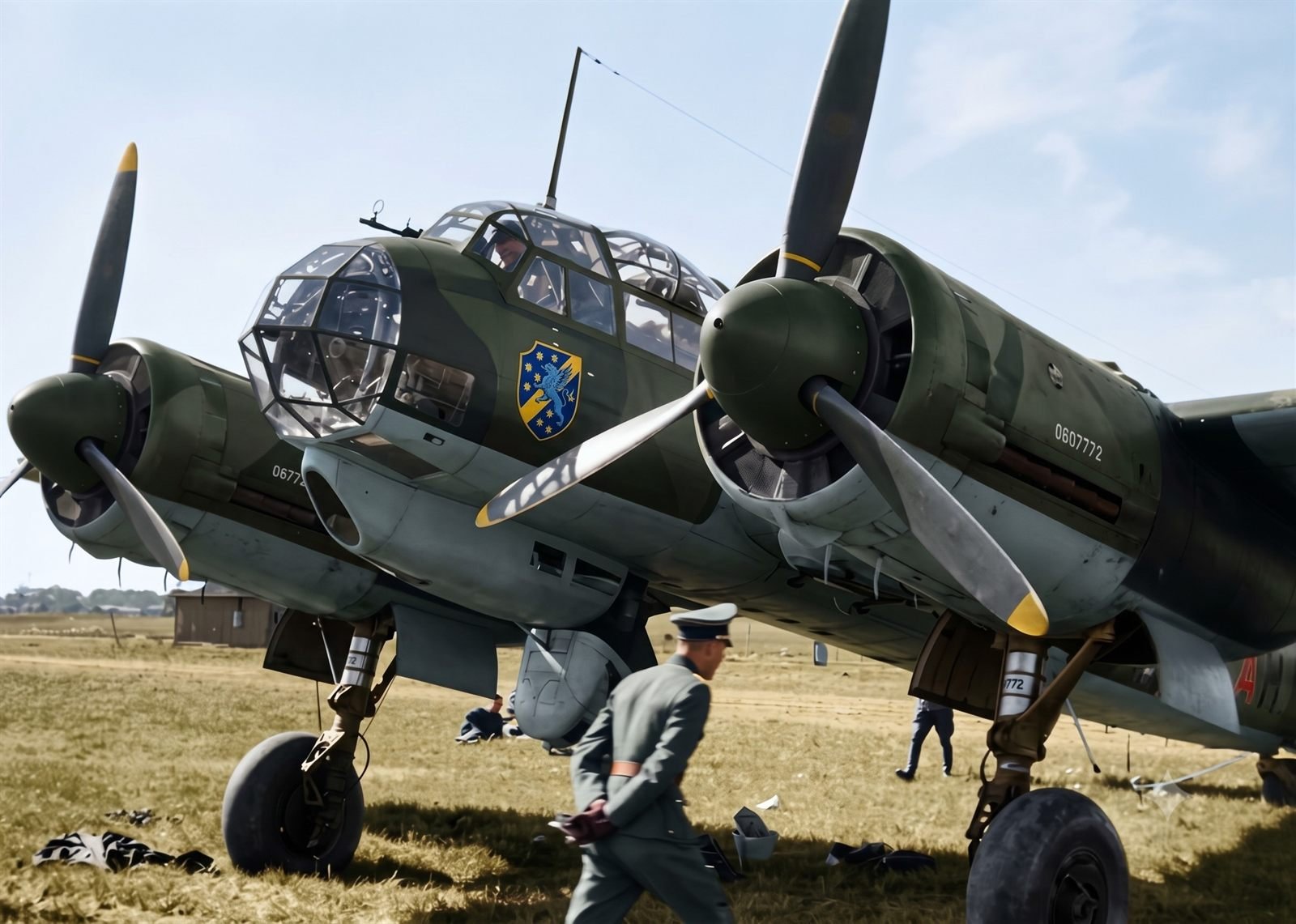
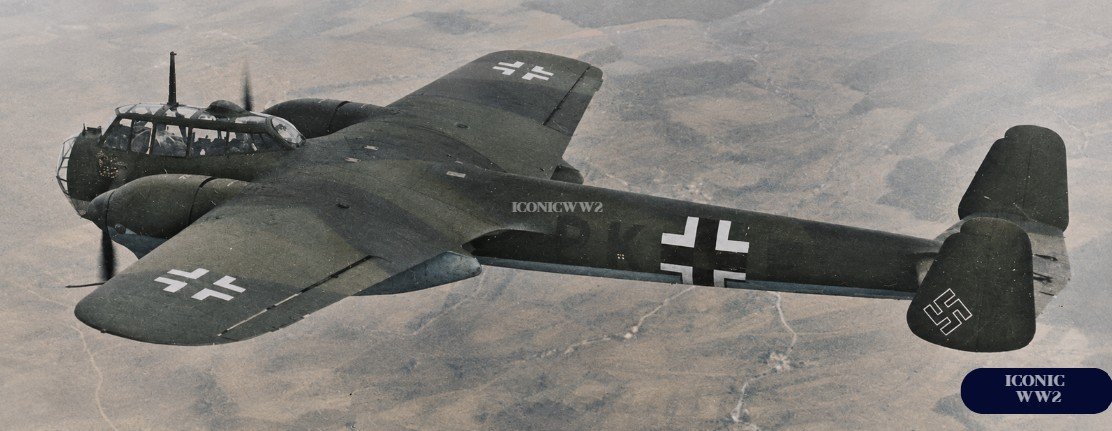
The definitive H-series was powered by two Junkers Jumo 211 inverted V-12s of about 1,340 hp each. Its signature came with the P-series of 1938: the stepless, fully glazed asymmetric “greenhouse” nose, with no separate windscreen for the pilot and an offset ball mount for the nose gun — one of the most recognisable silhouettes of the war. The crew of five worked close together, in the German fashion, most of them in that single glazed compartment.
Bombs were stowed in an unusual arrangement: eight vertical cells in the fuselage, each holding a 250 kg bomb nose-up, so the weapons somersaulted as they fell. The H-6 could reach roughly 435 km/h and carry up to ~2,000 kg internally — around 3,600 kg with external racks. Defensive armament grew from three hand-aimed machine guns to seven plus a 20 mm cannon, and was never enough; what crews actually trusted was the aircraft’s stability and its legendary ability to absorb battle damage.
In the summer of 1940 the He 111 was the most numerous bomber in the Luftwaffe’s order of battle — around 500 aircraft across the Channel coast. Against the Hurricane and the Spitfire the Spanish lesson collapsed: too slow to run and too lightly armed to fight, the Heinkel formations suffered heavily whenever the escort failed them, and by September the type was being pulled back from daylight over England.
Its answer was the night. Through the winter of 1940–41 the He 111 carried the weight of the Blitz, led by the pathfinders of KGr 100 riding the X-Gerät radio beams — most infamously to Coventry on 14 November 1940, when 500 tons of bombs gutted the city centre. Until the campaign ebbed in May 1941, the drone of Jumo engines over London was, for most Britons, simply the sound of the Heinkel.
From the first hours of Barbarossa the He 111 was everywhere on the Eastern Front, and it stayed there long after it was obsolete — because Germany never fielded a successor. The He 177 burned, the “Bomber B” programme died, and the 1935 airframe soldiered on. From Norway, the torpedo-armed H-6s of KG 26 joined the slaughter of the Arctic convoys in 1942, carrying two LT F5b torpedoes apiece.
Its bitterest chapter came at Stalingrad, when the bomber was pressed into service as a transport to feed the encircled 6th Army through the winter of 1942–43: about 165 He 111s were lost in the airlift that never came close to its quota. The type’s last great strike came astonishingly late — on the night of 21/22 June 1944, He 111s of KG 53 and KG 55 caught the USAAF’s shuttle-mission bombers on the ground at Poltava and destroyed 43 B-17 Flying Fortresses.
About 6,500 He 111s were built before German production ended in the autumn of 1944. The strangest late variants kept it in the fight after the bomber war was lost: the H-22 carried a V-1 flying bomb under one wing and air-launched it at night from over the North Sea — roughly 1,200 V-1s were thrown at London and Southampton this way, at a punishing cost in crews. Stranger still was the He 111 Z Zwilling: two airframes joined at the wing with a fifth engine between them, built to tow the giant Me 321 glider.
The design outlived the Reich by three decades. Spain built the He 111 under licence as the CASA 2.111, re-engined after the war with Rolls-Royce Merlins, and flew it into the 1970s — which is why the Heinkels filling the screen in the 1969 film Battle of Britain are real ones, powered by the engines of their old enemy.
The He 111 is the story of the Luftwaffe’s bomber arm in a single airframe: brilliant and almost uncatchable over Spain in 1937, bled white over England in 1940, and still flying frontline missions in 1944 because nothing had come to replace it. No other major air force fought the whole war with a first-generation bomber in first-line service.
Yet the crews kept faith with it to the end — stable, honest, capable of coming home on one engine with the fuselage shot through. As a weapon it was outlived by every enemy it faced; as a design, the airliner-that-was-a-bomber proved tough enough to carry six years of war it was never meant to see.
- William Green, Warplanes of the Third Reich (Macdonald & Co.).
- J. R. Smith & Antony L. Kay, German Aircraft of the Second World War (Putnam).
- Chris Goss, The Luftwaffe Bombers’ Battle of Britain (Crécy).
Iconic WW2 is free, ad-free and tracker-free — kept going only by the time it takes to research, restore and colorize each machine. If this profile was worth your read, you can help the archive grow.
| Manufacturer | Ernst Heinkel Flugzeugwerke |
| Nation | Germany |
| Role | Medium bomber |
| First Flight | 24 February 1935 |
| Service Entry | 1936 |
| Crew | 5 |
| Units Built | ~6,500 (all versions) |
| He 111 H-6 | Definitive bomber / torpedo-bomber |
| He 111 P | Introduced the glazed stepless nose, 1938 |
| He 111 H-22 | Air-launch carrier for V-1 flying bombs |
| He 111 Z / CASA 2.111 | Twin-fuselage glider tug / Spanish licence |
| Engines | 2× Junkers Jumo 211F |
| Type | Inverted V-12, liquid-cooled |
| Power | ~1,340 hp each |
| Note | P-series: Daimler-Benz DB 601 |
| Max Speed | ~435 km/h |
| Cruise Speed | ~370 km/h |
| Range | ~2,300 km |
| Service Ceiling | ~6,700 m |
| Length | 16.40 m |
| Wingspan | 22.60 m |
| Height | 4.00 m |
| Max Take-off | ~14,000 kg |
| Bomb Load | up to ~2,000 kg internal |
| External racks | up to ~3,600 kg total |
| Defensive | up to 7× 7.92 mm MG 15/81 + 1× 20 mm MG FF |
| Anti-ship | 2× LT F5b torpedoes (KG 26) |