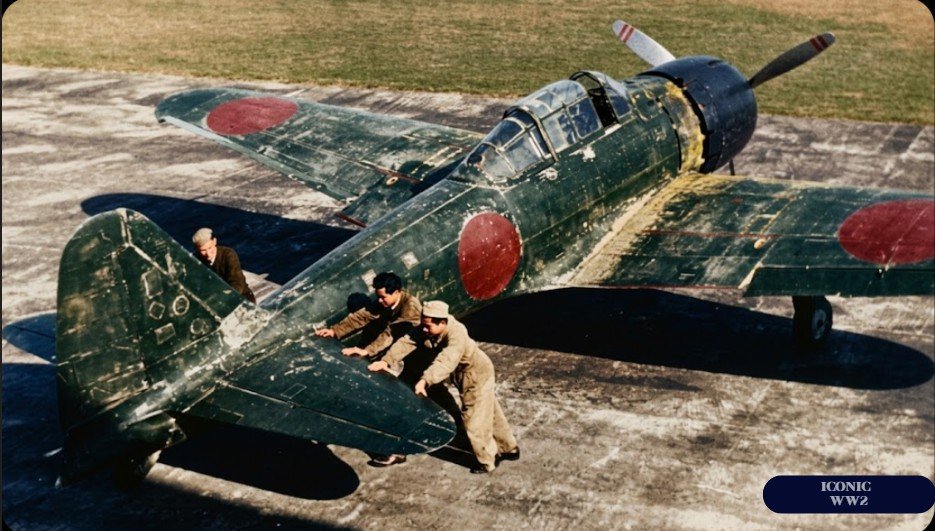
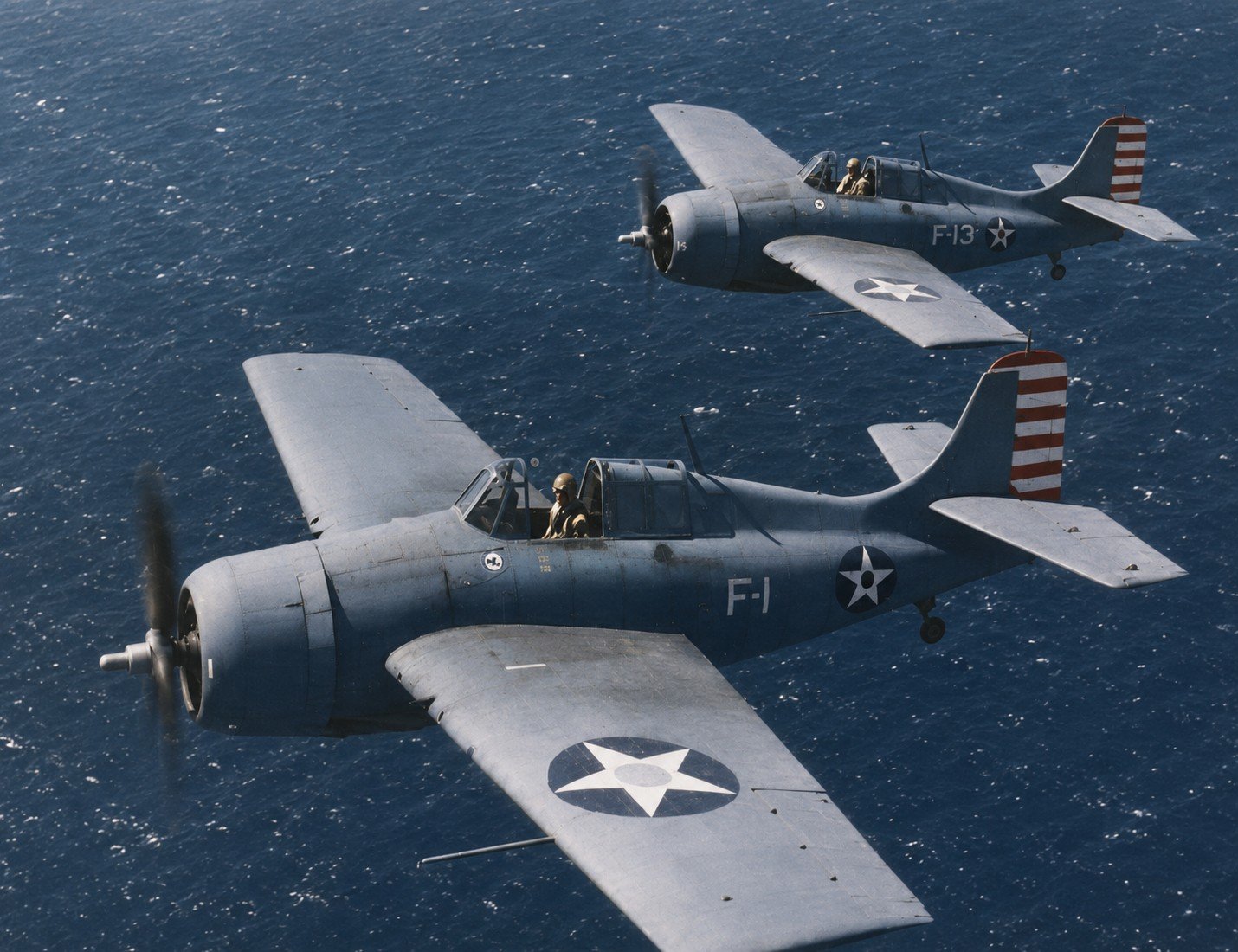
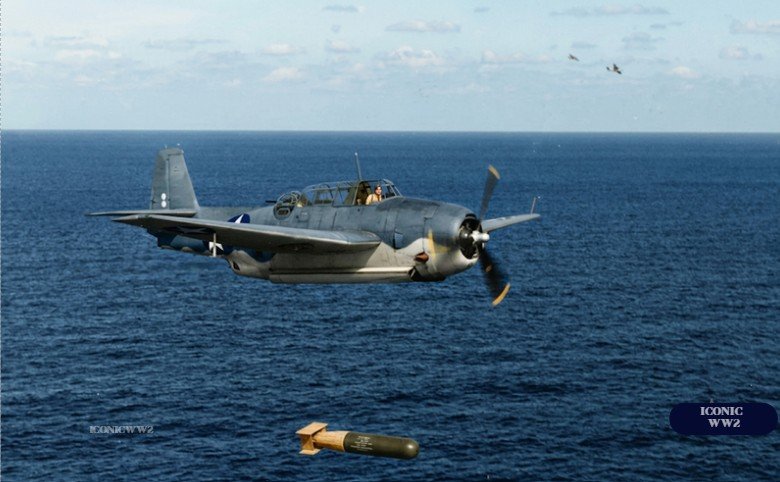
The Hellcat was designed for one overriding purpose: to defeat the Mitsubishi A6M Zero and win back command of the Pacific skies. Grumman had already built the tough but outclassed F4F Wildcat, and drew directly on early combat reports — and on the near-intact “Akutan Zero” recovered in the Aleutians in 1942 — to shape a fighter that could beat the Japanese on its own terms.
The prototype XF6F first flew on 26 June 1942; re-engined with the more powerful Pratt & Whitney R-2800, the definitive XF6F-3 flew on 30 July 1942. Development was extraordinarily fast: the type reached front-line squadrons in early 1943 and flew its first combat on 1 September 1943 over Marcus Island, barely a year after its maiden flight.
At the Hellcat’s heart was the Pratt & Whitney R-2800 Double Wasp, an 18-cylinder twin-row radial of about 2,000 hp (up to ~2,200 hp with water injection in the F6F-5), driving a large three-blade propeller for a top speed near 612 km/h (380 mph), a service ceiling around 11,370 m and a strong rate of climb. Where the Zero traded protection for agility, the Hellcat was built around pilot survivability and firepower: heavy armour plate, a bullet-resistant windscreen and self-sealing tanks let it absorb punishment that would have destroyed a Japanese fighter.
Its battery of six 0.50 in (12.7 mm) Browning M2 machine guns with 400 rounds each hit hard, and — just as important — the aircraft was docile and forgiving to fly, with wide-track, inward-retracting landing gear that made it easy for a relatively green pilot to bring back aboard a pitching carrier deck. It could out-dive, out-roll and out-climb the Zero and dictate the terms of combat, even where it could not out-turn the nimble Japanese fighter at low speed.
The Hellcat’s impact was immediate and overwhelming. From late 1943 it equipped the fast-carrier task forces that drove across the Central Pacific, and it swiftly established a crushing superiority over Japanese naval aviation — helped as much by the erosion of Japan’s experienced pilot cadre as by the aircraft itself.
US Navy and Marine Hellcats were credited with 5,163 aerial victories — around 56% of all US Navy/Marine air-to-air kills of the Pacific war — against relatively light losses, for an overall kill-to-loss ratio commonly cited at about 19:1. The type produced more American aces than any other US fighter.
No pilot embodied the Hellcat’s dominance more than Commander David McCampbell, air group commander aboard USS Essex and the US Navy’s top-scoring ace of the war with 34 aerial victories, every one of them in the Hellcat. On 24 October 1944, during the Battle of Leyte Gulf, he and his wingman waded into a formation of some sixty Japanese aircraft; McCampbell alone shot down nine in a single sortie — a US record that still stands, and one of the actions for which he received the Medal of Honor.
He was one of many. The Hellcat produced 305 American aces, more than any other US fighter of the war — a total made possible not only by the aircraft’s qualities but by the sheer number of targets its pilots met as Japan flung its dwindling, half-trained air groups against the fast carriers.
The Hellcat’s dominance was displayed most starkly at the Battle of the Philippine Sea on 19–20 June 1944. As the Japanese launched their carrier air groups against the US fleet, waves of Hellcats — backed by radar direction and proximity-fuzed anti-aircraft fire — annihilated them.
Japanese naval aviation lost around three aircraft carriers and some 550–645 aircraft in two days, shattering its carrier air arm beyond recovery. American aircrew nicknamed the one-sided slaughter the “Great Marianas Turkey Shoot.” After it, Japanese carrier air power was never again a serious offensive threat.
The two principal versions were the F6F-3 and the improved F6F-5, the latter with an uprated engine, aerodynamic refinements and provision for up to 2,000 lb (900 kg) of bombs or six rockets for ground and anti-ship attack. Radar-equipped F6F-3N and -5N night fighters pioneered carrier night interception, some armed with a mix of 20 mm cannon and machine guns.
Grumman’s Bethpage plant — nicknamed the “Ironworks” — turned out Hellcats at a phenomenal rate, building about 12,275 aircraft in roughly two years. This combination of quality and quantity meant the US Navy could equip every fast carrier with a fighter that was, by any practical measure, superior to its opponents.
The F6F Hellcat is arguably the most successful carrier fighter in history. It was not the fastest or the most manoeuvrable aircraft of the war, but it was superbly suited to its role: rugged, well-armed, forgiving to fly, easy to build in vast numbers and available exactly when the US Navy needed it.
In under two years of combat it destroyed Japanese naval air power and helped secure command of the Pacific — a decisive strategic result achieved with a machine designed, built and fielded with remarkable speed. If any single aircraft “won the air war” over the Pacific, the strongest claim belongs to the Hellcat.
- Barrett Tillman, Hellcat: The F6F in World War II (Naval Institute Press).
- Barrett Tillman, Hellcat Aces of World War 2 (Osprey, Aircraft of the Aces).
- Richard B. Frank, Guadalcanal (Random House) — for the Pacific carrier war in context.
- Barrett Tillman, Clash of the Carriers: The True Story of the Marianas Turkey Shoot (NAL Caliber).
Iconic WW2 is free, ad-free and tracker-free — kept going only by the time it takes to research, restore and colorize each machine. If this profile was worth your read, you can help the archive grow.
| Manufacturer | Grumman |
| Nation | United States |
| Role | Carrier-based fighter |
| First Flight | 26 June 1942 |
| Combat Debut | 1 September 1943 |
| Units Built | ~12,275 |
| Engine | Pratt & Whitney R-2800 Double Wasp |
| Type | 18-cyl. air-cooled radial |
| Power | ~2,000 hp (2,200 w/ water inj.) |
| Max Speed | 612 km/h @ 7,100 m |
| Service Ceiling | ~11,370 m |
| Combat Range | ~1,520 km |
| Climb Rate | ~17 m/s |
| Wingspan | 13.06 m |
| Length | 10.24 m |
| Height | 3.99 m |
| Empty Weight | ~4,190 kg |
| Max Takeoff | ~6,990 kg |
| Machine Guns | 6× 12.7 mm Browning M2 |
| Ammunition | 400 rounds per gun |
| Night Fighter (-5N) | 2× 20 mm + 4× 12.7 mm |
| Ordnance | up to 900 kg bombs / 6 rockets |