The Dauntless began life as somebody else’s aeroplane. Its direct ancestor was the Northrop BT-1 dive bomber of 1935; when Northrop’s El Segundo plant became a division of Douglas in 1937, the design team under Ed Heinemann reworked the aircraft — new landing gear, refined tail, perforated dive flaps — into what the Navy accepted as the SBD: Scout Bomber, Douglas. The first production SBD-1 flew on 1 May 1940, and deliveries went to the Marine Corps that summer, followed by the longer-ranged SBD-2 to the Navy’s carriers.
The aircraft arrived at exactly the right moment. The US Navy had spent the 1930s turning dive-bombing into a precision weapon against moving warships — a skill that would define the Pacific war — and the SBD-3 of early 1941 added the equipment that made the type combat-ready: self-sealing fuel tanks, armour protection and two 12.7 mm guns in the cowling. By Pearl Harbor, the Dauntless was the standard dive bomber of every American carrier air group.
The SBD was built around a Wright R-1820 Cyclone nine-cylinder radial — 1,000 hp in the Midway-era SBD-3, 1,200 hp in the definitive SBD-5 — pulling a two-man crew: pilot forward, radioman-gunner facing aft under the long greenhouse canopy. Unusually for a carrier aircraft, the wings did not fold; Heinemann accepted the deck-space penalty in exchange for a lighter, stronger structure that could take the strain of near-vertical dives.
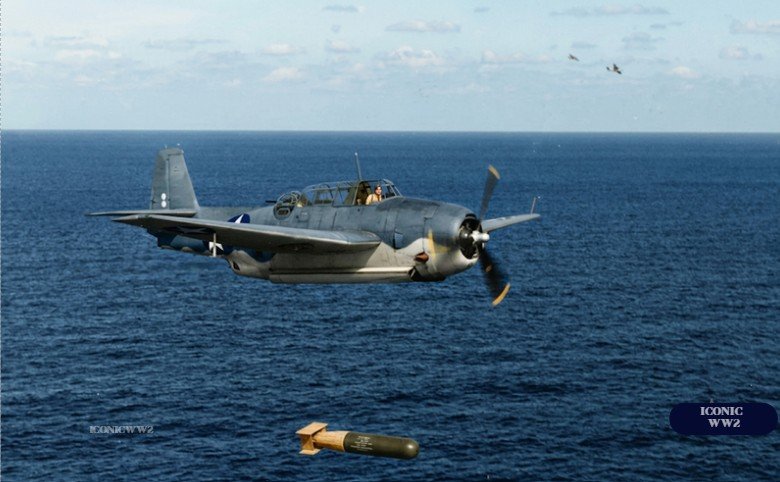
Its signature was the set of perforated “Swiss cheese” dive flaps: split flaps drilled with 3-inch holes that smoothed the airflow, cured tail buffeting and held a 70-degree attack dive at a steady, aimable ~440 km/h. The bomb — up to a 726 kg weapon on the centreline — swung clear of the propeller on a displacement yoke before release. Armament was completed by two fixed 12.7 mm guns in the nose and a flexible twin 7.62 mm mount for the gunner, who used it to real effect against Japanese fighters.
The Dauntless drew first blood in the early 1942 island raids, then made history twice in a month. At the Battle of the Coral Sea on 7 May 1942, SBDs from Lexington and Yorktown helped send the light carrier Shōhō under in minutes — prompting the famous radio call “Scratch one flattop!” — and damaged the fleet carrier Shōkaku the next day.
Then came 4 June 1942. At about 10:22 that morning, SBD squadrons from Enterprise (VB-6 and VS-6) and Yorktown (VB-3) arrived over the Japanese carrier force almost simultaneously and tipped into their dives: in roughly six minutes, Akagi, Kaga and Sōryū were burning wrecks. A fourth strike that afternoon finished Hiryū. Four fleet carriers destroyed in a single day — by one aircraft type — broke the offensive power of the Japanese carrier fleet; two days later SBDs added the heavy cruiser Mikuma.
From August 1942 the Dauntless fought the grinding Solomons campaign from both flight decks and the mud of Henderson Field, where Marine and Navy SBDs of the “Cactus Air Force” attacked the Tokyo Express runs night after night. SBDs from Saratoga helped sink the light carrier Ryūjō at the Eastern Solomons in August; in the November naval battles they helped finish the battleship Hiei and sank the heavy cruiser Kinugasa.
Through it all the type earned its backronym — “Slow But Deadly” — and a reputation as a survivor: its loss rate was among the lowest of any US carrier aircraft of the war. It was also, as the “S” in its designation said, a scout: SBD search teams found the Japanese fleet as often as they struck it.
Production ran through six major versions. The SBD-3 fought Coral Sea and Midway; the SBD-5, with the 1,200 hp R-1820-60 and 2,965 built, was the most numerous; the SBD-6 closed the line. When the last aircraft was delivered on 21 July 1944, 5,936 had been built — including 953 A-24 Banshees, the Army’s carrier-hook-less version, which fared poorly in unescorted low-level use over New Guinea.
The SBD flew its last great carrier battle at the Philippine Sea in June 1944, by which time the bigger, faster SB2C Helldiver was replacing it aboard the fleet carriers — a successor most crews considered a step backwards in handling and reliability. Marine squadrons kept flying the Dauntless in the Philippines into 1945, and France and New Zealand operated it too.
On paper the Dauntless was nothing special: a pre-war design of modest speed, modest range and modest bomb load. Its results were anything but. Six Japanese carriers — Shōhō, Akagi, Kaga, Sōryū, Hiryū and Ryūjō — were sunk wholly or largely by SBD strikes, and it is often credited with sinking more Japanese warship tonnage than any other Allied aircraft.
No single type did more to turn the Pacific war. The six minutes its crews spent in their dives on the morning of 4 June 1942 rank among the most consequential of the twentieth century — a battle, and arguably an ocean, decided by one honest, unglamorous dive bomber.
- Barrett Tillman, The Dauntless Dive Bomber of World War Two (Naval Institute Press) — the standard reference.
- Peter C. Smith, Douglas SBD Dauntless (The Crowood Press).
- Barrett Tillman, SBD Dauntless Units of World War 2 (Osprey).
Iconic WW2 is free, ad-free and tracker-free — kept going only by the time it takes to research, restore and colorize each machine. If this profile was worth your read, you can help the archive grow.
| Manufacturer | Douglas Aircraft (El Segundo) |
| Nation | United States |
| Role | Carrier scout / dive bomber |
| First Flight | 1 May 1940 (SBD-1) |
| Service Entry | 1940 |
| Crew | 2 (pilot, radioman-gunner) |
| Units Built | 5,936 (incl. 953 A-24) |
| SBD-3 | Coral Sea & Midway workhorse |
| SBD-5 | Definitive: 1,200 hp, 2,965 built |
| SBD-6 | Final version, 1,350 hp |
| A-24 Banshee | USAAF land-based version |
| Engine | Wright R-1820-60 Cyclone |
| Type | 9-cylinder air-cooled radial |
| Power | 1,200 hp |
| Note | SBD-3: R-1820-52, 1,000 hp |
| Max Speed | ~410 km/h |
| Range | ~1,795 km (with 454 kg bomb) |
| Service Ceiling | ~7,780 m |
| Dive Speed | ~440 km/h held at 70° |
| Length | 10.09 m |
| Wingspan | 12.66 m (non-folding) |
| Height | 4.14 m |
| Max Take-off | ~4,853 kg |
| Bomb Load | up to ~1,020 kg |
| Centreline | 1× 726 kg (1,600 lb) bomb |
| Fixed | 2× 12.7 mm Browning (cowl) |
| Defensive | 2× 7.62 mm flexible (rear) |