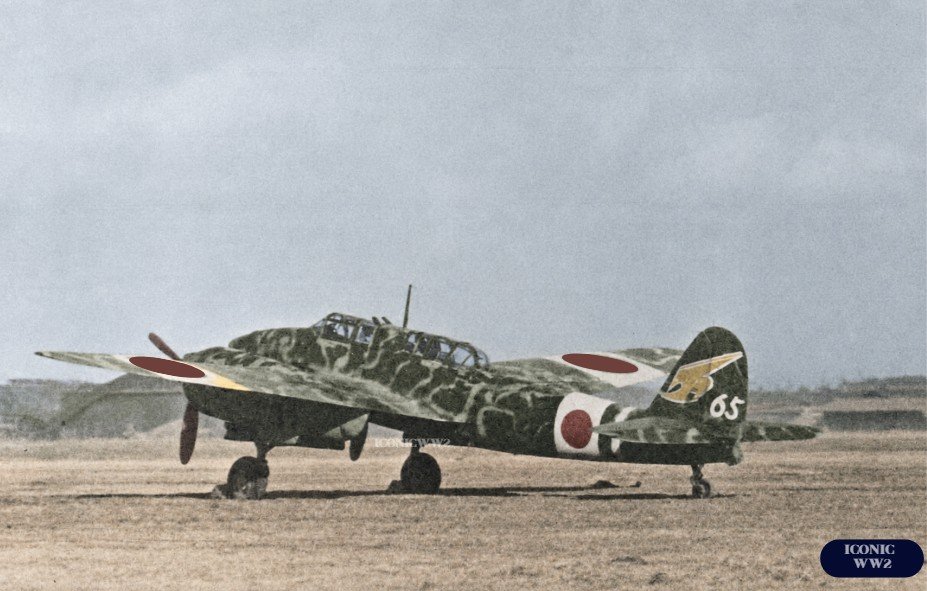
In 1937 the Imperial Japanese Navy issued a requirement of almost impossible severity: a carrier fighter combining great speed, heavy armament, phenomenal range and the agility to out-dogfight anything in the sky. Most engineers thought it could not be done with the modest engine power Japan had available. Jiro Horikoshi of Mitsubishi found the answer in a single ruthless principle — save weight at any cost.
Every gram was hunted down. Horikoshi adopted a new lightweight aluminium alloy, pared the structure to the minimum, and omitted the armour plate and self-sealing fuel tanks that protected Western fighters. The result, first flown on 1 April 1939, achieved its astonishing range and agility by sacrificing almost everything else. Named for the Japanese year 2600 of its acceptance, it became the Zero.
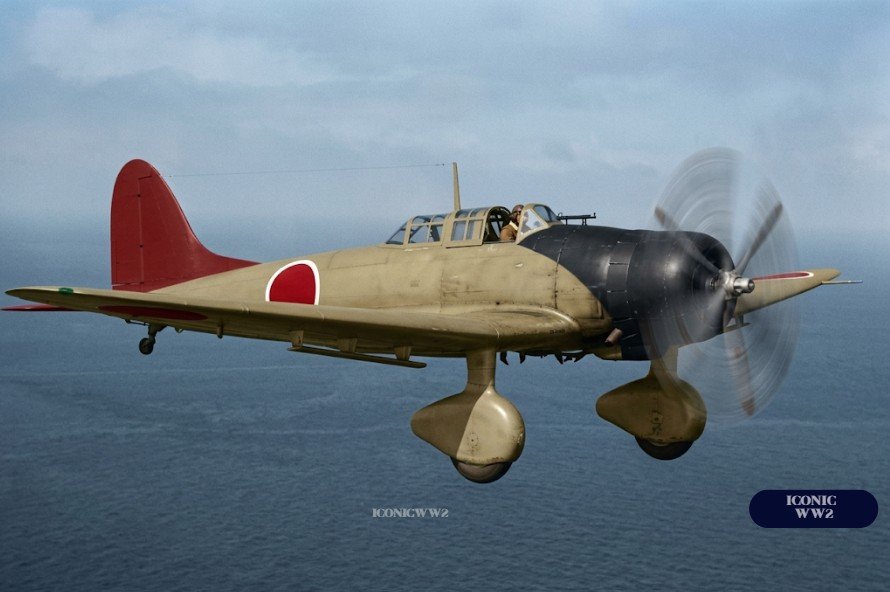
When it entered combat the Zero was simply the finest carrier fighter in the world. The A6M2 could turn inside any Allied fighter, climb with them and outrange them by hundreds of miles, and its two 20 mm cannon hit hard; Allied pilots learned the hard way never to dogfight a Zero at low speed.
But the very lightness that made it lethal also doomed it. With no armour and unprotected tanks, the Zero burned or broke up under a brief burst of fire that a heavier fighter would have shrugged off. It was a machine with no margin for the war’s second half: as Allied aircraft grew faster, tougher and better armed, the Zero’s early advantages slipped away — and Japan, fatally, never produced a successor in time to replace it.
Nearly 11,000 were built, more than any other Japanese aircraft. The early A6M2 that escorted the Pearl Harbor strike gave way to the clipped-wing A6M3 and then to the most-produced version, the A6M5, which gained a stronger structure and improved diving speed in an effort to keep pace with its tormentors.
Later sub-types finally added the armour and self-sealing tanks the design had originally rejected, along with heavier armament, but the extra weight blunted the agility that was the Zero’s whole reason for being. There were also floatplane fighter (A6M2-N) and two-seat trainer versions, keeping the ubiquitous airframe in service in every role the Navy needed.
For the first six months of the Pacific war the Zero was, quite simply, invincible. On 7 December 1941 it flew top cover over Pearl Harbor and strafed the airfields; on the same day, Zeros ranging from Formosa fell on the Philippines and destroyed much of the US Far East Air Force — a strike flown over a 1,000 km round trip so far beyond what the Americans believed possible that they at first refused to accept land-based fighters had done it.
The rampage rolled on across Malaya, the Dutch East Indies and northern Australia, brushing aside Brewster Buffaloes, P-40s and Hurricanes wherever they rose, and reaching Darwin in February 1942. That April the carriers of the Kidō Butai carried the Zero into the Indian Ocean, overwhelming the RAF’s Hurricanes over Ceylon and helping to sink a British carrier and two heavy cruisers. Allied intelligence had dismissed pre-war warnings of a superlative Japanese fighter; now their pilots were simply told never to dogfight one. For half a year the Zero owned the skies over a third of the globe.
What made the Zero strategically different was neither speed nor agility but reach: with a drop tank it could fly around 3,100 km, and its pilots cruised lean at low revolutions to stretch every litre. Zeros escorted bombers from Formosa to the Philippines on the war’s first day — a 1,000 km round trip no Allied fighter could have made.
From Rabaul, the crack Tainan Kōkūtai flew 1,000 km each way to fight over Guadalcanal, day after day — the longest sustained fighter missions of the war, and a grinding drain on even elite pilots. It was in this unit that aces like Saburō Sakai (some 60 claims) made the Zero’s legend; Sakai’s five-hour return to Rabaul in August 1942, half-blinded by a head wound, remains one of aviation’s great survival stories.
For a year the Zero carried all before it — from Pearl Harbor to Ceylon, no Allied fighter could live with it in a turning fight. What broke the spell was not a single better aeroplane but a systematic effort to understand it. In July 1942 a nearly intact Zero was recovered from a bog in the Aleutians and shipped to San Diego, where American test pilots flew it and catalogued its flaws: controls that grew heavy and stiff at speed, a poor roll to the right, and an engine that cut out under negative G. Now the Allies knew exactly how to kill it.
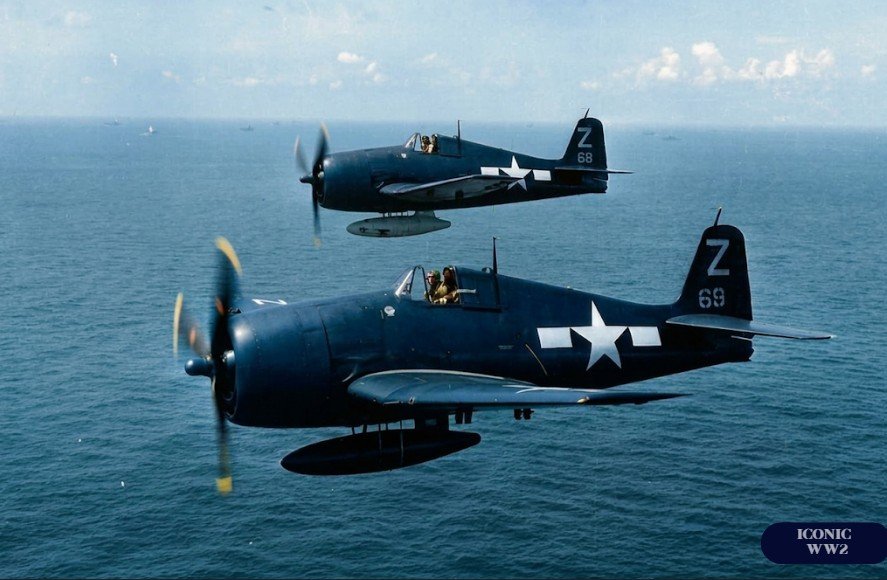
The lessons were written into new tactics and new fighters. Pilots were taught never to dogfight a Zero but to use speed and the dive and to fight in pairs — the Thach Weave, first flown on the Wildcat at Midway. Then came the machines built to those lessons: the fast, heavily built Corsair, the P-38 Lightning that dived through Zero formations, and above all the F6F Hellcat, which ran up a crushing kill ratio over the type. As Japan’s pool of irreplaceable veteran pilots drained away at Midway and in the Marianas, the Zero’s dominance collapsed — and by 1944, outclassed and flown by half-trained boys, many were loaded with a bomb and expended as kamikaze.
The Mitsubishi A6M Zero was the symbol of Japanese naval air power throughout the war — at its debut a world-beater that stunned the Allies, and at its end a tragic emblem of a nation fighting on with obsolete weapons and untrained boys. Few aircraft have ever risen so high or fallen so far in the space of four years.
Its fate was written into its design. Horikoshi achieved the Zero’s range and agility by gambling everything on lightness, and when the Allies changed the terms of the air war — heavier fighters, dive-and-zoom tactics, armour and self-sealing tanks — that gamble could not be revised without redesigning the aircraft. Japan never did: roughly 10,939 were built, and the Zero fought its last battles in 1945 substantially as it had been built in 1940.
- Jirō Horikoshi, Eagles of Mitsubishi: The Story of the Zero Fighter (University of Washington Press, 1981) — by the Zero’s own designer.
- Robert C. Mikesh, Zero: Combat & Development History of Japan’s Legendary Mitsubishi A6M Zero Fighter (Motorbooks, 1994).
- Ikuhiko Hata & Yasuho Izawa, Japanese Naval Aces and Fighter Units in World War II (Naval Institute Press).
- Saburō Sakai, with Martin Caidin & Fred Saito, Samurai! (1957) — the memoir of the Zero ace.
Iconic WW2 is free, ad-free and tracker-free — kept going only by the time it takes to research, restore and colorize each machine. If this profile was worth your read, you can help the archive grow.
| Manufacturer | Mitsubishi |
| Designer | Jiro Horikoshi |
| Nation | Japan |
| Role | Carrier fighter |
| First Flight | 1 April 1939 |
| In Production | 1940 – 1945 |
| Units Built | ~10,939 |
| A6M2 | Pearl Harbor era |
| A6M3 | Clipped-wing, 1942 |
| A6M5 | Most-produced, 1943 |
| A6M7 | Fighter-bomber, 1944 |
| Engine | Nakajima Sakae radial |
| Type | 14-cyl air-cooled radial |
| Power | 940 – 1,130 hp |
| Feature | Exceptional fuel economy |
| Max Speed | 565 km/h |
| Service Ceiling | ~11,700 m |
| Range | ~1,900 km (combat) |
| Climb Rate | ~15 m/s |
| Wingspan | 11.00 m |
| Length | 9.06 m |
| Height | 3.05 m |
| Wing Area | 21.30 m² |
| Empty Weight | 1,680 kg |
| Max Takeoff | 2,733 kg |
| Cannon | 2× 20mm Type 99 |
| Machine Guns | 2× 7.7mm Type 97 |
| Bombs (optional) | 2× 60 kg / kamikaze load |