The Macchi C.200 Saetta (“Lightning Bolt”) was born from a 1936 Regia Aeronautica requirement for a modern, all-metal monoplane fighter to replace the fabric-and-wire biplanes that still equipped Italy’s fighter squadrons. The task fell to Mario Castoldi, the brilliant Macchi designer behind the M.C.72 racing seaplanes, which in 1934 set a world speed record for piston-engined floatplanes of over 709 km/h that has never been beaten.
Castoldi faced a fundamental constraint: Italy had no reliable high-power inline engine in production. He therefore designed the Saetta around the air-cooled Fiat A.74 RC.38 radial, accepting the aerodynamic penalty of its broad frontal area in exchange for proven reliability. The prototype first flew on 24 December 1937.
The Saetta won the 1938 fighter competition against rivals from Fiat, Reggiane and others and was ordered into production, but early service revealed a dangerous vice: the aircraft would drop a wing and spin without warning. The cause was traced to the wing geometry, and a revised outer wing with washout cured it.
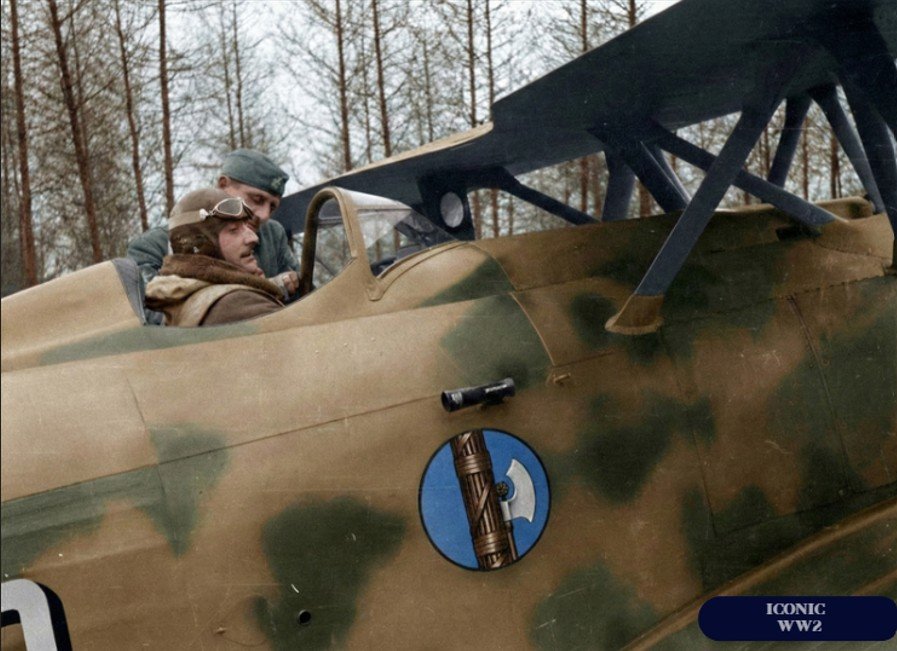
More telling was a cultural clash. The Saetta had entered service with a fully enclosed, faired cockpit, but Regia Aeronautica pilots — steeped in the open-cockpit tradition of aerobatic biplane flying — distrusted it and complained of poor visibility. Production aircraft were progressively changed to a semi-enclosed, then a fully open cockpit: a rare reversal that says much about the conservative instincts of Italy’s pre-war fighter arm. The type was mass-produced by Macchi, Breda and SAI-Ambrosini.
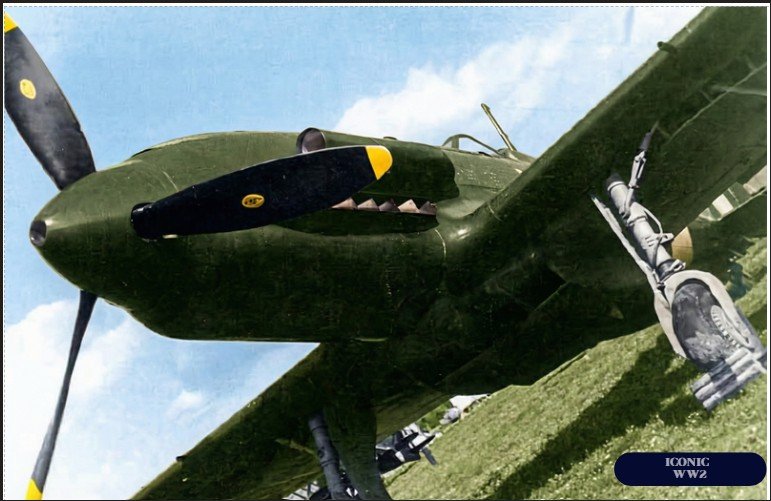
The Saetta’s figures were honest mid-1930s state of the art: the 870 hp Fiat A.74 RC.38 radial gave 504 km/h at 4,500 m, a service ceiling near 8,900 m, and a climb to 5,000 m in about six minutes. The humped cockpit that gave it the nickname “Gobbo” (hunchback) bought superb visibility over the nose.
Armament was the standard Italian pair of 12.7 mm Breda-SAFAT machine guns, synchronised through the propeller — around 370 rounds each. It was too little against bombers, but the guns were reliable, and the airframe behind them was stressed for dives that would break lighter fighters: pilots learned to fight the Saetta in the vertical, where the sturdy radial and strong wing gave them the advantage.
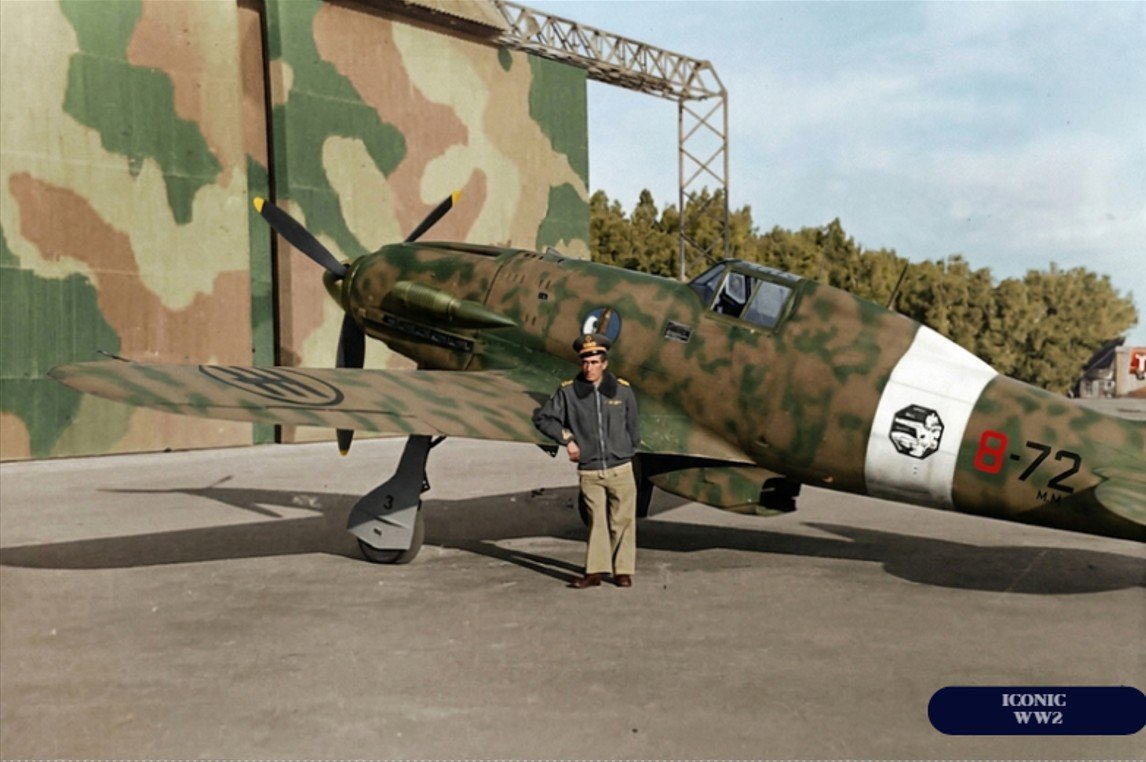
Production spanned several sub-types. Beyond the early closed-canopy machines and the definitive open-cockpit standard, the principal variants were the C.200 CB (Caccia Bombardiere), a fighter-bomber able to carry light bombs or drop tanks under the wings, and the tropicalised C.200 AS (Africa Settentrionale) fitted with sand filters for desert operations.
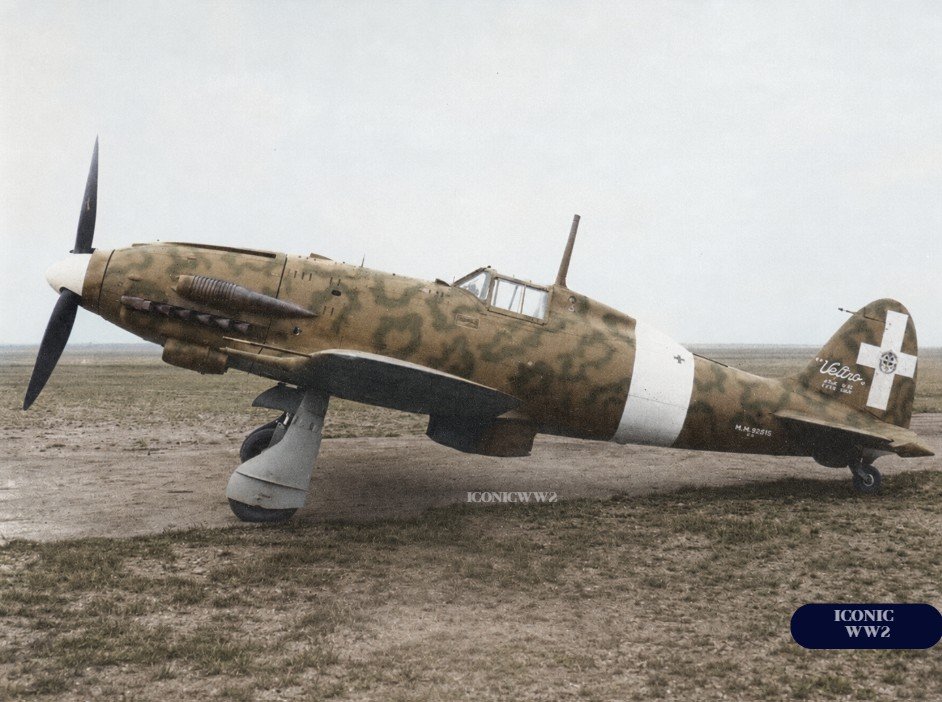
Most significant of all was what the airframe became. Mating the Saetta’s clean structure to a licence-built Daimler-Benz DB 601 inline engine produced the C.202 Folgore — and, in turn, the C.205 Veltro. The Saetta was thus the direct ancestor of Italy’s finest wartime fighters.
When Italy entered the war in June 1940 around 150 Saettas were in service, and the type went on to fight on nearly every front the Regia Aeronautica engaged. It flew convoy escort and interception over the Mediterranean and Malta, ground attack and fighter sweeps across North Africa, and operations over Greece and the Balkans.
Outpaced in level speed by the best Allied fighters and armed with only two machine guns, the Saetta was never a world-beater on paper. But it was strong, forgiving and superbly manoeuvrable, a steady gun platform that could absorb heavy battle damage and still bring its pilot home — qualities that earned it deep affection from the men who flew it, even as newer types arrived.
Perhaps its most distinguished service came far from Italy, on the Eastern Front. From August 1941 the Saettas of the 22° Gruppo Autonomo, part of the Italian expeditionary corps in Russia (the CSIR), flew escort and ground-attack sorties over the southern steppe alongside the advancing Axis armies.
In the low-altitude fighting that prevailed there — where the Saetta’s agility and rugged radial counted for more than top speed — its pilots claimed a distinctly favourable kill ratio against Soviet aircraft for very light losses, among the better records of any Italian unit in the war. Fitted with racks for light bombs, the Saettas also flew ground-attack over the Don and the approaches to Stalingrad. It was a reminder that in the right conditions, and the right hands, the little Lightning Bolt was still a dangerous adversary.
Around 1,150 Saettas were built, making it one of the most numerous Italian fighters of the war. It was the Regia Aeronautica’s first modern monoplane fighter to serve in large numbers — a genuinely transitional aircraft, under-gunned and under-powered against front-line opposition, yet rugged, agile and deeply trusted by those who flew it.
Its lasting importance lies less in its own combat record than in its bloodline: the Saetta’s airframe, re-engined and refined, became the Folgore and the Veltro. In that sense every great Italian fighter of the war traced its lineage directly back to Castoldi’s patient little radial-engined Lightning Bolt.
- Chris Dunning, Courage Alone: The Italian Air Force 1940–1943 (Hikoki Publications).
- Jonathan W. Thompson, Italian Civil and Military Aircraft 1930–1945 (Aero Publishers).
- Håkan Gustavsson & Ludovico Slongo, Desert Prelude 1940–41 (MMP/Stratus).
Iconic WW2 is free, ad-free and tracker-free — kept going only by the time it takes to research, restore and colorize each machine. If this profile was worth your read, you can help the archive grow.
| Manufacturer | Aeronautica Macchi |
| Designer | Mario Castoldi |
| Nation | Italy |
| Role | Fighter |
| First Flight | 24 December 1937 |
| Service Entry | 1939 |
| Units Built | ~1,150 |
| C.200 (early) | Enclosed cockpit |
| C.200 (standard) | Open cockpit |
| C.200 CB | Fighter-bomber |
| C.200 AS | Tropicalised, North Africa |
| Engine | Fiat A.74 RC.38 |
| Type | 14-cyl air-cooled radial |
| Power | 870 hp |
| Feature | Air-cooled radial, low maintenance |
| Max Speed | 504 km/h @ 4,500 m |
| Service Ceiling | ~8,900 m |
| Range | ~870 km |
| Climb Rate | ~14 m/s |
| Wingspan | 10.58 m |
| Length | 8.19 m |
| Height | 3.51 m |
| Wing Area | 16.82 m² |
| Empty Weight | 1,964 kg |
| Max Takeoff | 2,395 kg |
| Machine Guns | 2× 12.7mm Breda-SAFAT |
| Bombs (C.200 CB) | 2× 160 kg |