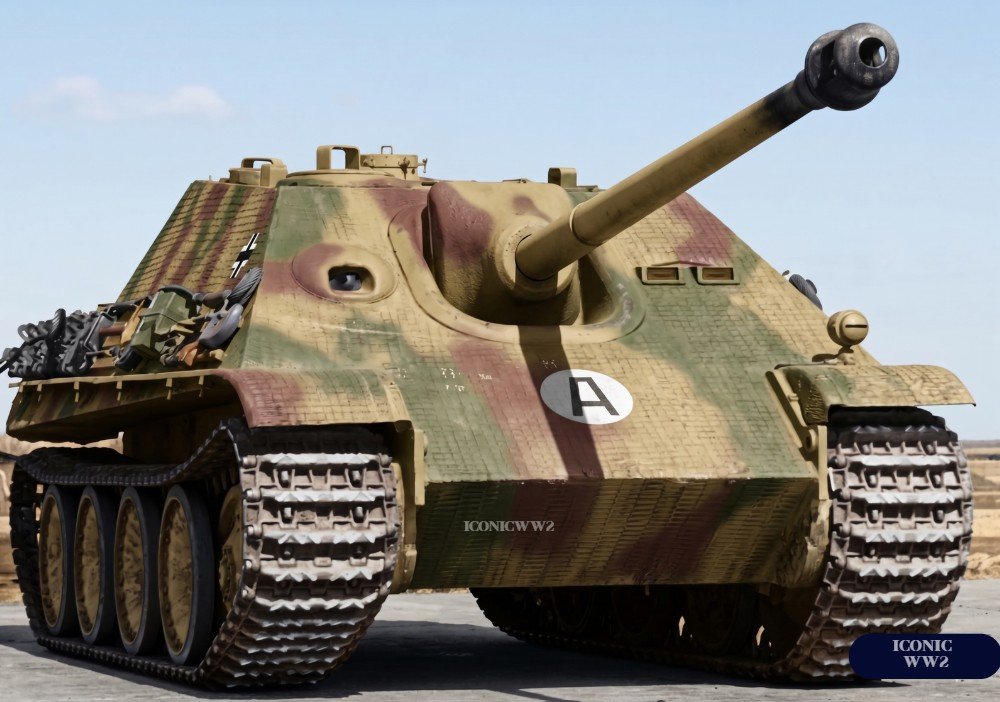
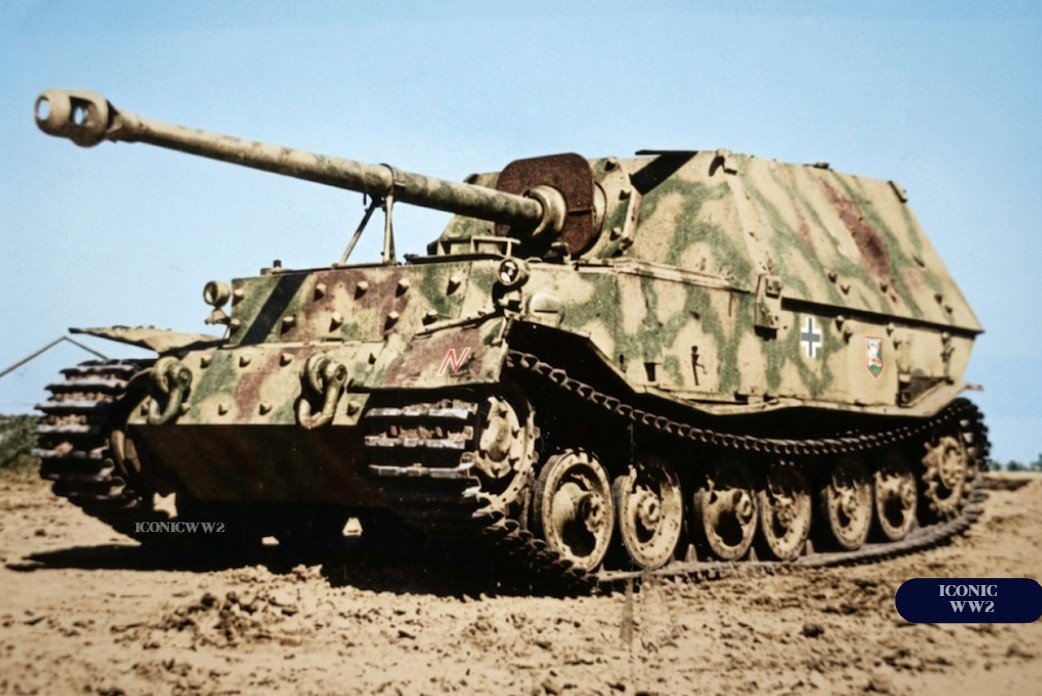
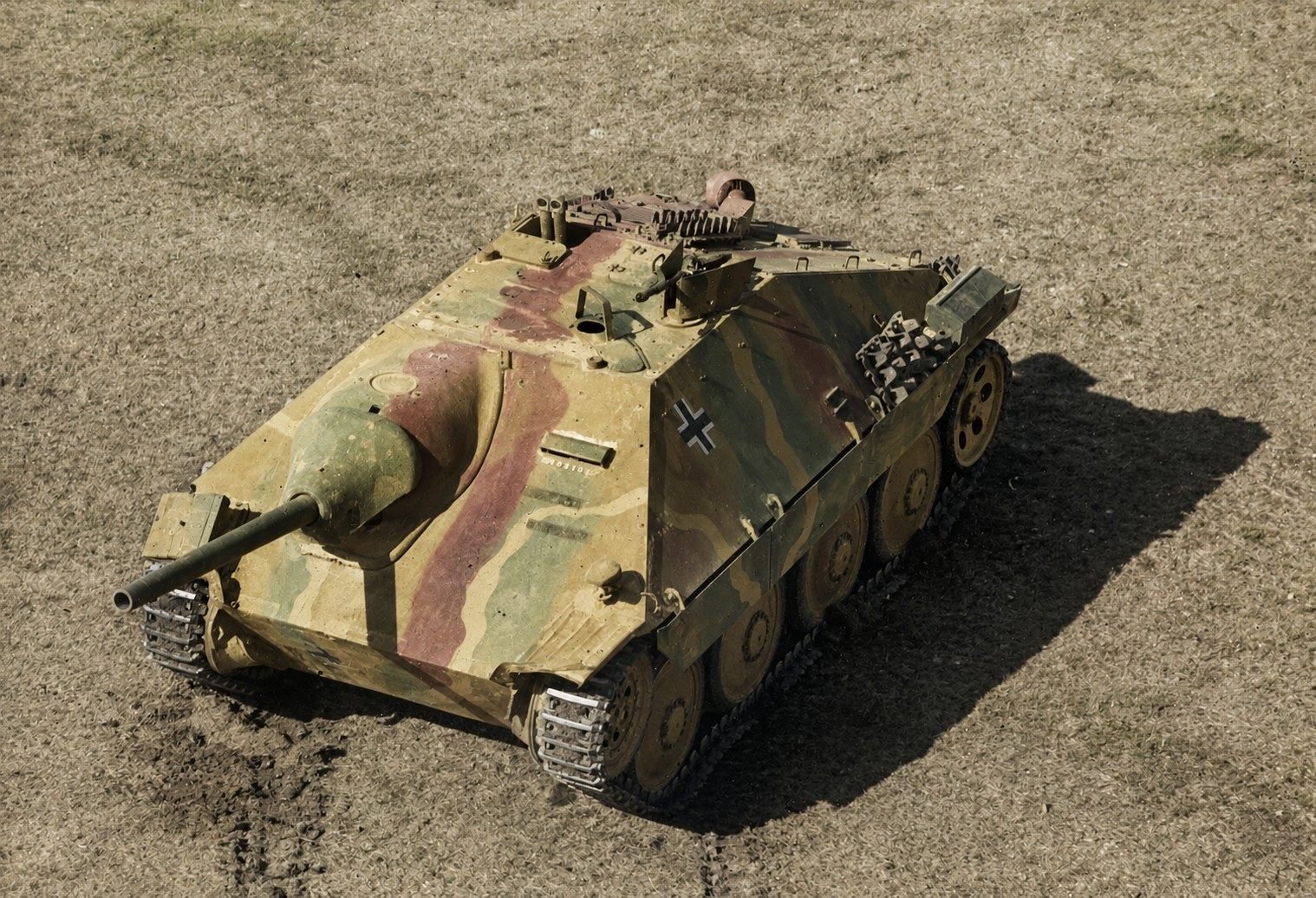
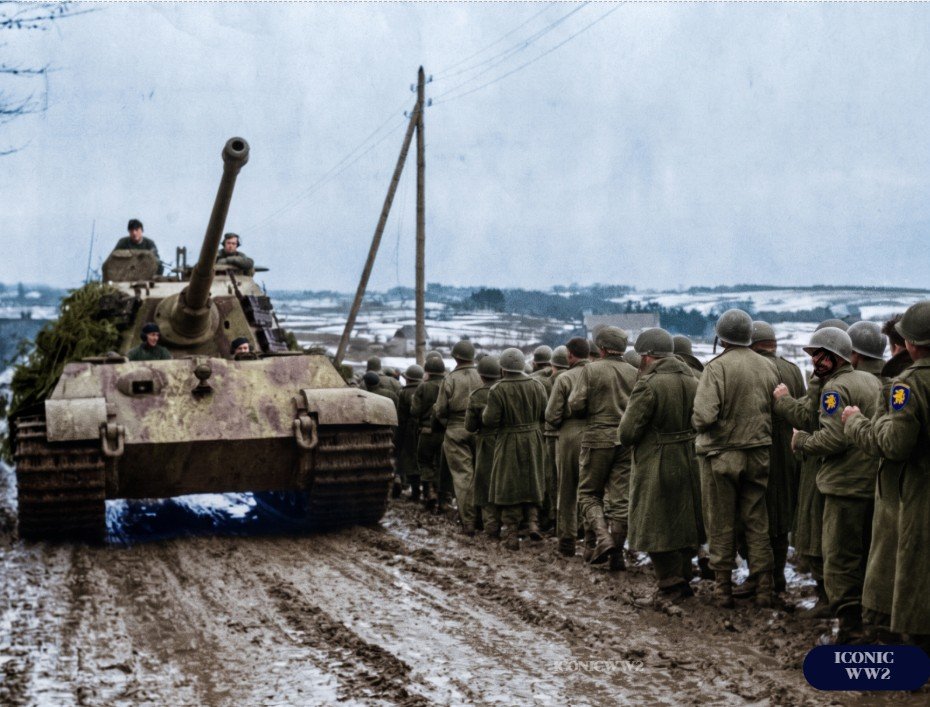
The Jagdtiger was the end of the line. At 71.7 tonnes it was the heaviest armoured fighting vehicle to see combat in the Second World War, and it carried the most powerful anti-tank gun any nation put into service: a 12.8 cm PaK 44, behind a casemate front 250 mm thick. On paper it was invincible — a machine that could destroy any Allied tank long before that tank could scratch it.
In practice it was one of the war’s great follies. Fewer than a hundred were built, they broke down constantly, and most of those the Allies found had been blown up by their own crews rather than knocked out in battle. The Jagdtiger is the point at which Germany’s pursuit of ever-heavier armour stopped being a weapon and became a liability.
The recipe was simple enough: take the chassis of the Tiger II, already the heaviest tank in service, lengthen it, and replace the turret with a tall fixed casemate housing a gun too big for any turret to carry. The result was built at the Nibelungenwerk at St. Valentin from July 1944, and designated Panzerjäger Tiger Ausf. B — Sd.Kfz. 186.
Two suspension systems were used. The first eleven vehicles rode on a Porsche design with eight road-wheel pairs, intended to save weight and steel; the rest used the standard Henschel torsion-bar arrangement with nine. Of 150 ordered, only around 70 to 85 were ever completed before the works were overrun — the exact figure is still disputed.
The reason for all that weight sat in the casemate: the 12.8 cm PaK 44 L/55, the heaviest anti-tank gun to reach service with any army in the war. It fired a shell that could smash through the frontal armour of any Allied tank at ranges far beyond those at which a M4 Sherman or a T-34 could reply — the Jagdtiger could, in theory, kill at distances where it was simply untouchable.
Its protection matched. The casemate front was 250 mm of steel and the hull glacis 150 mm; nothing in the Allied inventory could penetrate it head-on. Where a Jagdtiger could be brought to a firing position and left there, dug in and facing the right way, it was the most formidable defensive weapon on the battlefield. The problem was getting it there.
Driving 71.7 tonnes was the same Maybach HL230 V-12 that powered the Panther and the Tiger II — around 600 hp, giving a power-to-weight ratio of roughly 8 hp per tonne, a figure that would have been poor for a tractor. Top speed was 34 km/h on a good road, and range just 120 km on roads and 80 km across country.
Worse, the drivetrain could not cope. Transmissions and final drives failed under the stress of turning that much weight, and the long gun was heavy enough that cross-country travel could knock it out of alignment, forcing the crew to re-zero it. A Jagdtiger that broke down was, for practical purposes, lost: no German recovery vehicle could tow it, and a 72-tonne casualty could not be dragged clear of an advancing enemy.
The first vehicles reached their units in September 1944, going to just two formations: schwere Panzerjäger-Abteilung 512 and 653. They arrived into a war already lost, on fronts collapsing faster than a 34 km/h vehicle could redeploy along them.
They fought in the West through the winter battles of 1944–45 — the first Jagdtiger was lost during Operation Nordwind in January 1945, and they saw action at Auenheim that same month — and in the final defence of Germany, including operations around Iserlohn in April 1945. A handful also went east. Everywhere the story was the same: the gun worked magnificently, and the vehicle carrying it did not.
No statistic captures the Jagdtiger better than the record of the 2nd Company of the 512th, commanded by Otto Carius — one of Germany’s great tank aces, a man who had destroyed scores of Soviet tanks from a Tiger. His company had ten Jagdtigers: the most powerful armoured vehicles on earth.
Between them they destroyed one American tank. One was lost to enemy action, one to friendly fire, and eight were abandoned and blown up by their own crews after breaking down or running dry. Across the whole type only about 20% of Jagdtigers were lost to the enemy at all; the rest were destroyed by the men who drove them. Carius himself came to regard the machine as a waste of the men and steel poured into it.
The Jagdtiger is what happens when a doctrine follows its own logic past the point of sense. Every step — a bigger gun, thicker armour, therefore more weight, therefore a stressed drivetrain — was individually reasonable, and the end product was an armoured vehicle that spent most of its short career immobile, out of fuel, or being demolished by its crew at the roadside.
It was, genuinely, the most powerful anti-tank weapon of the war, and in a static defensive position very nearly unkillable. But Germany in 1945 had no fuel, no recovery capability and no stable front to defend, and so the heaviest fighting vehicle ever built achieved almost nothing. Three survive today — at Bovington, Fort Benning and Kubinka — vast, silent and, even now, faintly absurd.
- Peter Chamberlain & Hilary L. Doyle, Encyclopedia of German Tanks of World War Two (Arms & Armour Press).
- Thomas L. Jentz & Hilary L. Doyle, Germany’s Tiger Tanks: VK45.02 to Tiger II (Schiffer).
- Otto Carius, Tigers in the Mud (Stackpole Books) — memoir of the 2nd Company, s.Pz.Jg.Abt. 512.
- Walter J. Spielberger, Tigers I and II and their Variants (Schiffer).
Iconic WW2 is free, ad-free and tracker-free — kept going only by the time it takes to research, restore and colorize each machine. If this profile was worth your read, you can help the archive grow.
| Designation | Panzerjäger Tiger Ausf. B (Sd.Kfz. 186) |
| Builder | Nibelungenwerk, St. Valentin |
| Nation | Germany |
| Role | Heavy tank destroyer |
| Crew | 6 |
| Built | ~70–85 (of 150 ordered) |
| Porsche suspension | 8 road-wheel pairs — 11 built |
| Henschel suspension | 9 road-wheel pairs — the rest |
| Serial range | 305001–305088 |
| Survivors | 3 (Bovington, Fort Benning, Kubinka) |
| Engine | Maybach HL230 P30 V-12 |
| Power | ~600 hp |
| Power/weight | ~8 hp per tonne |
| Fuel | 860 litres |
| Max road speed | 34 km/h |
| Range (road) | 120 km |
| Range (off-road) | 80 km |
| Weakness | Transmission and final drives failed under the weight |
| Combat weight | 71.7 t |
| Length (with gun) | 10.65 m |
| Width | 3.6 m |
| Height | 2.8 m |
| Main gun | 12.8 cm PaK 44 L/55 |
| Secondary | 1× 7.92 mm MG 34 (glacis) |
| Casemate front | 250 mm |
| Hull front / sides | 150 mm / 80 mm |