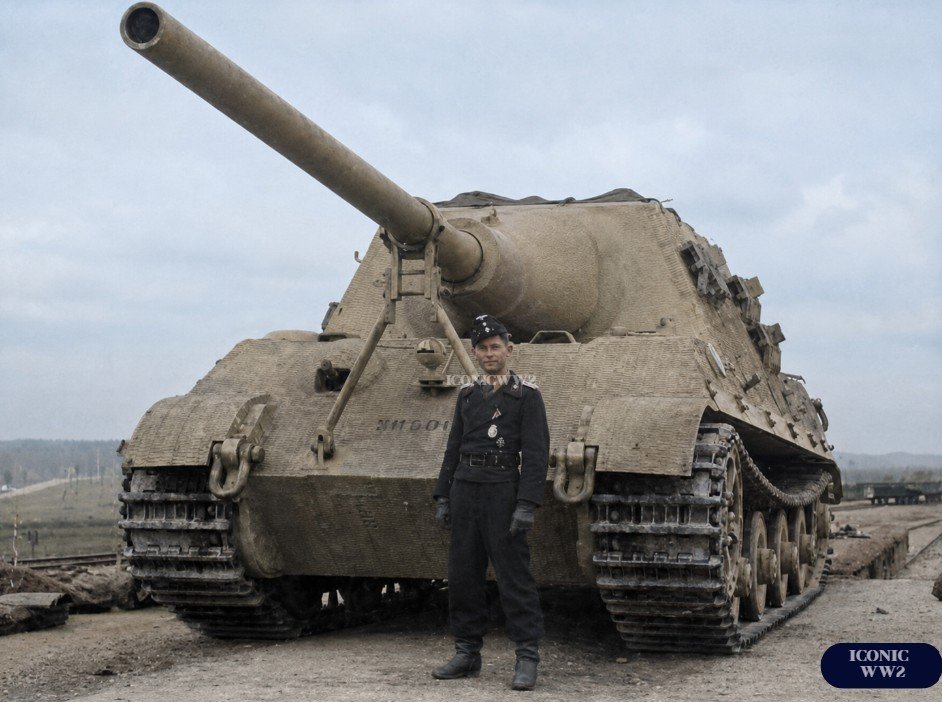
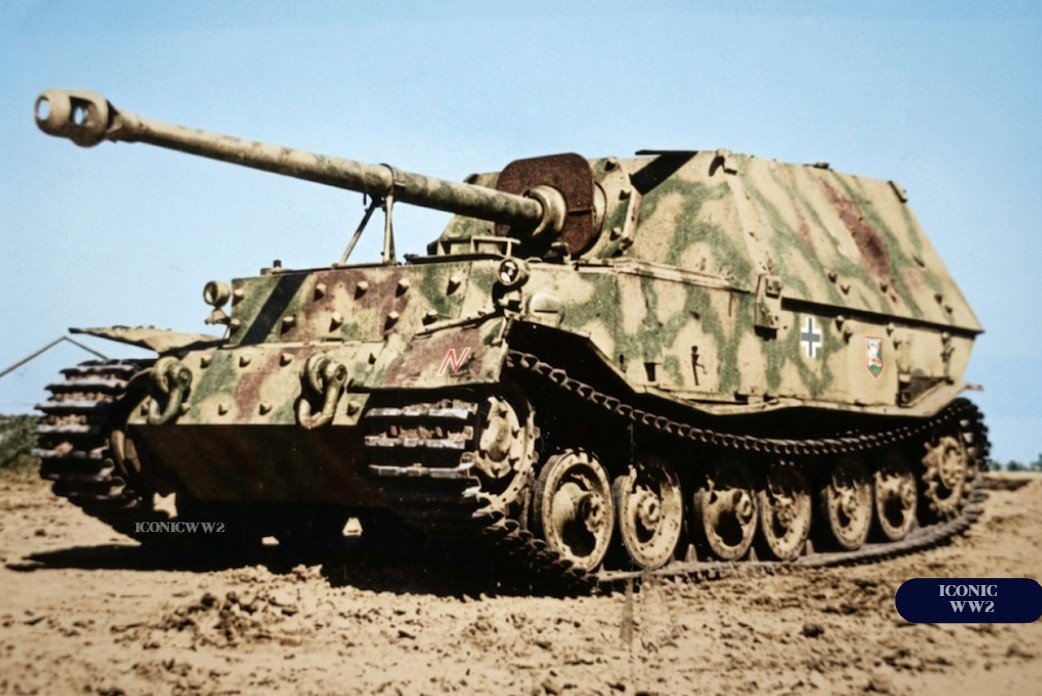
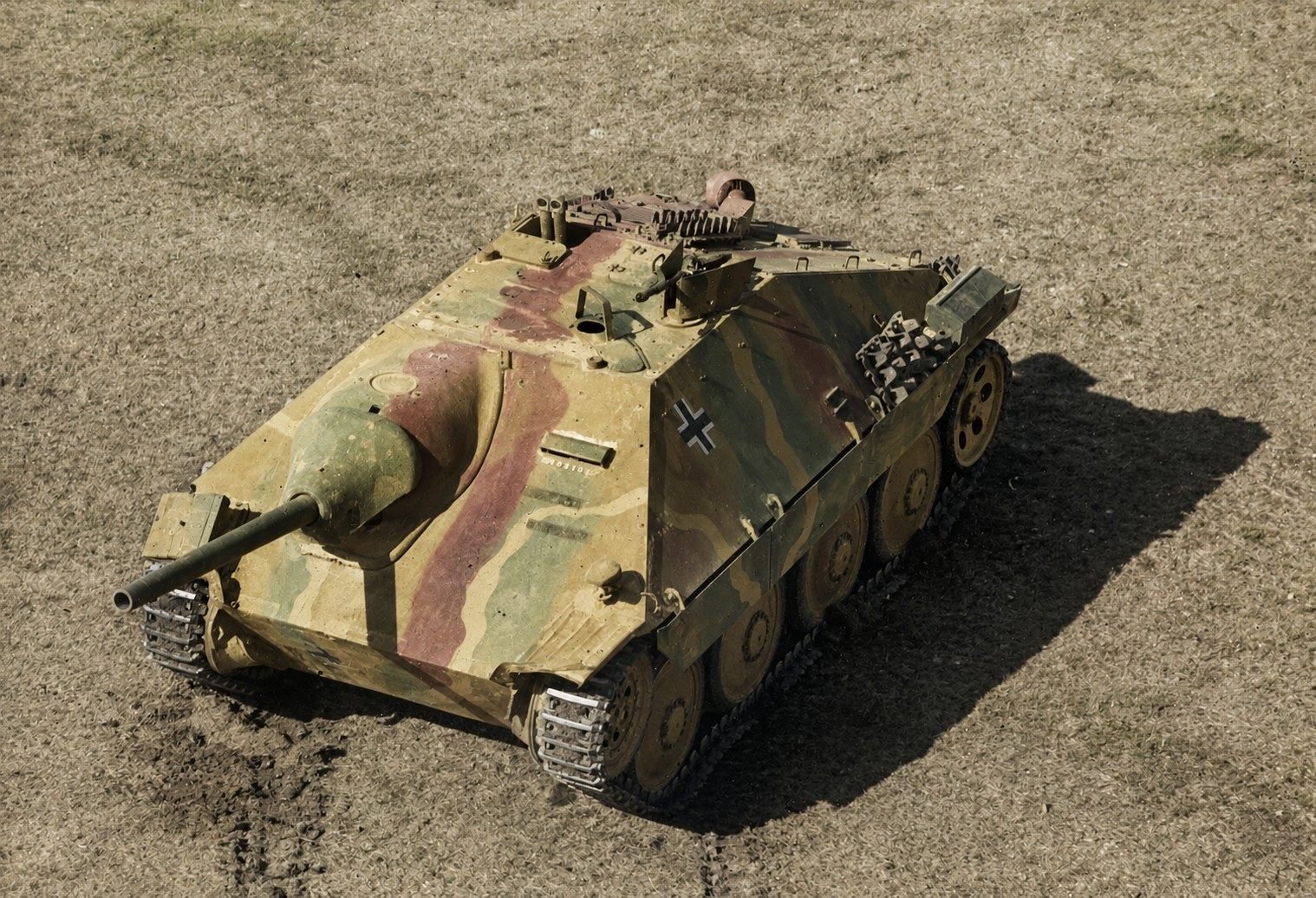
By 1943 Germany had two outstanding weapons that did not yet sit in the same vehicle: the superb Panther chassis, with its sloped armour and 700 hp engine, and the 8.8 cm PaK 43 anti-tank gun, an L/71 weapon so long and powerful that it could defeat almost any Allied tank at well over 2,000 m. The PaK 43 was too large for the Panther's turret, but mounting it in a fixed casemate on the same hull promised a tank destroyer of exceptional balance.
Ordered as the schwerer Panzerjäger 8.8 cm PaK 43 auf Fahrgestell Panther — designation Sd.Kfz. 173 — the vehicle was named Jagdpanther ("hunting panther") on Hitler's personal instruction in early 1944. It entered production in January 1944 at MIAG, later joined by MNH.
The Jagdpanther's gun was the 8.8 cm PaK 43/3 L/71, the same calibre and barrel length as the Tiger II's weapon. Firing the PzGr 39/43 it penetrated roughly 203 mm of armour at 1,000 m, and with the tungsten PzGr 40/43 around 237 mm — figures that left no Allied or Soviet tank safe at normal combat range. Around 57 rounds were stowed, served by a five-man crew with one bow 7.92 mm MG 34.
Protection came from the Panther's well-shaped hull extended into a low casemate: an 80 mm glacis sloped at 55°, giving an effective thickness of roughly 140 mm, with 50 mm sides. At about 45.5 t the vehicle kept the Panther's Maybach HL 230 P30 V-12 petrol engine of ~700 hp, good for ~46 km/h on road and a range near 210 km.
The weaknesses were inherited too. The Panther's final drives were chronically overstressed and failure-prone, and the long L/71 barrel overhanging the nose made the Jagdpanther nose-heavy and awkward in close country. Like the Panther, it was a powerful machine that demanded careful handling and constant maintenance.
The Jagdpanther changed little across its short production life, but two main batches are distinguished. Early vehicles mounted the one-piece PaK 43/3 barrel and a single, larger gun-mantlet ring; late vehicles adopted a two-piece barrel (easier to replace when worn) and a bolted, two-piece mantlet, along with the late Panther's twin engine-deck fans and other production simplifications.
Total output reached only about 415 vehicles before the war's end — a fraction of the demand. Persistent Allied bombing of the assembly plants and the broader collapse of German industry in 1944–45 kept the Jagdpanther rare, and unlike the StuG III it never became a mass-produced workhorse.
The Jagdpanther first saw action in Normandy in the summer of 1944, issued to independent heavy Panzerjäger battalions. Its most famous early engagement came on 30 July 1944 near Les Loges during the British Operation Bluecoat, when a handful of Jagdpanthers of the 654th Battalion knocked out several Churchill tanks in minutes before withdrawing — a sharp demonstration of the L/71 gun's reach.
That reach came from the superb 8.8 cm PaK 43 L/71, mounted in a low, well-sloped casemate on the reliable Panther hull. It could defeat almost any Allied or Soviet tank frontally at ranges beyond a kilometre, and its clean, purposeful shape made it, in the judgement of many, the finest tank destroyer of the war.
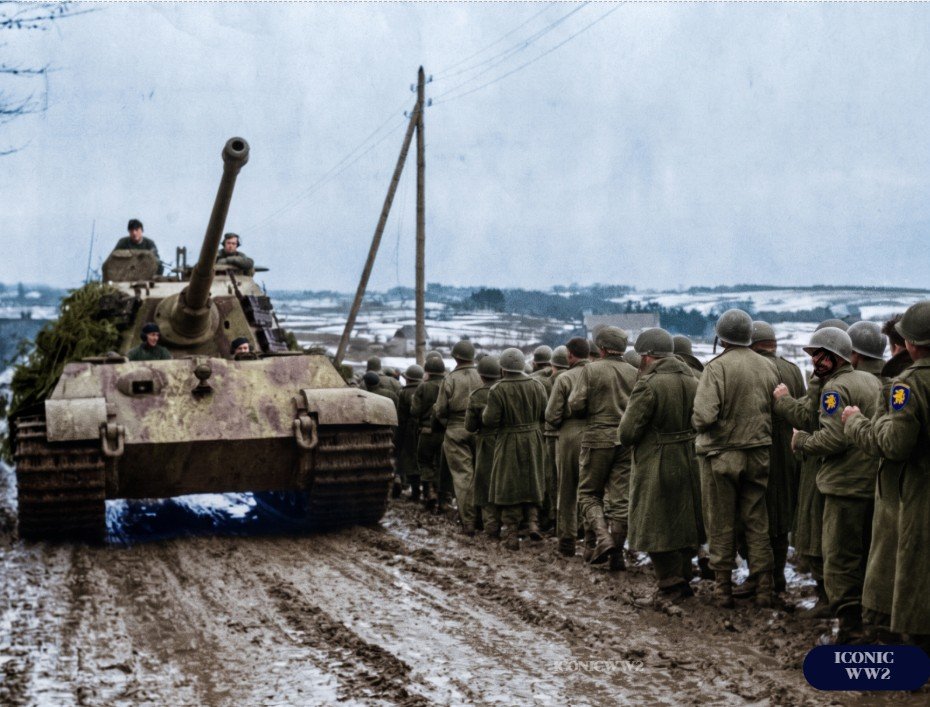
Thereafter the type fought on both fronts, in the Ardennes offensive of December 1944 and in the defensive battles in the East, always in small numbers. Used properly — fighting from ambush, from cover, at long range — it was a deadly defensive weapon that could destroy enemy armour before being seen. Committed carelessly in the open, its thin side armour and the strain on its drivetrain told against it.
As with all the late-war German cats, many losses were not to enemy fire but to breakdown, fuel shortage and abandonment. The Jagdpanther’s fighting record was therefore brilliant in detail but marginal in mass: barely 415 were built — too few, and too late, to alter the outcome.
The Jagdpanther is widely regarded as the best-balanced tank destroyer of the Second World War. It married the war's most effective anti-tank gun, the 8.8 cm L/71, to the war's best medium-tank chassis, achieving a combination of firepower, protection and mobility that no Allied tank destroyer matched.
But balance on paper could not overcome arithmetic. With only about 415 built, hampered by the Panther's fragile final drives and starved of fuel, it remained a superb weapon in a losing war — remembered for what a single well-handled vehicle could do, not for any influence on the result.
- Thomas L. Jentz & Hilary L. Doyle, Panzer Tracts No. 9-3: Jagdpanther.
- Hilary L. Doyle & Thomas L. Jentz, Jagdpanther Tank Destroyer 1943–45 (Osprey, New Vanguard).
- Walter J. Spielberger, Panther & Its Variants (Schiffer).
Iconic WW2 is free, ad-free and tracker-free — kept going only by the time it takes to research, restore and colorize each machine. If this profile was worth your read, you can help the archive grow.
| Manufacturer | MIAG (later MNH) |
| Nation | Germany |
| Role | Tank destroyer (casemate) |
| Designation | Sd.Kfz. 173 |
| Service Entry | 1944 |
| Crew | 5 (commander, gunner, loader, driver, radio/bow MG) |
| Units Built | ~415 |
| Engine | Maybach HL 230 P30 |
| Type | V-12 petrol |
| Power | ~700 hp |
| Transmission | ZF AK 7-200, 7-speed |
| Weak Point | Panther final drives |
| Road Speed | ~46 km/h |
| Cross-country Speed | ~25 km/h |
| Range (road) | ~210 km |
| Combat Weight | ~45.5 t |
| Length (with gun) | 9.87 m |
| Hull Length | 6.87 m |
| Width | 3.42 m |
| Height | 2.71 m |
| Combat Weight | ~45.5 t |
| Main Gun | 8.8 cm PaK 43/3 L/71 |
| Penetration | ~203 mm @ 1 km (PzGr 39/43) |
| Secondary | 1× 7.92 mm MG 34 |
| Ammunition | ~57 rounds |
| Glacis Armour | 80 mm @ 55° (≈140 mm eff.) |
| Side Armour | 50 mm |