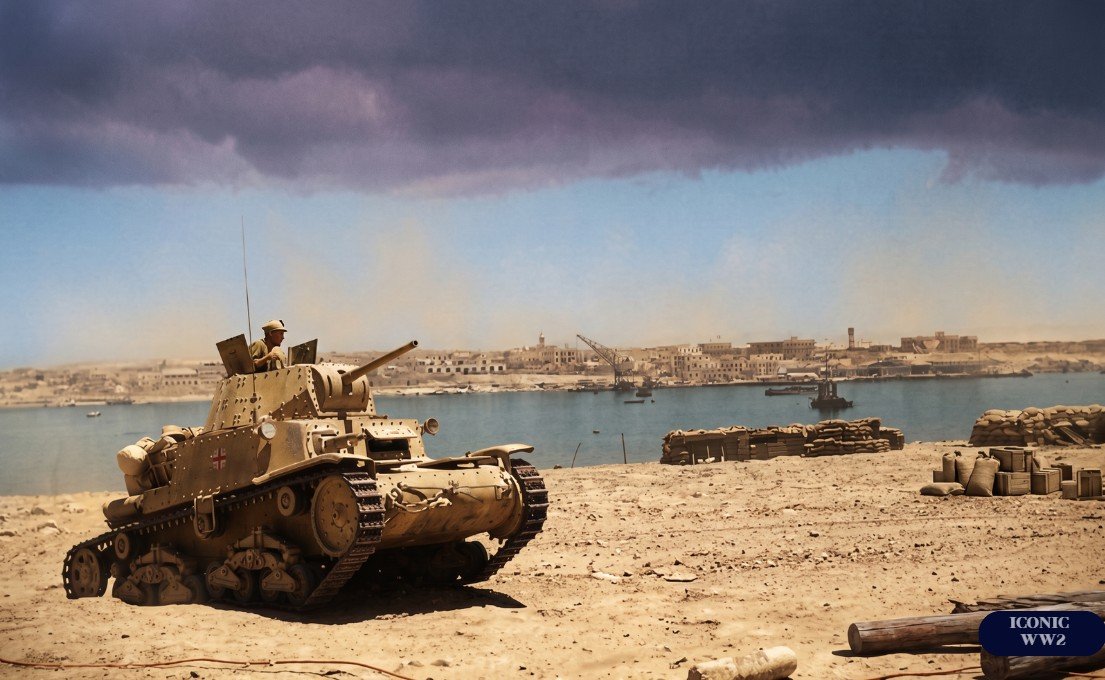
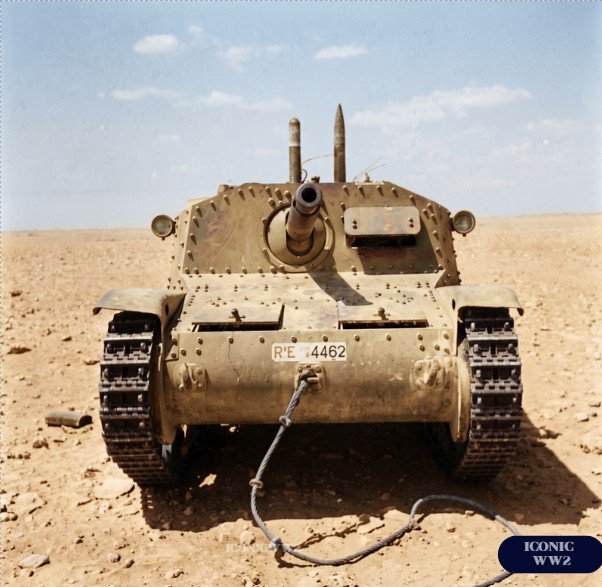
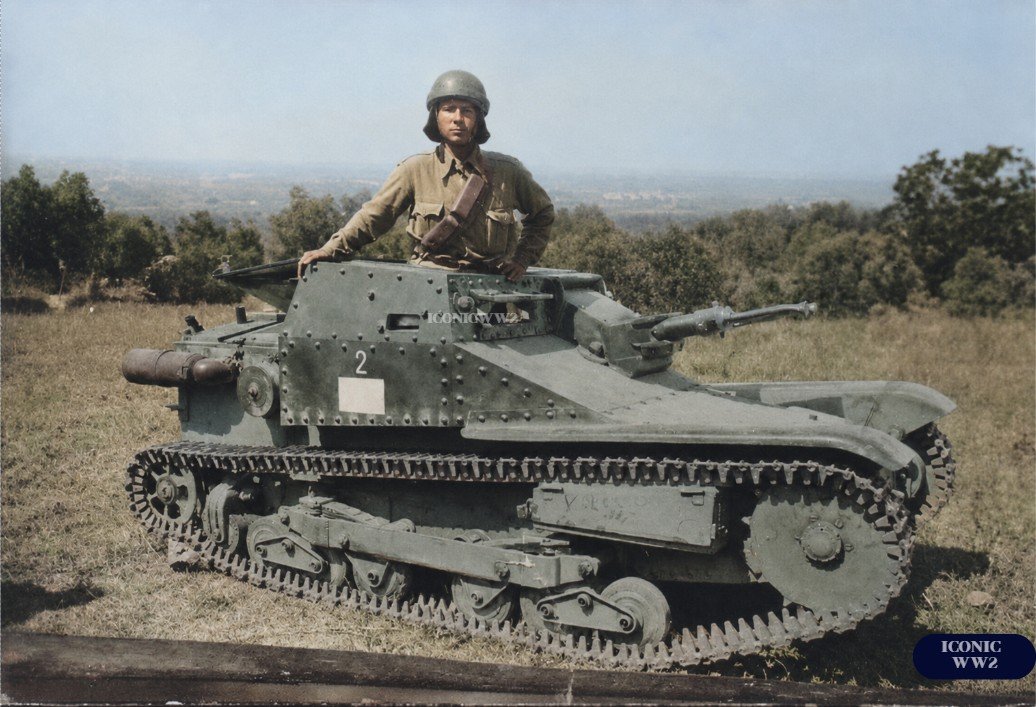
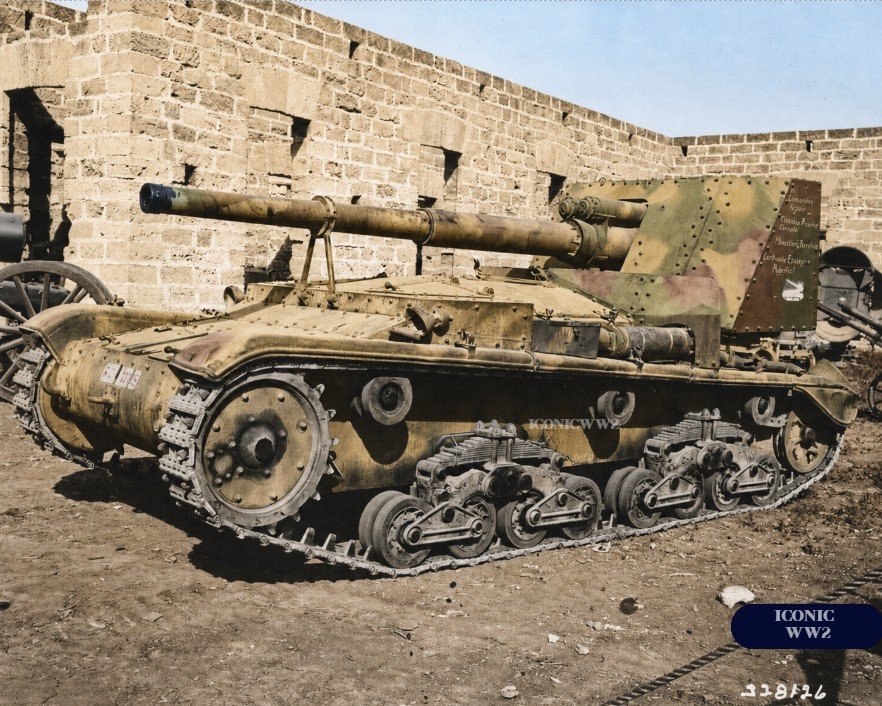
By 1940 the Regio Esercito knew its M-series medium tanks were too light, and it began work on a true carro pesante (heavy tank). The shock of meeting the Soviet T-34 on the Eastern Front in 1941 — reported back by Italian officers — sharpened the requirement, and the project crystallised as the Carro Armato P26/40: '26' for its tonnage, '40' for the design year.
Developed by Fiat-Ansaldo, the P40 was by far the most capable tank Italy ever put into production. But its gestation was painfully slow: design refinements, engine troubles and the chronic weakness of Italian industry meant that not a single example reached the troops before the armistice of September 1943 — by which point Italy was effectively out of the war it had been built for.
The P40 mounted a 75 mm Ansaldo 75/34 (L/34) gun in a fully traversing turret — a far more potent weapon than the 47 mm of the M-series, firing both armour-piercing and high-explosive rounds and broadly comparable to the short 75 mm guns of contemporary German and American mediums. A single 8 mm Breda 38 machine gun was carried, with provision for an anti-aircraft mount.
Armour was sloped and reached about 50 mm at the front — adequate, though no longer exceptional, by 1943 standards. The persistent problem was propulsion. The intended SPA 342 V12 petrol engine of ~330 hp was in chronically short supply, and many hulls were completed without engines or fitted with underpowered substitutes, leaving the ~26 t tank's planned 40 km/h road speed often unrealised.
Had it appeared in 1941 the P40 would have been a genuinely competitive medium tank. Arriving in 1943, against Shermans, T-34s and up-gunned Panzers, it was merely adequate — and produced in numbers far too small to matter.
Production was meagre: estimates run to only around 100 vehicles actually completed, the great majority after the Italian armistice and under German control. A self-propelled gun version was studied — mounting a 75/34 or the longer 105/25 in a casemate — but little came of it before the war ended.
Because so few left the factory before September 1943, the P40 is in practice a German story as much as an Italian one. The Germans, having seized the Fiat-Ansaldo plants, kept the line running for their own use, designating the tank the Panzerkampfwagen P40 737(i).
The P40’s only real campaign was fought in German hands in Italy. Vehicles taken over as the Pz.Kpfw. P40 737(i) served with German units against the Anzio beachhead in early 1944, where the 75 mm gun proved genuinely useful in the flat, canal-cut terrain around the perimeter.
Chronic engine shortages meant many hulls left Fiat-Ansaldo unpowered — so the Germans dug them in as armoured strongpoints, using P40 turrets and complete tanks as static pillboxes in the defences of the Gothic Line and around northern Italian cities. A tank designed to restore Italian mobile warfare ended the war, in the bitterest irony, as fixed fortification.
Almost no P40s saw service with the Italian army for which they were designed. After September 1943 the Germans took over the surviving and newly built vehicles and employed them on occupation and anti-partisan duties in Italy and the Balkans, and as static pillboxes dug in along defensive lines — including, reportedly, parts of the Italian and Western fronts — where their guns served as fixed strongpoints even when no engine was available.
In this role the P40's good gun and adequate armour had some value, but it never fought as the massed armoured spearhead its designers had imagined. The tank that was meant to give Italy a heavy-tank capability instead ended the war as a German auxiliary, scattered in ones and twos across secondary fronts.
The Carro Armato P26/40 is the might-have-been of Italian armour — the one design that could have stood in the line against the T-34 and Sherman, fatally delayed until the moment Italy left the war. Its 75/34 gun and 50 mm sloped armour were respectable; its tiny production run and engine shortages were not.
As a symbol it sums up the whole Italian armoured effort: sound enough ideas, defeated by weak industry and bad timing. That its handful of vehicles fought mostly under German colours, often as immobile gun positions, is a fitting and melancholy epitaph for Italy's most ambitious tank.
- Nicola Pignato & Filippo Cappellano, Gli Autoveicoli da Combattimento dell’Esercito Italiano (Ufficio Storico SME).
- Filippo Cappellano & Pier Paolo Battistelli, Italian Medium Tanks 1939–45 (Osprey, New Vanguard 195).
Iconic WW2 is free, ad-free and tracker-free — kept going only by the time it takes to research, restore and colorize each machine. If this profile was worth your read, you can help the archive grow.
| Manufacturer | Fiat-Ansaldo |
| Nation | Italy |
| Role | Heavy tank (~medium by 1943) |
| Service Entry | 1943 |
| Crew | 4 |
| Combat Weight | ~26 t |
| Produced | ~100, mostly under German control |
| Designation | Panzerkampfwagen P40 737(i) |
| Operator | German forces after Sept 1943 |
| Roles | Anti-partisan, static pillbox |
| Italian service | Almost none |
| Engine | SPA 342 V12 petrol |
| Power | ~330 hp |
| Road Speed | ~40 km/h (when engined) |
| Range | ~275 km road |
| Length | ~5.80 m |
| Width | ~2.80 m |
| Height | ~2.50 m |
| Suspension | Leaf-spring bogies |
| Main Gun | 75 mm 75/34 L/34 |
| Secondary | 8 mm Breda 38 MG |
| Front Armour | ~50 mm sloped |
| Limitation | Too few, too late (1943) |