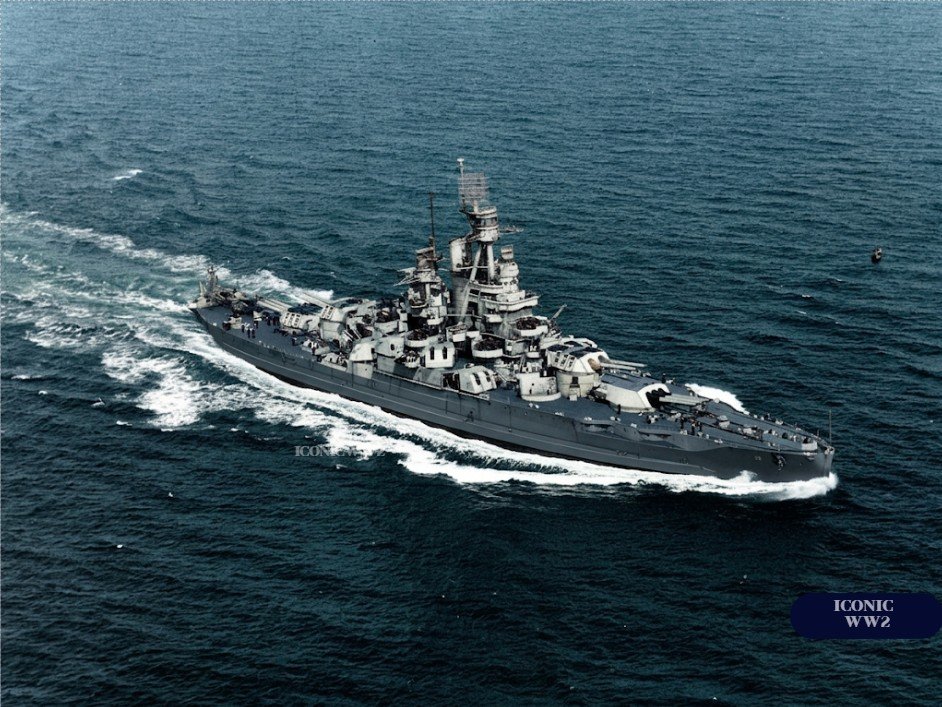
USS Arizona was a product of the United States Navy's “standard-type” battleship programme — a series of slow but powerfully armed and well-protected dreadnoughts designed to a common doctrine so that they could manoeuvre and fight together as a uniform battle line. She was the second of the two Pennsylvania-class ships, sister to USS Pennsylvania (BB-38).
Laid down at the New York Navy Yard in Brooklyn in 1914 and commissioned on 17 October 1916, Arizona embodied American battleship thinking of the First World War era: a heavy main battery, a thick armoured belt, and a designed speed of just 21 knots, the standard pace of the US battle line. She arrived too late to see combat in the First World War and spent the interwar decades as a mainstay of the fleet.
Arizona carried twelve 14-inch (356 mm) /45 guns in four triple turrets — a powerful, concentrated main battery for her day — backed by a secondary battery of 5-inch /51 guns. Her protection was on the generous American pattern, with a main belt of around 343 mm and turret faces up to 457 mm thick, built to stand in the line and trade heavy blows.
Her machinery — four geared steam turbines driving four shafts, fed by oil-fired boilers and developing some 33,000 shp — gave her the standard 21 knots. This was deliberate: the standard-type ships traded speed for armour and firepower, on the theory that a uniform, well-protected battle line mattered more than the speed of any single ship.
Between 1929 and 1931 Arizona was extensively modernised, gaining anti-torpedo bulges, new tripod masts, improved fire control and additional deck armour. But the rebuild could not address the gravest threat of the coming war — the aircraft. Her horizontal protection and anti-aircraft armament, like those of every battleship of her generation, were never truly adequate against a determined air attack, a weakness that would prove catastrophic.
On the morning of 7 December 1941, Arizona lay moored along Battleship Row at Pearl Harbor, inboard of the repair ship Vestal. When the Japanese carrier strike fell on the fleet, she was among the first and hardest hit. High-level bombers carrying 800 kg armour-piercing bombs — converted 16-inch naval shells — attacked the moored battleships from altitude.
At about 08:06, one of these bombs penetrated near the forward turrets and detonated inside the forward magazines. The resulting explosion was cataclysmic: the forward part of the ship was torn apart and lifted bodily by the blast, and Arizona was wrecked and sank at her moorings within minutes, burning fiercely for two days.
Of her crew, 1,177 officers and men were killed — roughly half of all the Americans who died at Pearl Harbor, and the greatest loss of life on any warship in United States history. Among the dead were many who remain entombed in the ship to this day.
Unlike most of the other battleships sunk in the harbour — several of which were raised, repaired and returned to the war — Arizona was damaged far beyond any hope of salvage. Her usable guns and some fittings were removed, but the shattered hull was left where she sank, on the bottom of Pearl Harbor.
The scale of the loss set Arizona apart. Of the 1,177 men of her crew who died when her forward magazines erupted, the great majority were never recovered — entombed in the wreck where they fell. It was nearly half of all the American servicemen killed at Pearl Harbor, lost aboard a single ship in a matter of seconds.
In 1962 the USS Arizona Memorial was dedicated, a white structure spanning the sunken hull without touching it, marking the grave of the men still aboard. Oil continues to seep from her ruptured tanks to the surface in slow droplets — the so-called “tears of the Arizona” — and the wreck remains a national war grave and one of the most visited memorials in America.
Survivors of the ship were, by their own wish, permitted to have their ashes interred in the wreck alongside their shipmates when they died — the crew of the Arizona reunited beneath the water. More than eighty years on she remains the emotional heart of Pearl Harbor: a rusting hull, a wall of names, and the slow rise of oil that visitors watch in silence.
USS Arizona never fired her guns in anger in the war that destroyed her. A standard-type dreadnought built for the gun battles of an earlier era, she was annihilated in minutes by exactly the weapon her kind was least able to withstand — the bomb dropped from the air — at the very moment the United States entered the Second World War.
Her loss became the defining image of the attack on Pearl Harbor and a rallying cry for the American war effort. That the conflict opened with Arizona's destruction and ended on the deck of the battleship USS Missouri in Tokyo Bay gave the Pacific war a stark symmetry; today the two ships lie within sight of each other at Pearl Harbor — one marking the war's violent beginning, the other its triumphant end.
- Gordon W. Prange, At Dawn We Slept: The Untold Story of Pearl Harbor (1981) — the definitive account.
- Joy Waldron Jasper, James P. Delgado & Jim Adams, The USS Arizona (St. Martin’s Press, 2001).
- Craig Nelson, Pearl Harbor: From Infamy to Greatness (Scribner, 2016).
Iconic WW2 is free, ad-free and tracker-free — kept going only by the time it takes to research, restore and colorize each machine. If this profile was worth your read, you can help the archive grow.
| Class | Pennsylvania |
| Builder | New York Navy Yard, Brooklyn |
| Nation | United States |
| Type | Standard-type battleship |
| Commissioned | 17 October 1916 |
| Modernised | 1929–1931 |
| Sunk | 7 December 1941 (Pearl Harbor) |
| Crew Lost | 1,177 killed |
| Arizona (BB-39) | Destroyed at Pearl Harbor, 1941 |
| Pennsylvania (BB-38) | Sister; survived, served to 1946 |
| Cause | AP bomb to forward magazine |
| Today | War grave & memorial (1962) |
| Machinery | 4× geared steam turbines |
| Boilers | 6 Bureau Express (post-refit) |
| Power | ~33,000 shp |
| Shafts | 4 |
| Max Speed | ~21 knots |
| Range | ~8,000 nmi at 10 kn |
| Standard Displacement | ~31,400 t |
| Full Load | ~37,000 t (post-refit) |
| Length | 185.3 m |
| Beam | 29.7 m (32.4 m with bulges) |
| Draught | ~8.8 m |
| Main Battery | 12× 356 mm /45 (4×3) |
| Secondary | 12× 127 mm /51 + 8× 127 mm /25 AA |
| Belt Armour | up to 343 mm |
| Turret Face | up to 457 mm |