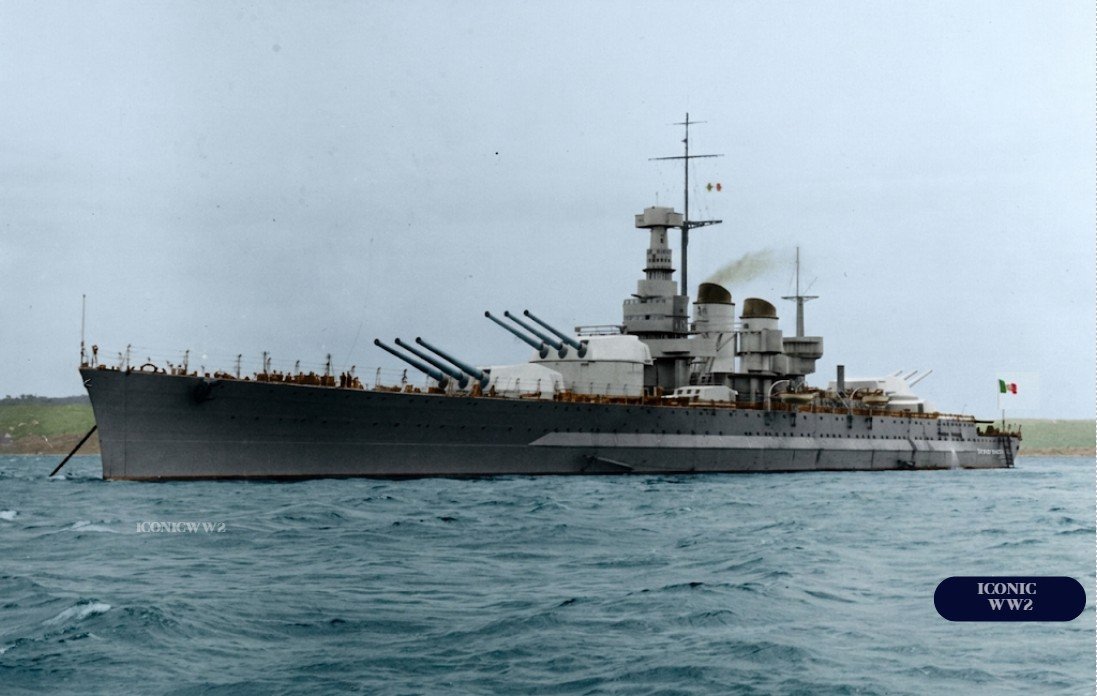
Giulio Cesare was born into another age of naval war. Laid down at the Ansaldo yard at Genoa-Sestri Ponente in 1910 and commissioned on 14 May 1914, she was a true dreadnought of the First World War — one of three ships of the Conte di Cavour class, alongside the name ship Conte di Cavour and the ill-fated Leonardo da Vinci, lost to a magazine explosion at Taranto in 1916.
As built she displaced about 23,000 tons, made 21.5 knots on roughly 31,000 shp, and carried thirteen 305 mm /46 guns in an unusual arrangement of three triple and two twin turrets — including a centreline turret amidships. She saw little action in the First World War, the Italian and Austro-Hungarian fleets largely keeping to harbour, and by the 1930s she was a slow, obsolescent veteran in a navy hungry for modern capital ships it could not afford to build from scratch.
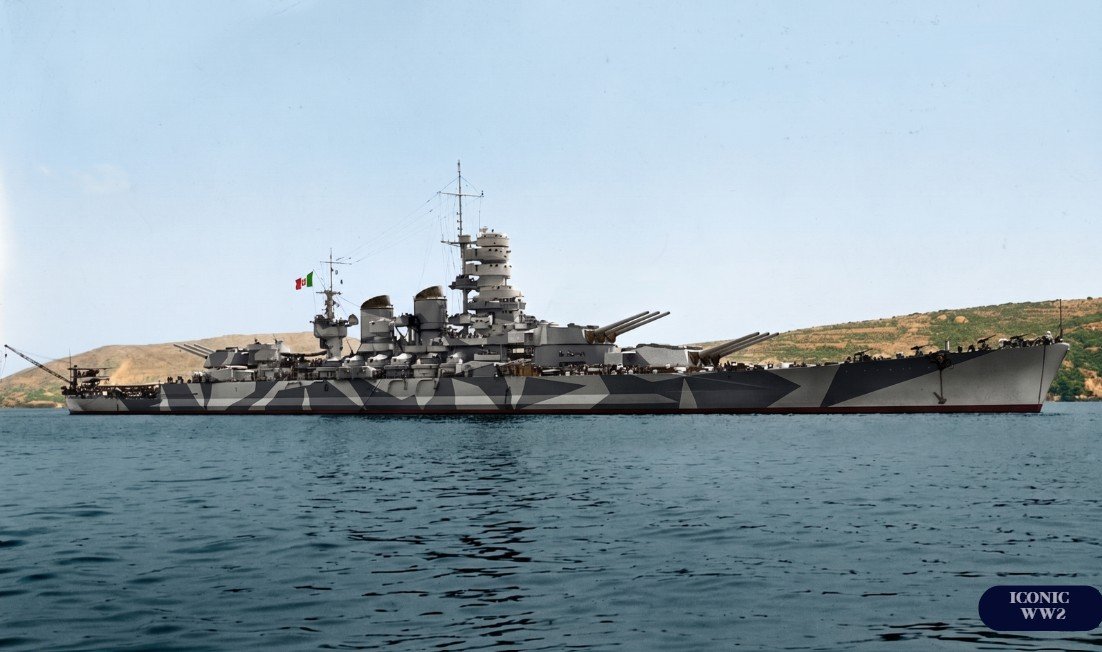
Rather than scrap her, the Regia Marina chose one of the most radical battleship rebuilds ever attempted. Between 1933 and 1937 Giulio Cesare was effectively taken apart and rebuilt around her old hull. A new bow section lengthened her from about 176 m to 186.4 m; the old machinery was torn out and replaced by two sets of Belluzzo geared turbines and eight Yarrow boilers developing some 75,000 shp — more than doubling her power and lifting her speed to around 28 knots.
Her armament was transformed. The amidships turret was removed, and the remaining ten 305 mm guns were bored out to 320 mm /44, firing a ~525 kg shell to about 28,000 m. A new secondary battery of twelve 120 mm /50 and eight 100 mm /47 AA guns replaced the old casemate weapons, and the Pugliese underwater protection system was worked into the hull against torpedoes.
The result looked like a new ship — fast, clean-lined and far more capable — but the reconstruction could not erase her age. Her 250 mm belt and roughly 135 mm of deck armour were thin against modern 15-inch shellfire, and ten 320 mm guns were outranged and outweighed by the nine 381 mm guns of newer rivals. She was a brilliantly modernised dreadnought, not a true new-generation battleship.
Two ships of the class were reconstructed to this standard: Giulio Cesare and Conte di Cavour. They were intended as a fast-but-cheap counter to the French Dunkerque class while Italy completed the far more powerful Littorio-class battleships, and to stand in the line of battle in the confined waters of the Mediterranean.
Their careers diverged sharply. Conte di Cavour was crippled at her moorings during the British carrier raid on Taranto on the night of 11–12 November 1940 and never returned to effective service. Giulio Cesare, the more active of the two, would carry the class's war at sea.
Giulio Cesare's most famous moment came at the Battle of Calabria (Punta Stilo) on 9 July 1940, the first major fleet clash of the Mediterranean war. Steaming as flagship of Admiral Inigo Campioni alongside Conte di Cavour, she traded fire with the British Mediterranean Fleet. At a range of roughly 24,000 m, a 15-inch shell from HMS Warspite struck her near the after funnel — one of the longest-range gunnery hits ever scored between two moving ships.
The hit knocked out several boilers, briefly cut her speed and started fires, and the Italian fleet broke off and retired behind a smokescreen. Thereafter, hamstrung by Italy's chronic fuel shortage and the rise of Allied air and naval power, Giulio Cesare spent much of her war on escort and training duties, conserving the precious oil the Regia Marina never had in quantity. After the armistice of 8 September 1943 she sailed to Malta and was interned.
Giulio Cesare's strangest chapter came after the war. Under the peace treaty she was handed to the Soviet Union as war reparations in 1949 and recommissioned into the Black Sea Fleet as Novorossiysk — an Italian dreadnought now flying the Soviet flag.
On 29 October 1955, lying at anchor in Sevastopol harbour, she was torn open by a massive underwater explosion — most likely a leftover German ground mine from the war. The ageing ship capsized over the following hours, and over 600 Soviet sailors were killed, many trapped inside the inverted hull. It was one of the worst peacetime disasters in Soviet naval history — and the final, grim end of a ship that had first put to sea in 1914.
RN Giulio Cesare bridged two eras of the battleship like almost no other ship. Built as a coal-burning dreadnought before the First World War and rebuilt into a fast, 320 mm-gunned warship for the Second, she embodied Italy's attempt to stretch scarce resources by modernising the old rather than building anew.
Outgunned by newer battleships, starved of fuel, and ultimately destroyed by a wartime mine while serving a foreign navy a decade after the war's end, her long life traced the whole arc of the dreadnought age — from the gun duels of 1916 to the ruined harbour of Sevastopol in 1955. Few warships served so long, under so many flags, or ended so tragically.
- Roger Chesneau (ed.), Conway’s All the World’s Fighting Ships 1922–1946 (Conway Maritime Press).
- Aldo Fraccaroli, Italian Warships of World War II (Ian Allan).
Iconic WW2 is free, ad-free and tracker-free — kept going only by the time it takes to research, restore and colorize each machine. If this profile was worth your read, you can help the archive grow.
| Class | Conte di Cavour |
| Builder | Gio. Ansaldo & C., Genoa-Sestri |
| Nation | Italy |
| Type | Battleship (rebuilt dreadnought) |
| Commissioned | 14 May 1914 |
| Reconstructed | 1933–1937 |
| Fate | Sunk 29 Oct 1955 as Novorossiysk |
| Crew | ~1,200 |
| Giulio Cesare | Hit at Punta Stilo; later Novorossiysk |
| Conte di Cavour | Crippled at Taranto, Nov 1940 |
| Leonardo da Vinci | Lost to magazine blast, 1916 (not rebuilt) |
| Reparations | Ceded to USSR, 1949 |
| Machinery | 2× Belluzzo geared turbines |
| Boilers | 8 Yarrow |
| Power | ~75,000 shp (was ~31,000) |
| Shafts | 2 |
| Max Speed | ~28 knots (was 21.5) |
| Range | ~3,100 nmi at 20 kn |
| Standard Displacement | ~26,140 t |
| Full Load | ~29,100 t |
| Length | 186.4 m (was ~176 m) |
| Beam | 28.6 m |
| Draught | ~10.4 m |
| Main Battery | 10× 320 mm /44 (2×3, 2×2) |
| Secondary | 12× 120 mm /50 + 8× 100 mm /47 AA |
| Light AA | 8× 37 mm + 12× 20 mm |
| Belt / Deck | 250 mm / up to ~135 mm |
| Torpedo Defence | Pugliese system |