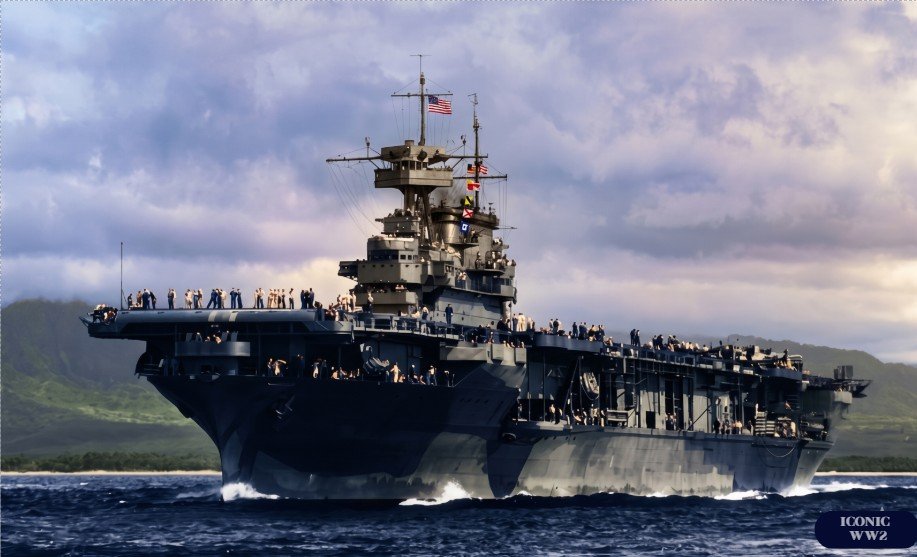
Yorktown was the lead ship of the class that defined the American fleet carrier. Designed within the tonnage limits of the Washington and London naval treaties, and drawing on hard-won experience with the converted Lexington and the too-small Ranger, the class balanced a large air group, high speed and good seakeeping on roughly 25,500 tons full load.
Built at Newport News Shipbuilding in Virginia, Yorktown was commissioned on 30 September 1937. With her sisters Enterprise and Hornet, she formed the trio of modern fleet carriers on which — after Pearl Harbor put the battle line on the bottom — the entire American war in the Pacific would briefly depend.
The Yorktown class carried a typical air group of about 90 aircraft — in 1942, Wildcat fighters, Dauntless dive-bombers and Devastator torpedo-bombers — launched from a 244-metre (802 ft) wooden flight deck served by three elevators. Nine boilers and geared turbines delivered 120,000 shaft horsepower and a top speed of 32.5 knots.
Protection followed American doctrine: the flight deck was unarmoured, trading resistance for aircraft capacity and treating the deck as replaceable. What made the class genuinely hard to kill was less armour than superb damage control — redundant systems, rigorous firefighting doctrine and crews trained to keep a wounded ship fighting. Yorktown’s final battle would prove the point twice in a single day.
In early 1942 Yorktown raided Japanese positions in the Gilberts and Marshalls and off New Guinea — morale-critical pinpricks in the darkest months of the war. Then, on 4–8 May 1942, she and Lexington met the Japanese carrier force covering the invasion of Port Moresby in the Battle of the Coral Sea: the first naval battle in history in which the opposing fleets never sighted each other.
The invasion was turned back — Japan’s first strategic check of the war — but at a price: Lexington was lost, and Yorktown took a bomb that punched through four decks before exploding, killing 66 men. Japanese aircrews reported her sunk. Estimates for repairing her ran to 90 days.
Ninety days was time the US Navy did not have: intelligence had revealed that Japan’s next target was Midway, with four fleet carriers, and the date was fixed. When Yorktown limped into Pearl Harbor on 27 May 1942, Admiral Nimitz personally inspected the damage and gave the yard three days.
Around 1,400 dockyard workers swarmed the ship in Drydock No. 1, working around the clock; power for the welding gear reportedly forced rolling blackouts in Honolulu. Patched, braced and carrying a composite air group, Yorktown sailed on 30 May — 72 hours after arriving — to join Enterprise and Hornet at a rendezvous optimistically named “Point Luck.”
On 4 June 1942 Yorktown’s air group earned a full share of the decisive blow. Launched after Enterprise and Hornet and held briefly in reserve, her strike arrived over the Japanese fleet at almost the perfect moment: the dive-bombers of VB-3 under Max Leslie tore apart the carrier Sōryū in the same fatal minutes that Enterprise’s aircraft destroyed Akagi and Kaga.
It was bought in part with the lives of her torpedo squadron. The obsolete Devastators of VT-3, led by Lance Massey, pressed home a near-suicidal attack that helped pull the Japanese fighters down to sea level, leaving the sky above open to the dive-bombers. Three of the four Japanese carriers were blazing wrecks within minutes; only Hiryū survived to strike back.
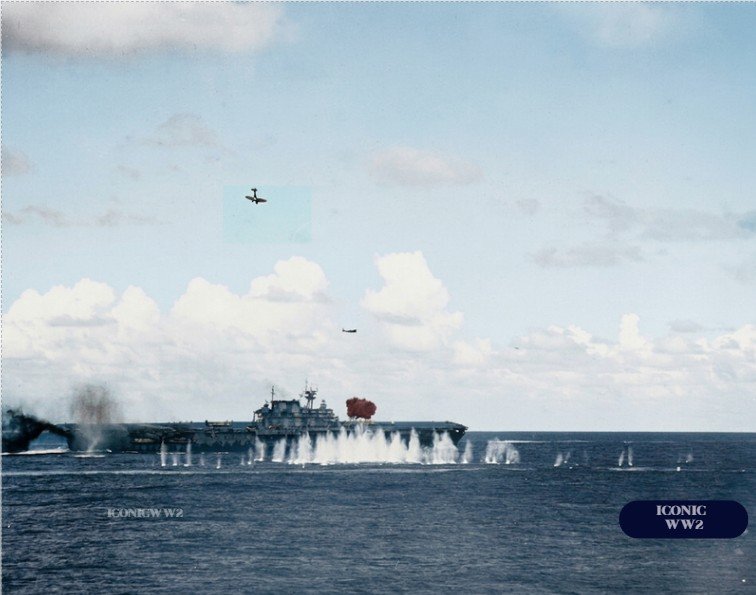
Hiryū’s answer came in two waves, and both found Yorktown. Just after midday her dive-bombers planted three bombs in the ship, stopping her dead and knocking out her boilers — but Yorktown’s renowned damage control had her steaming again at nearly 19 knots within the hour, patched so convincingly that the pilots of the second wave believed they were attacking a fresh, undamaged carrier.
That second strike put two torpedoes into her, jamming her rudder and opening her to the sea; Captain Elliott Buckmaster ordered her abandoned as she heeled over. Japan credited its aircrews with sinking two separate carriers — when in truth the same stubborn ship had absorbed the whole counterblow. Hiryū herself was hunted down and mortally wounded that evening, in part by Yorktown’s own orphaned dive-bombers flying from Enterprise, and followed her three sisters to the bottom.
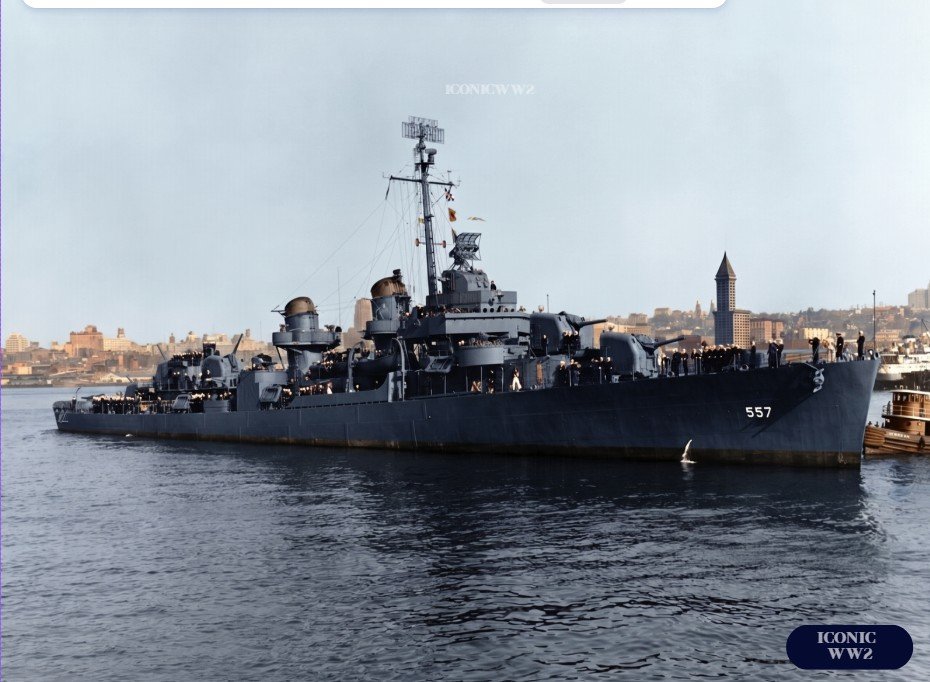
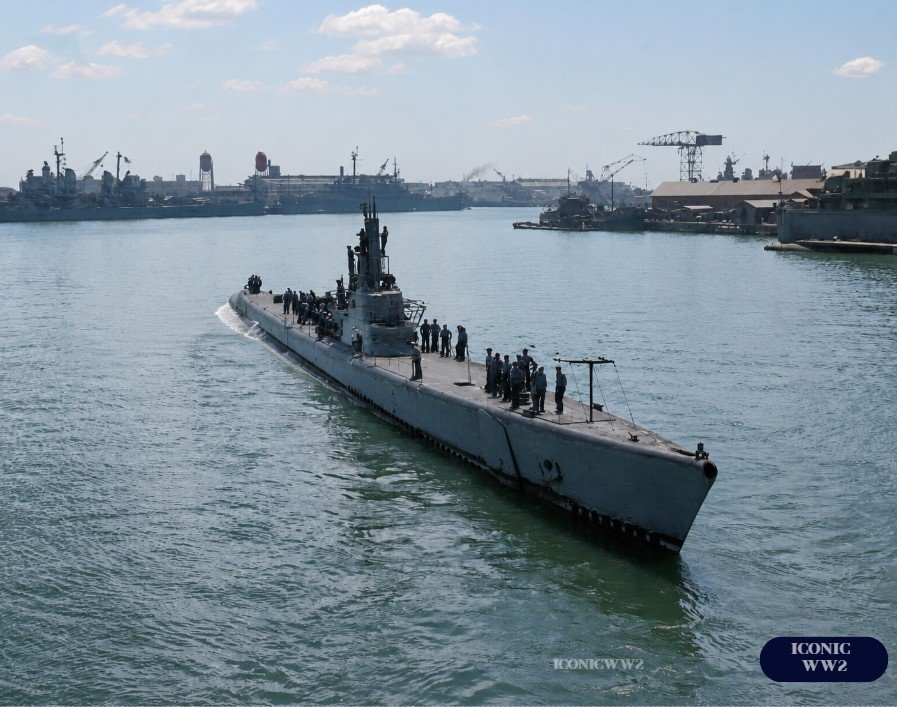
Abandoned but refusing to sink, Yorktown was reboarded by a salvage party on 6 June and taken under tow. That afternoon the Japanese submarine I-168, under Lieutenant Commander Yahachi Tanabe, slipped through the screen and fired four torpedoes: two hit the carrier, one broke the destroyer USS Hammann in half alongside. Yorktown finally rolled over and sank at dawn on 7 June 1942. Her wreck was found in 1998 by Robert Ballard, sitting upright three miles down.
She was gone six months into the war, but her contribution was decisive: without the 72-hour miracle at Pearl Harbor, the US Navy would have faced Midway with two carriers against four. A new Essex-class carrier took her name within a year — the fighting name Yorktown has never left the US Navy for long.
- Roger Chesneau (ed.), Conway’s All the World’s Fighting Ships 1922–1946 (Conway Maritime Press).
- Norman Friedman, U.S. Aircraft Carriers: An Illustrated Design History (Naval Institute Press).
- Jonathan Parshall & Anthony Tully, Shattered Sword: The Untold Story of the Battle of Midway (Potomac Books).
- Walter Lord, Incredible Victory: The Battle of Midway (Harper & Row).
Iconic WW2 is free, ad-free and tracker-free — kept going only by the time it takes to research, restore and colorize each machine. If this profile was worth your read, you can help the archive grow.
| Class | Yorktown (lead ship) |
| Builder | Newport News Shipbuilding |
| Nation | United States |
| Type | Fleet aircraft carrier |
| Commissioned | 30 September 1937 |
| Fate | Sunk 7 June 1942, Battle of Midway |
| Crew | ~2,200 (with air group) |
| Ships in Class | 3 (Yorktown, Enterprise, Hornet) |
| Enterprise (CV-6) | Most decorated US warship |
| Hornet (CV-8) | Launched Doolittle Raid; sunk 1942 |
| Battle Stars | 3 (Coral Sea · Midway) |
| Wreck | Found by Robert Ballard, 1998 |
| Fighters | Grumman F4F Wildcat |
| Dive-bombers | Douglas SBD Dauntless |
| Torpedo-bombers | Douglas TBD Devastator |
| Complement | ~90 aircraft |
| Machinery | 4× geared steam turbines |
| Boilers | 9 Babcock & Wilcox |
| Power | ~120,000 shp |
| Shafts | 4 |
| Max Speed | 32.5 knots |
| Range | ~12,000 nmi at 15 kn |
| Length | 251.4 m |
| Beam | 33.4 m (flight deck) |
| Full Load | ~25,500 t |
| Coral Sea | First carrier-vs-carrier battle, May 1942 |
| Pearl Harbor repair | ~90 days of work in 72 hours |
| Midway | Air group destroyed Sōryū, 4 June 1942 |
| Sunk by | Submarine I-168, 6–7 June 1942 |