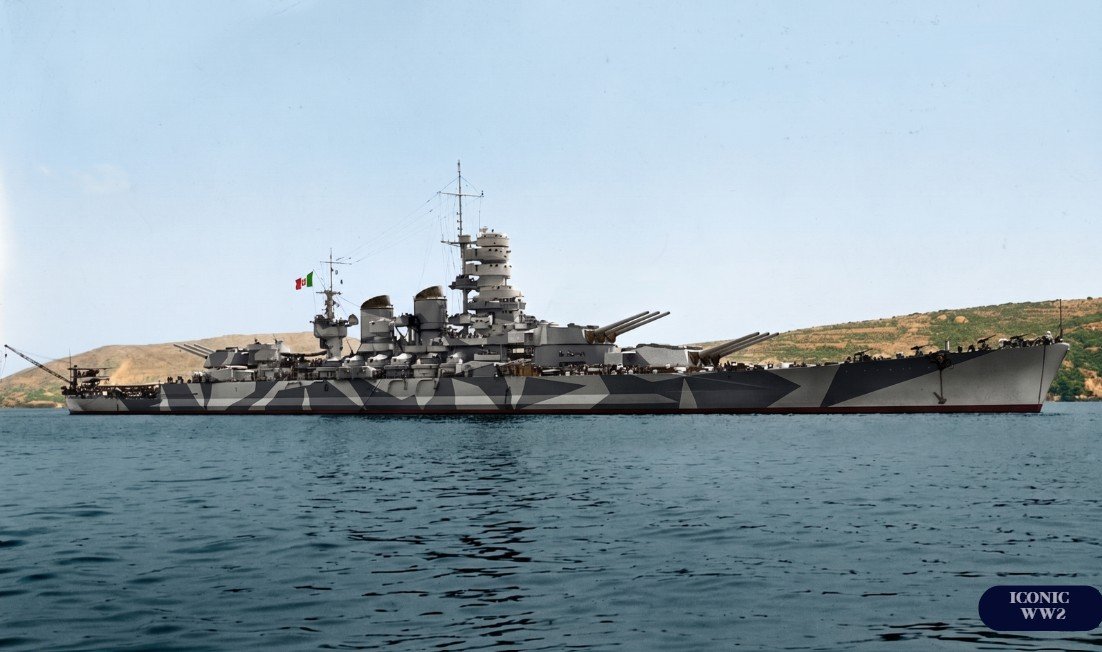
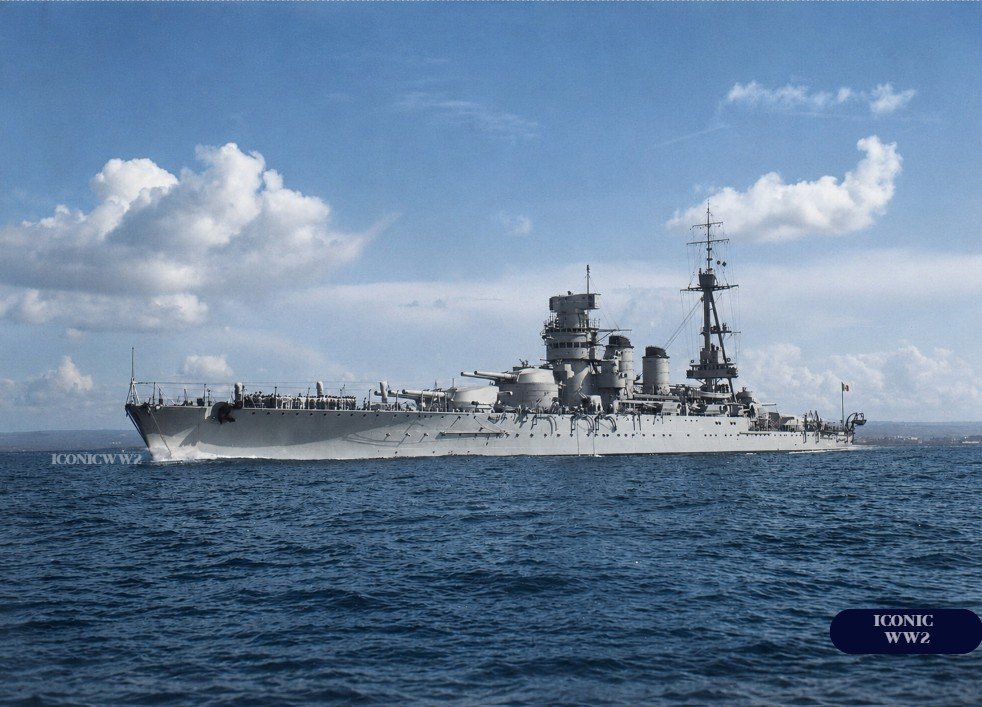
By the mid-1930s the Regia Marina's battle line consisted of elderly, reconstructed First World War dreadnoughts, hopelessly outclassed by the new French Dunkerque class. Italy's answer was a class of genuinely modern fast battleships: the Littorio class, of which Vittorio Veneto was the second unit, laid down in 1934 and commissioned on 28 April 1940, just weeks before Italy entered the war.
Named after the decisive Italian victory of 1918, Vittorio Veneto became the flagship of the Italian battle fleet. She and her sister Littorio represented a genuine leap in capability — among the most powerful battleships built by any European navy save the German Bismarck class and the British King George Vs — and restored, on paper, a modern capital-ship force to the Mediterranean.
Vittorio Veneto's main battery was nine 381 mm (15 in) /50 Ansaldo Model 1934 guns in three triple turrets. These guns fired a heavy shell at an exceptionally high muzzle velocity of about 850 m/s, giving a maximum range beyond 42 km — among the longest-reaching guns afloat. The price of that velocity was severe barrel wear and wide shell dispersion, which hampered accuracy at long range.
The secondary and anti-aircraft batteries comprised twelve 152 mm guns, twelve stabilised 90 mm high-angle guns and numerous 37 mm and 20 mm weapons. On a standard displacement of about 40,700 tonnes (roughly 45,000 t full load) and a length of 237.8 m, powerful machinery of some 130,000 shp drove her at about 30 knots — genuinely fast for so large a ship.
Protection was extensive but idiosyncratic. The main belt was around 350 mm, backed by a decapping plate intended to shatter incoming shells before they struck the main armour. Horizontal protection totalled up to roughly 162 mm across multiple decks against plunging fire and bombs.
Underwater, the ships used the distinctive Italian Pugliese torpedo-defence system — a large hollow cylinder within the hull designed to absorb and dissipate the force of a torpedo hit. In practice the system delivered mixed results, and the class's protective scheme, though heavy, never fully lived up to its promise in action.
Vittorio Veneto was the most active of Italy's modern battleships. She fought at the Battle of Cape Spartivento in November 1940 and was central to the disastrous Battle of Cape Matapan in March 1941, where — lacking radar and surprised by the radar-equipped British fleet — she was hit and slowed by an air-launched torpedo from a Fleet Air Arm aircraft, yet survived and escaped while three Italian cruisers were annihilated.
She was torpedoed again in December 1941 by the British submarine HMS Urge, requiring months of repair, and later covered Axis convoys and fought in the Second Battle of Sirte (March 1942). Her career, like that of the whole Regia Marina battle fleet, was increasingly paralysed by chronic fuel shortages and by the fundamental Italian handicaps of no radar and limited night-fighting capability.
When Italy signed the armistice in September 1943, Vittorio Veneto sailed with the fleet to surrender to the Allies at Malta. On the way the ships were attacked by German aircraft using the new Fritz X guided bomb, which sank her sister Roma; Vittorio Veneto reached Malta safely.
She was subsequently interned in the Bitter Lakes in Egypt for the remainder of the war. Assigned to Britain as war reparations but never taken into foreign service, she was returned to Italy and finally scrapped between 1948 and 1951.
Vittorio Veneto was a fine and formidable warship — fast, heavily armed and, at Matapan, proof that the Littorio class could take serious damage and survive. She represented the best of Italian naval engineering and the ambition of a navy determined to contest the Mediterranean with the Royal Navy.
Yet her career illustrates the gap between fine ships and effective sea power. Superbly built but blinded by the absence of radar, hampered by fuel shortages and a cautious high command, she and her sisters never delivered the decisive results their designers intended. Vittorio Veneto remains the proudest and most active symbol of Italy's modern battle fleet — a magnificent instrument that circumstance never allowed to be fully used.
- Roger Chesneau (ed.), Conway’s All the World’s Fighting Ships 1922–1946 (Conway Maritime Press).
- Aldo Fraccaroli, Italian Warships of World War II (Ian Allan).
- Erminio Bagnasco & Augusto de Toro, The Littorio Class: Italy’s Last and Largest Battleships (Seaforth).
Iconic WW2 is free, ad-free and tracker-free — kept going only by the time it takes to research, restore and colorize each machine. If this profile was worth your read, you can help the archive grow.
| Class | Littorio (Vittorio Veneto) |
| Builder | C.R.D.A., Trieste |
| Nation | Italy |
| Type | Fast battleship |
| Commissioned | 28 April 1940 |
| Fate | Interned 1943; scrapped 1948–51 |
| Shaft Power | ~130,000 shp |
| Max Speed | ~30 knots |
| Range | ~3,920 nmi at 20 kn |
| Length | 237.8 m |
| Beam | 32.9 m |
| Full Load | ~45,000 t |
| Crew | ~1,830–1,950 |
| Main Battery | 9× 381 mm /50 (3×3) |
| Muzzle Velocity | ~850 m/s; range >42 km |
| Secondary | 12× 152 mm + 12× 90 mm AA |
| Light AA | 37 mm + 20 mm batteries |
| Main Belt | ~350 mm (+ decapping plate) |
| Deck (total) | up to ~162 mm |
| Underwater | Pugliese torpedo-defence system |