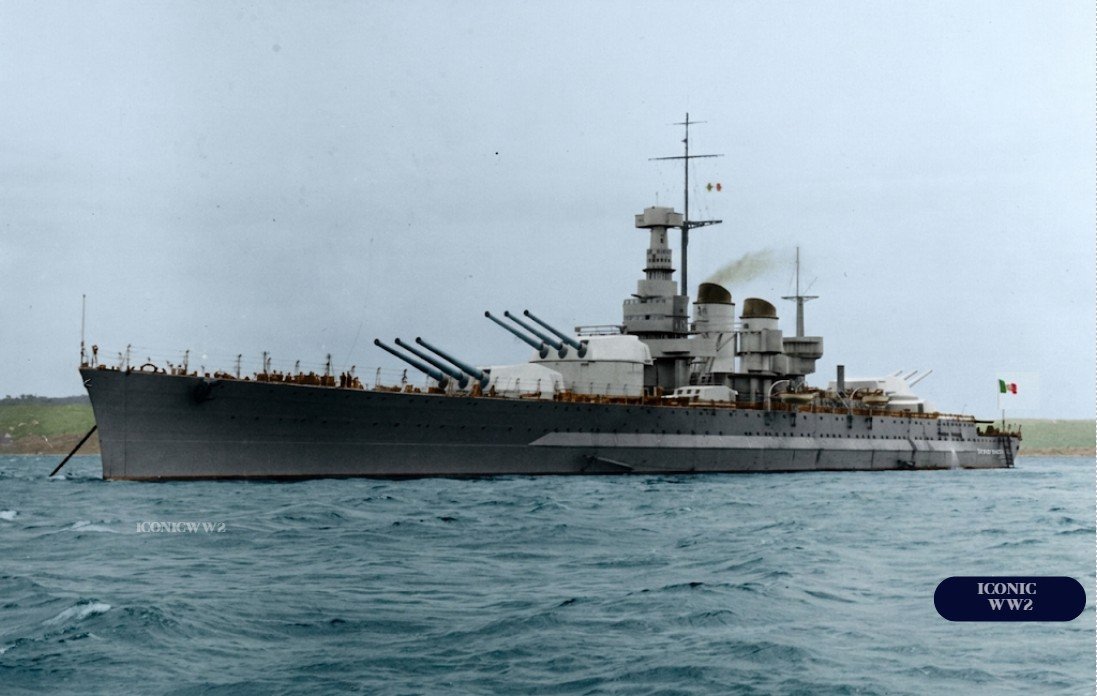
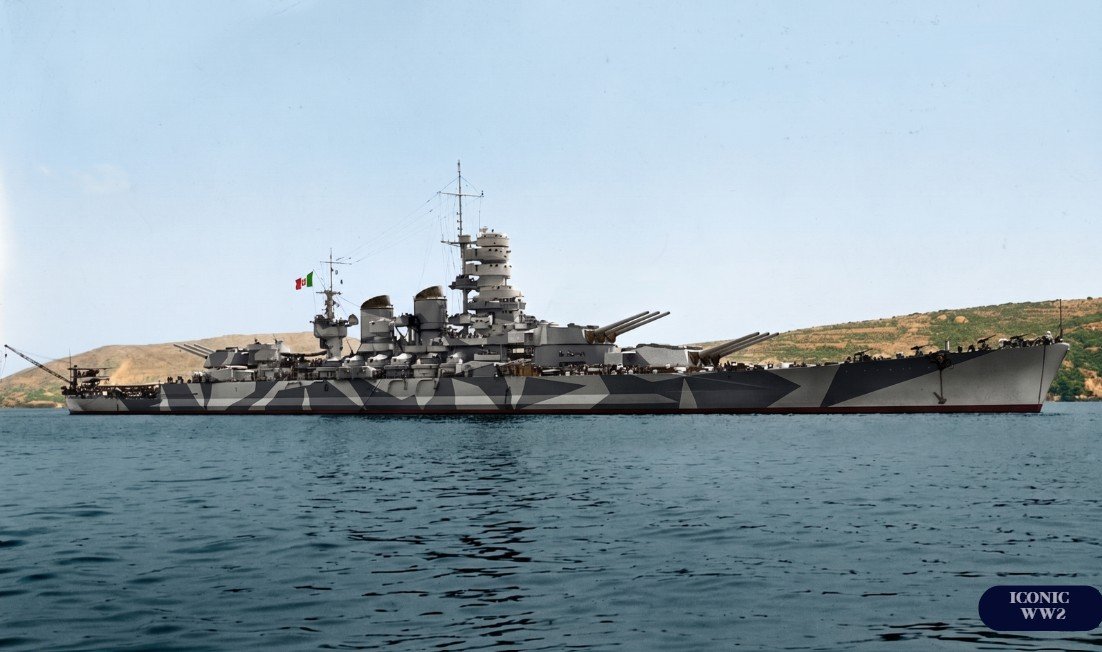
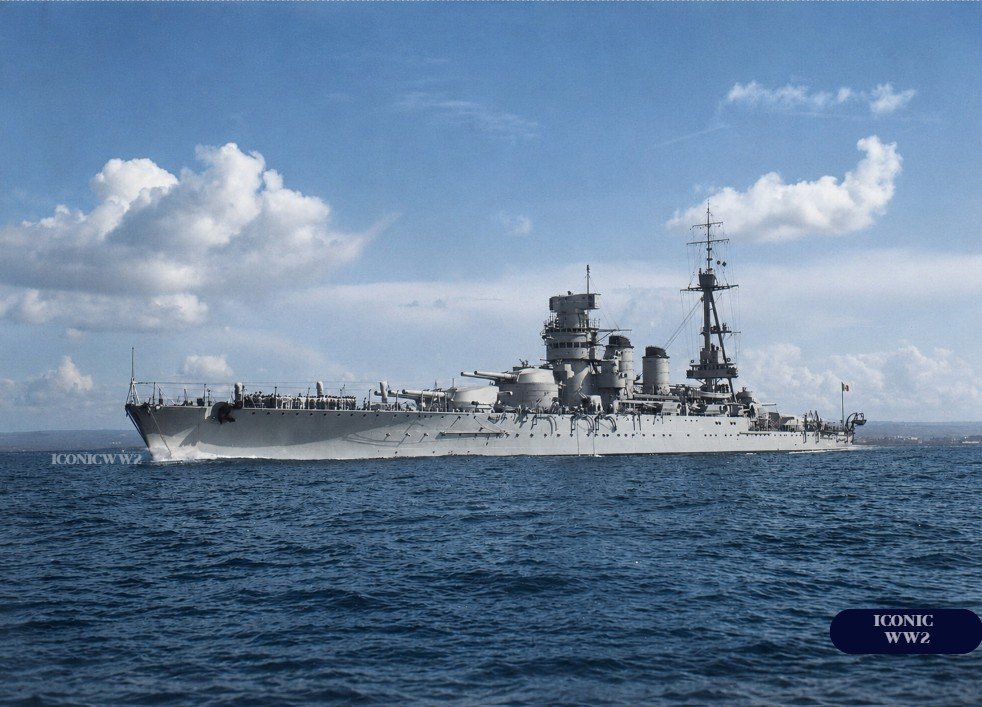
The naval treaties of the 1920s created a new category of warship — the “treaty cruiser,” limited to 10,000 tons and 8-inch (203mm) guns. Most navies, chasing speed and firepower within that tight weight limit, sacrificed protection, producing fast but fragile ships often derided as “tin-clads.” Italy's earlier Trento class had followed exactly that path: very fast, but lightly armoured and vulnerable.
For the next class the Regia Marina chose a different and bolder course. Accepting a modest reduction in speed, the designers poured weight into armour, aiming to build a heavy cruiser that could actually survive in a gunfight. The result was the Zara class, led by RN Zara, commissioned in 1931 — widely regarded as among the best-protected and most balanced heavy cruisers ever built under the treaty system.
The Zara class achieved a level of protection unmatched by almost any other 8-inch cruiser. A substantial armoured belt, deck and turrets gave the ships a degree of resilience approaching that of a small capital ship — bought, in reality, by quietly exceeding the 10,000-ton treaty limit, as most nations did to some degree. Their standard displacement was closer to 14,000 tons.
Their main armament of eight 203mm guns in four twin turrets was powerful, though the Italian practice of mounting the gun barrels closely together in a single cradle could cause shells to interfere in flight, hurting accuracy at long range. Still capable of around 32 knots, the Zaras combined heavy firepower and good speed with the protection their predecessors had lacked.
Handsome, well-balanced and tough, they were the pride of the Italian cruiser force and looked every inch the part. Yet they shared the Regia Marina's chronic institutional weaknesses: a lack of radar, limited training for night fighting, and a doctrine ill-prepared for the kind of close-range nocturnal action at which the Royal Navy excelled.
Four ships were built: Zara, Fiume, Gorizia and Pola, named for cities of the Italian Adriatic and its eastern shore. Together they formed the 1st Cruiser Division, the hard core of the Regia Marina's heavy cruiser strength and a frequent presence in the convoy battles and fleet sorties of the Mediterranean war.
Pola differed slightly, fitted out as a divisional flagship. For a decade the four ships were the elite of the Italian fleet — and then, in a single catastrophic night, three of them were annihilated together, a blow from which the Regia Marina's morale never fully recovered.
On the night of 28–29 March 1941, off Cape Matapan in the southern Aegean, the Zara class met disaster. Earlier that day the cruiser Pola had been crippled by a British air-launched torpedo and lay dead in the water. Zara and Fiume, with destroyers, were sent back in the darkness to aid their stricken sister — sailing, unknowingly, straight into the path of the British Mediterranean Fleet.
The British battleships Warspite, Valiant and Barham, equipped with radar and trained for night action, detected the Italian cruisers and held their fire until they were almost point-blank. When their 15-inch guns opened up, the effect was annihilating. Zara and Fiume were smashed to pieces and sunk within minutes; the helpless Pola was finished off soon after, and two Italian destroyers were lost as well. The Italians, lacking radar and caught completely by surprise, never even brought their guns to bear.
In a single engagement the Regia Marina lost three of its four finest cruisers and over 2,300 men, in one of the most lopsided fleet actions of the entire war.
The disaster laid bare the single greatest weakness of the Regia Marina: it had gone to war with no radar. Blind in the dark, its beautiful, fast cruisers had been detected, tracked and destroyed by an enemy they never saw, their own guns still trained fore-and-aft. Matapan taught the Italian navy, at a terrible price, that courage and fine ships counted for nothing against a foe who could see in the night.
The Zara class represented Italian naval architecture at its very best — arguably the finest heavy cruisers of the treaty era, blending firepower, speed and a level of protection no rival could match. As ships, they were a triumph of design.
Their fate, however, exposed the gulf between fine ships and effective sea power. Superbly built but blind in the dark, lacking radar and unprepared for night combat, three of the four were destroyed in minutes at Cape Matapan without inflicting a scratch in return. The Zara class stands as the great paradox of the Regia Marina: magnificent vessels, undone not by any failing of steel or design, but by the technological and doctrinal shortcomings of the navy that sent them to sea. The sole survivor, Gorizia, soldiered on until she too was lost late in the war.
- Roger Chesneau (ed.), Conway’s All the World’s Fighting Ships 1922–1946 (Conway Maritime Press).
- Aldo Fraccaroli, Italian Warships of World War II (Ian Allan).
Iconic WW2 is free, ad-free and tracker-free — kept going only by the time it takes to research, restore and colorize each machine. If this profile was worth your read, you can help the archive grow.
| Class | Zara |
| Builder | O.T.O., La Spezia |
| Nation | Italy |
| Type | Heavy cruiser |
| Commissioned | 20 October 1931 |
| Sunk | 29 March 1941 (Cape Matapan) |
| Crew | ~840 |
| Ships in Class | 4 |
| Zara | Lead ship; sunk at Matapan |
| Fiume | Sunk at Matapan, 1941 |
| Pola | Crippled, then sunk at Matapan |
| Gorizia | Sole survivor; lost late war |
| Machinery | 2× geared steam turbines |
| Boilers | 8 Thornycroft |
| Power | ~95,000 shp |
| Shafts | 2 |
| Max Speed | ~32 knots |
| Range | ~5,400 nmi at 16 kn |
| Standard Displacement | ~14,300 t |
| Full Load | ~16,000 t |
| Length | 182.8 m |
| Beam | 20.6 m |
| Draught | ~7.2 m |
| Main Battery | 8× 203 mm /53 (4×2) |
| Secondary | 16× 100 mm + AA & torpedoes |
| Belt Armour | up to 150 mm |
| Division | 1st Cruiser Division |