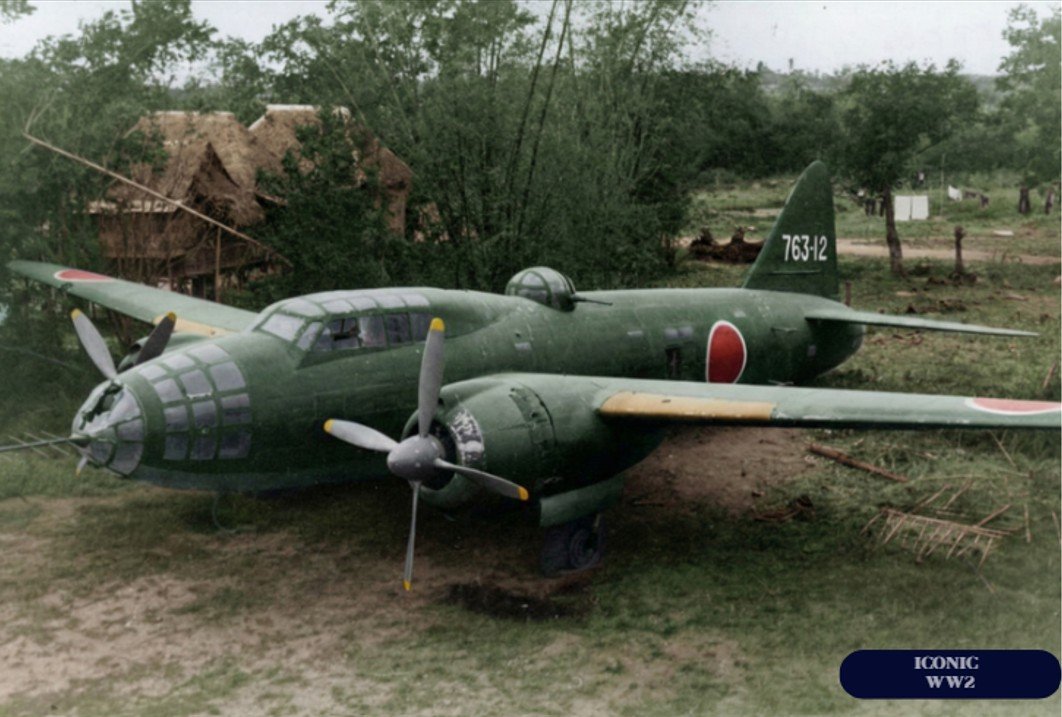
When the Imperial Japanese Navy issued its 1935 requirement for a new carrier attack aircraft, Nakajima’s response was startlingly modern. Where the world’s navies still flew fabric-covered biplane torpedo bombers, the B5N that first flew in January 1937 was an all-metal, low-wing monoplane with retractable landing gear, a variable-pitch propeller and Fowler flaps — features so advanced that the design team initially thought them too risky and prepared a simpler back-up.
The gamble paid off completely. By the time the Pacific war began, the B5N — given the Allied reporting name “Kate” — was, by a wide margin, the best carrier-borne torpedo bomber in the world, outclassing anything the Americans or British could put on a flight deck. It would hold that lead for the first, decisive year of the war.
The definitive B5N2 of 1939 was built around the reliable Nakajima Sakae 11 radial of about 1,000 hp — the same engine family that powered the Zero. It was not fast, topping out near 378 km/h, but it had excellent range and carried a three-man crew of pilot, observer/bombardier and radio-operator/gunner in a long, glazed canopy.
Its striking weakness was defence: a single hand-aimed 7.7 mm machine gun in the rear cockpit, and almost no armour or self-sealing tanks. The Kate was built to deliver its blow and trusted its escort and its speed of attack to survive. That blow was formidable — a single 800 kg load, either the superb Type 91 aerial torpedo or an equivalent weight of bombs — and in 1941–42 the crews who delivered it were the most skilled naval aviators in the world.
At Pearl Harbor the Kate struck in both of its roles at once. Forty B5Ns of the first wave came in low as torpedo bombers, their Type 91 torpedoes fitted with wooden fin-boxes specially devised to stop them diving into the mud of the shallow harbour — and they tore open the battleships along Ford Island.
Higher up, other B5Ns attacked as precision level bombers, carrying 800 kg armour-piercing bombs converted from battleship shells. One of those bombs, dropped by a Kate, punched deep into USS Arizona and detonated her forward magazines; the catastrophic explosion killed over 1,100 men and remains the single greatest loss of life in the history of the United States Navy. No other aircraft did more damage that morning.
What made the Kate historically decisive was what it did to the American carriers. At the Coral Sea in May 1942 its torpedoes helped doom USS Lexington. At Midway in June, B5Ns from the Hiryū put two torpedoes into USS Yorktown, crippling the carrier that had already survived the morning’s dive-bombers and leaving her to be finished by a submarine. At Santa Cruz that October, Kate torpedoes helped sink USS Hornet, the ship that had launched the Doolittle Raid.
Lexington, Yorktown, Hornet — three fleet carriers, the heart of American power in the Pacific in 1942, and the B5N had a hand in sinking every one. No other Axis aircraft could claim as much against the ships that mattered most.
The Kate’s reign was as brief as it was brilliant. The carrier battles of 1942 devoured Japan’s irreplaceable veteran aircrews, and by 1943 the once world-beating design had been overtaken by American fighters and by better torpedo bombers of its own side. Its intended successor, the faster Nakajima B6N “Jill”, began to replace it in the front line.
Relegated from the fleet carriers, surviving B5Ns found second-line work: maritime patrol and anti-submarine duty, some fitted with early air-to-surface radar and magnetic detectors, plus training and transport. Like so many Japanese aircraft, the Kate’s war ended in kamikaze units. About 1,150 were built in all.
The Nakajima B5N is one of the most successful naval aircraft of the war, and one of the least remembered. For a year it was simply the best of its kind in the world — the aircraft that opened the Pacific war at Pearl Harbor and then hunted down the very carriers that would decide it.
Its story mirrors that of the navy that flew it: a dazzling technical lead in 1941, squandered by 1943 as its matchless crews were lost and could not be replaced. Judged by the tonnage of capital ships it helped send to the bottom, few aircraft of the Second World War achieved more than the modest, obsolescent-looking Kate.
- René J. Francillon, Japanese Aircraft of the Pacific War (Putnam).
- William Green, Warplanes of the Second World War (Macdonald).
- Bill Gunston, The Illustrated Encyclopedia of Combat Aircraft of World War II (Salamander Books).
Iconic WW2 is free, ad-free and tracker-free — kept going only by the time it takes to research, restore and colorize each machine. If this profile was worth your read, you can help the archive grow.
| Manufacturer | Nakajima Hikōki |
| Nation | Japan |
| Role | Carrier torpedo / level bomber |
| First Flight | January 1937 |
| Service Entry | 1938 |
| Crew | 3 |
| Units Built | ~1,150 (all versions) |
| B5N2 | Definitive model — Sakae engine, Pearl Harbor |
| B5N1 | Original production, less powerful engine |
| Allied name | “Kate” |
| Successor | Nakajima B6N “Jill” |
| Engine | Nakajima Sakae 11 |
| Type | 14-cylinder air-cooled radial |
| Power | ~1,000 hp |
| B5N1 | Nakajima Hikari, ~770 hp |
| Max Speed | ~378 km/h |
| Range | ~1,990 km |
| Service Ceiling | ~8,260 m |
| Feature | Long range, advanced for its era |
| Length | 10.30 m |
| Wingspan | 15.52 m |
| Height | 3.70 m |
| Max Take-off | ~4,100 kg |
| Torpedo | 1× 800 kg Type 91 (aerial) |
| Bombs | up to 800 kg (incl. AP shells) |
| Defensive | 1× 7.7 mm Type 92 (rear, flexible) |
| Protection | None — no armour or sealed tanks |