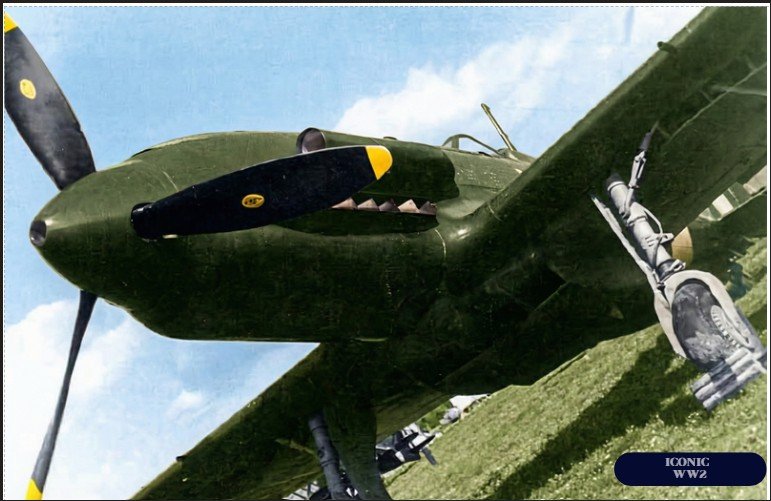
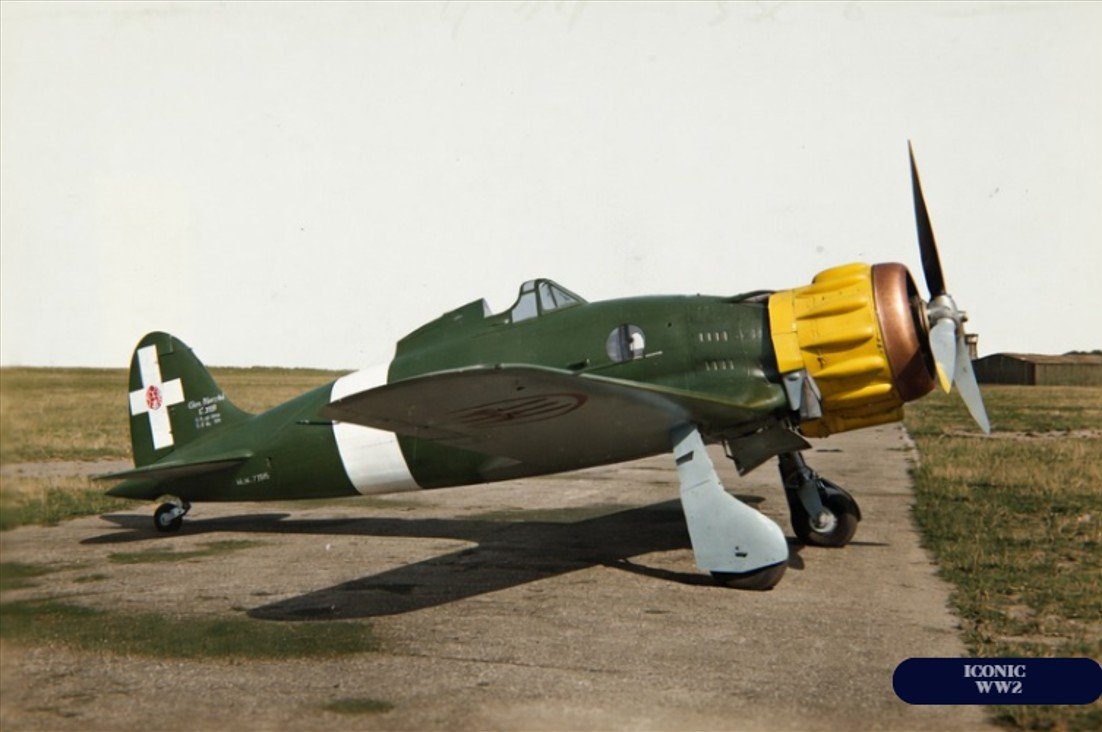
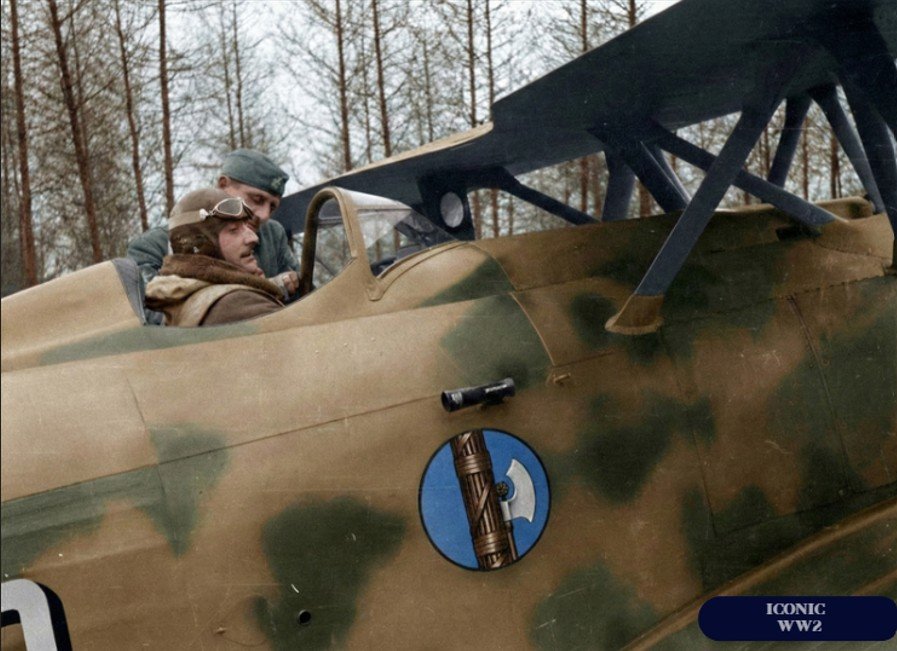
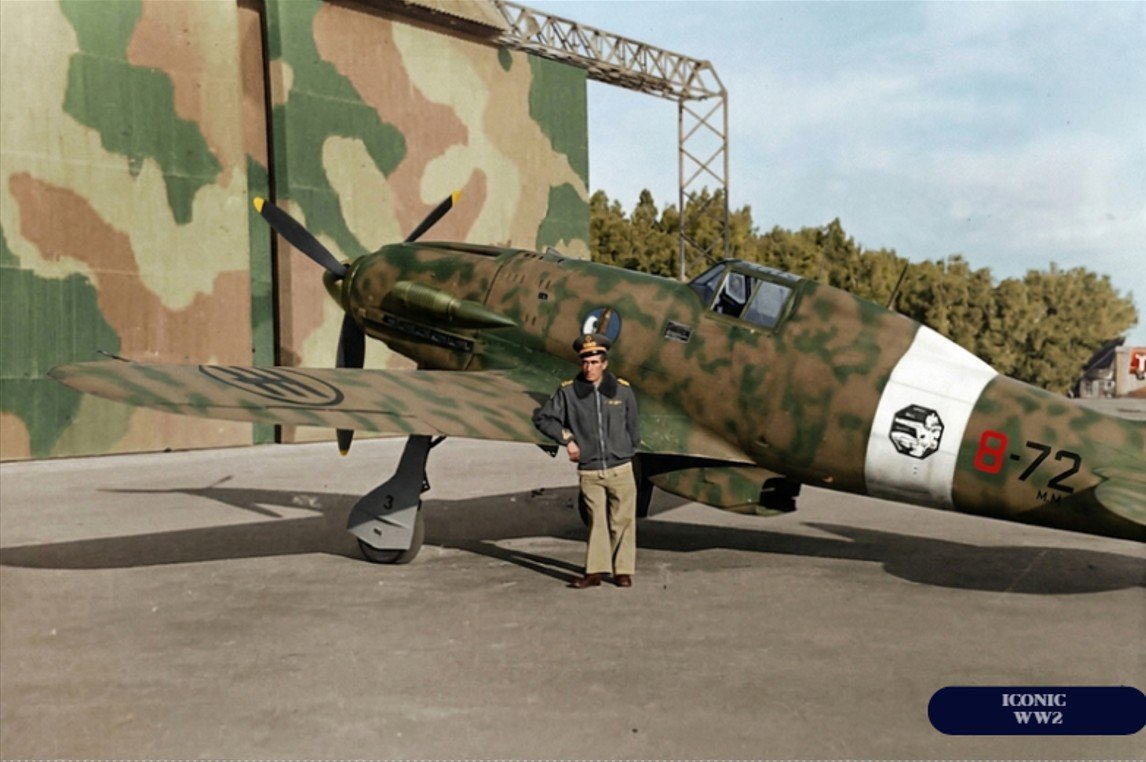
The Re.2001 Falco II (“Second Falcon”) was the interceptor of the Reggiane 2000 family, the sleek, elliptical-winged fighters built by Officine Meccaniche Reggiane of Reggio Emilia, part of the Caproni group. Designed by Roberto Longhi and Antonio Alessio, the line had begun with the radial-engined Re.2000 Falco of 1939 — a nimble, modern-looking machine that the Regia Aeronautica nonetheless kept out of front-line service, wary of the integral fuel tanks built into its wing.
The answer was to keep the Re.2000’s clean airframe and give it what Italian designers most coveted: a powerful inline engine. The result, first flown in 1940, was the Re.2001 — visually close to its stablemate the Macchi C.202 Folgore, and for exactly the same reason. Both were Italian airframes built around the same German engine, and both marked the Regia Aeronautica’s belated leap out of the age of the fabric-winged biplane into that of the modern monoplane fighter.
That engine was the Alfa Romeo R.A.1000 R.C.41-I Monsone — a licence-built copy of the German Daimler-Benz DB 601A, the same inverted-V12 that powered the Bf 109E and the C.202. Rated at around 1,175 hp, it transformed the Reggiane airframe: where the radial Re.2000 had been merely agile, the inline Re.2001 was fast and clean, reaching about 545 km/h and climbing strongly, with a service ceiling near 11,000 m.
The airframe it drove was among the most elegant of the war — a semi-elliptical wing with integral fuel tanks, a wide-track undercarriage that made it forgiving on rough forward strips, and a roomy, well-laid-out cockpit that Italian pilots praised. Its armament, though, betrayed the Regia Aeronautica’s persistent conservatism: two 12.7 mm Breda-SAFAT machine guns in the cowling and two rifle-calibre 7.7 mm in the wings — adequate against a fighter, thin against a bomber.
The Re.2001’s fate was decided not by any enemy but by a rival on its own side. The Macchi C.202 used the identical Alfa Romeo–built DB 601, and Italian industry could produce that engine only in painfully small numbers. Forced to choose, the Regia Aeronautica gave priority to the Macchi — so the Reggiane, though many pilots judged it the sturdier machine and the better gun platform, was starved of the very engines it needed.
The arithmetic was brutal. Where the C.202 was built in well over a thousand examples, only about 252 Re.2001s of all versions were completed. It was the recurring tragedy of the Italian war effort in miniature: two good designs competing for a supply of engines too small to arm even one of them properly, so that neither reached the front in the numbers its qualities deserved.
Where the Re.2001 did reach the front, it fought hard. From 1941 its principal battleground was the air over Malta and the convoy routes to Libya — the choke-point of the whole Mediterranean war. Flying chiefly with the 2° Gruppo Autonomo C.T., the Falco II escorted the bombers sent to neutralise the island and covered the merchant convoys on which the Axis armies in Africa depended.
Over Malta the Reggiane came up against the RAF’s Hurricane and, increasingly, the Spitfire — and, almost alone among Italian fighters bar the C.202, it could meet them on roughly even terms. It was fast enough to fight or break off at will, tough enough to carry its pilot home, and agile enough to hold its own in a turning fight. In experienced hands it was a genuine threat, and the island’s defenders learned to treat it with respect.
The Re.2001’s single most famous moment came during Operation Pedestal, the desperate Allied convoy fought through to Malta in August 1942. On 12 August, two Re.2001 fighter-bombers — each carrying a modified armour-piercing bomb of around 630 kg — slipped in among a group of returning Fleet Air Arm Fulmars and were mistaken by the fleet for friendly aircraft as they bore down on the carrier HMS Victorious.
One bomb struck the carrier’s armoured flight deck squarely — and broke apart without penetrating, the British armour shrugging off a weapon at the very limit of what a single-engined fighter could lift. It was a near-miss of history: had that bomb been built and fused to pierce the deck, a fleet carrier might have been crippled in the middle of the most closely fought convoy battle of the Mediterranean. Instead it stayed a footnote — but a vivid one, and the Reggiane’s enduring claim to fame.
The Falco II proved adaptable. As RAF bombers began ranging over Italian cities, a night-fighter version, the Re.2001CN (Caccia Notturna), was pressed into home defence — some fitted with a pair of 20 mm MG 151 cannon in underwing gondolas to give them the hitting power the standard armament lacked. Fighter-bomber (CB) variants carried light bomb loads for coastal patrol and anti-shipping work.
Most intriguing was the naval Re.2001, chosen as the fighter for Italy’s planned aircraft carrier Aquila, converted from the liner Roma at Genoa. A navalised version fitted with catapult spools and an arrester hook was developed to fly from her deck — but Aquila was never completed, and Italy’s one attempt at carrier aviation ended at the quayside. The Re.2001 that would have flown from her never went to sea.
The Reggiane Re.2001 Falco II was one of the might-have-beens of the air war: a clean, fast, well-liked fighter, the equal in most respects of the Macchi C.202 that overshadowed it, and denied only the engines that would have let it be built in numbers. It arrived at the right moment and in the right place — the Malta battles of 1941–42 — but never in enough strength to tip them.
Its stablemates would carry the Reggiane name further: the radial Re.2002 Ariete as a fighter-bomber over Sicily, and the Re.2005 Sagittario as a high-altitude interceptor in 1943. The Falco II was the family’s first combat-capable design, and its operational record is concentrated in one place and period: the Malta convoy battles of 1941–42, where it was one of only two Italian fighters able to engage the Hurricane and Spitfire on comparable terms.
- Chris Dunning, Courage Alone: The Italian Air Force 1940–1943 (Hikoki Publications).
- Jonathan W. Thompson, Italian Civil and Military Aircraft 1930–1945 (Aero Publishers).
- Sergio Govi, I caccia Reggiane 2000-2001-2002-2005 (Giorgio Apostolo Editore).
Iconic WW2 is free, ad-free and tracker-free — kept going only by the time it takes to research, restore and colorize each machine. If this profile was worth your read, you can help the archive grow.
| Manufacturer | Officine Meccaniche Reggiane (Caproni) |
| Nation | Italy |
| Role | Fighter / interceptor |
| Designers | Roberto Longhi & Antonio Alessio |
| First Flight | 1940 |
| Service Entry | 1941 |
| Units Built | ~252 (all versions) |
| Re.2000 Falco | Radial-engined first of the line, 1939 |
| Re.2001 Falco II | Inline DB 601-powered fighter |
| Re.2002 Ariete | Radial fighter-bomber |
| Re.2005 Sagittario | DB 605 high-altitude interceptor |
| Engine | Alfa Romeo R.A.1000 R.C.41-I Monsone |
| Type | Inverted V12, licence-built DB 601A |
| Power | ~1,175 hp |
| Note | Same engine as the C.202 — reserved for interceptors |
| Max Speed | ~545 km/h |
| Range | ~1,100 km |
| Service Ceiling | ~11,000 m |
| Primary role | Interception & convoy escort |
| Length | 8.36 m |
| Wingspan | 11.00 m |
| Height | 3.15 m |
| Loaded Weight | ~3,280 kg |
| Machine Guns | 2× 12.7 mm + 2× 7.7 mm Breda-SAFAT |
| Bomb load (CB) | ~100–250 kg; ~630 kg anti-ship |
| Night fighter (CN) | + 2× 20 mm MG 151 underwing |
| Primary role | Interceptor & fighter-bomber |