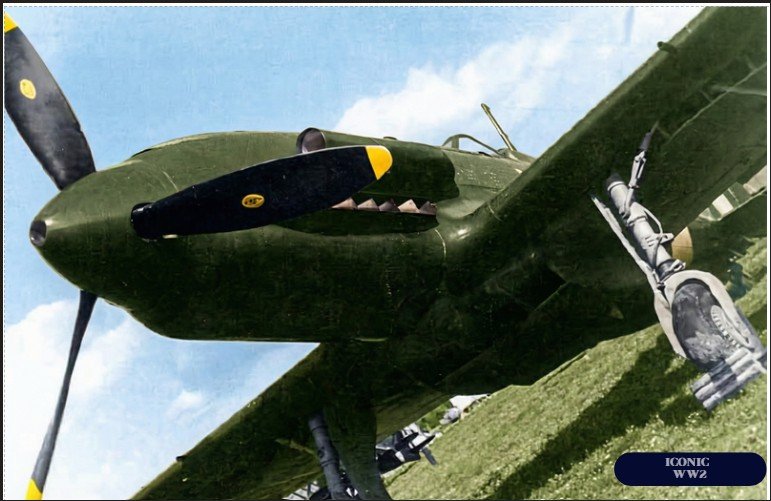
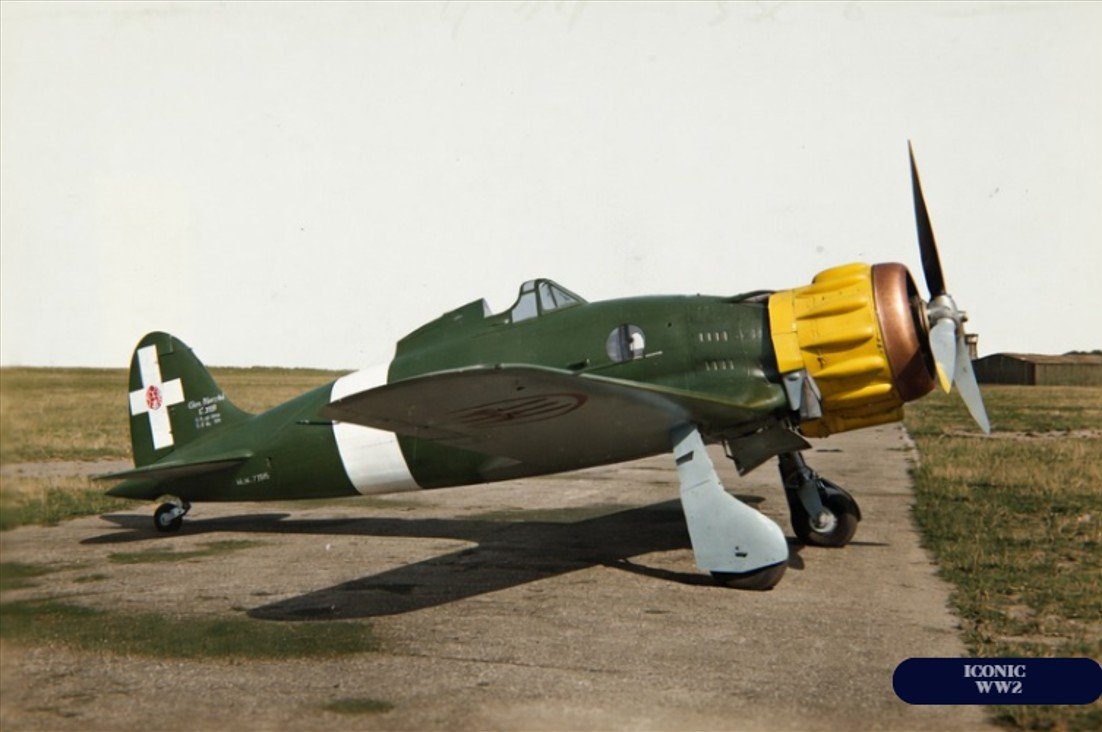
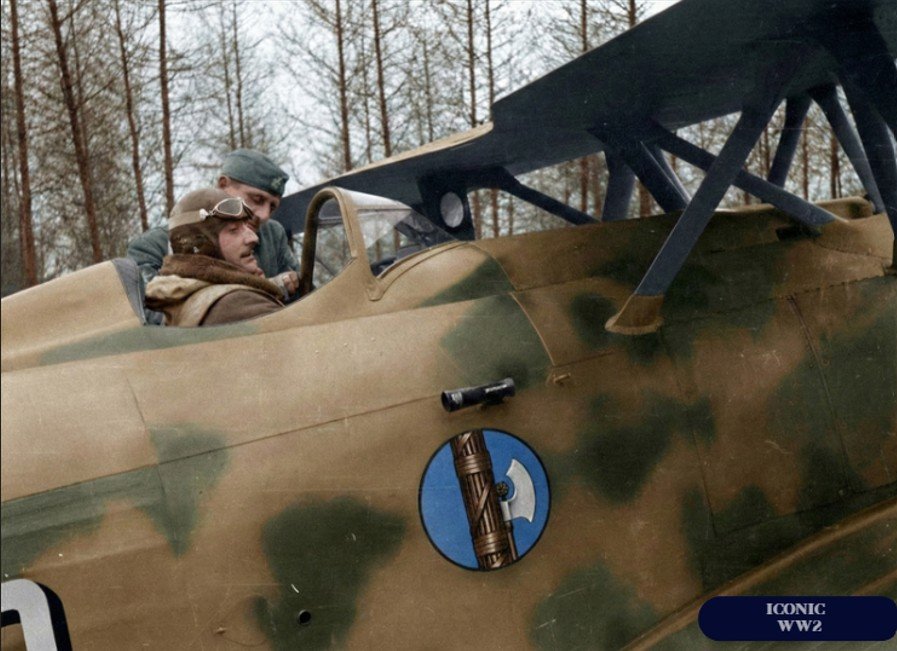
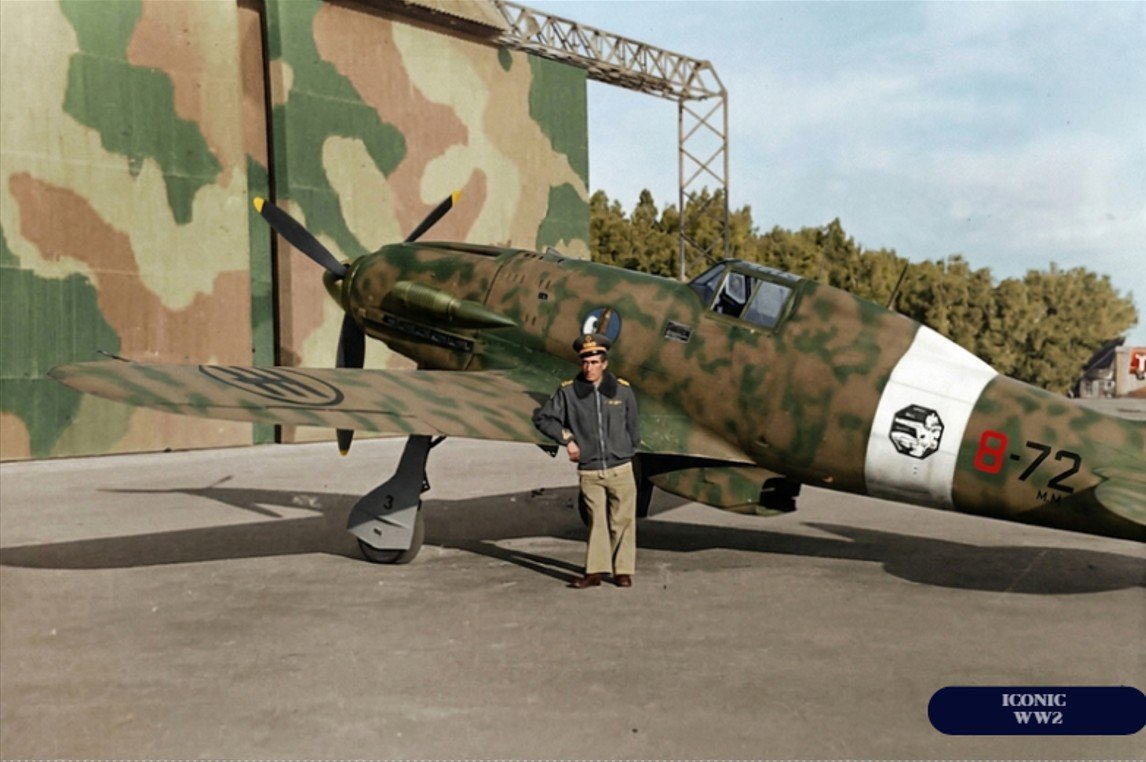
The Re.2002 Ariete (“Ram”) was the assault member of the Reggiane 2000 family, the line of sleek fighters built by Officine Meccaniche Reggiane of Reggio Emilia, part of the Caproni group. Its lineage ran from the radial-engined Re.2000 Falco of 1939, through the inline Re.2001 Falco II, to the superb Re.2005 Sagittario — and the Ariete was Roberto Longhi and Antonio Alessio’s answer to a specific need: a dedicated fighter-bomber for the Regia Aeronautica’s assault squadrons.
Its design turned on Italy’s chronic weakness — engines. The best Italian fighters of the war depended on the German Daimler-Benz inline, built under licence in limited numbers and jealously reserved for the pure interceptors like the Macchi C.202. For a fighter-bomber that would spend its life down low, the planners could not spare one — so the Ariete took the Re.2001’s graceful airframe and mated it, instead, to a home-built radial.
The engine was the Piaggio P.XIX RC.45, a 14-cylinder twin-row radial of around 1,175 hp. Bolting a broad radial onto the slender, elliptical-winged Reggiane airframe produced an aircraft of curious but pleasing proportions, and one that flew well: robust, stable, and — with the radial’s tolerance for battle damage — far better suited to the flak-swept business of ground and anti-ship attack than a liquid-cooled interceptor. First flown in October 1940, it reached a top speed of about 530 km/h.
Its real punch lay in its bombs. The Ariete could carry up to around 650 kg of ordnance — typically a 500 kg bomb slung under the fuselage with smaller bombs beneath the wings — enough to threaten a warship or a landing craft. Its guns were modest by late-war standards: two 12.7 mm Breda-SAFAT in the cowling and two 7.7 mm in the wings, adequate for strafing and for defending itself once the bombs were gone.
The Ariete came late, and slowly. Production at Reggio Emilia was dogged by material shortages and by Allied bombing, and it was not until the spring and summer of 1943 that the type reached the front-line assault units — chiefly the 5° Stormo Assalto and the 50° Stormo — just as Italy’s strategic position was collapsing and the war arrived on Italian soil.
Only about fifty Arietes reached Regia Aeronautica squadrons before the armistice, a fraction of the roughly 225 that would eventually be built. It was a familiar Italian story of the late war: a sound, capable design delivered in numbers far too small, and far too late, to change anything.
The Ariete’s brief combat career was spent hurling itself at the Allied invasion fleets. When the Allies landed in Sicily in Operation Husky on 10 July 1943, the fighter-bombers of the 5° Stormo were among the Italian aircraft that fell on the vast armada off the beaches, pressing home low-level and dive-bombing attacks against warships and transports through storms of naval anti-aircraft fire.
They did the same that September at Salerno (Operation Avalanche), striking the beachhead on the Italian mainland. But the odds were hopeless: over both landings the Allies held overwhelming air superiority, and the Arietes were hunted by the Spitfire and the P-38 Lightning and thinned by flak faster than they could be replaced. Their attacks were brave and occasionally damaging, but they could never be sustained.
Italy’s armistice of 8 September 1943 ended the Ariete’s Italian career almost as soon as it had begun. The Germans seized the Reggiane works at Reggio Emilia, took over the surviving airframes and ordered production to continue for their own use — so that a fair share of the type’s total output was in fact completed under German control after Italy had left the war.
The Luftwaffe put these captured and newly built Arietes to work far from home, operating them in southern France through 1944 on coastal-patrol and anti-partisan duties against the Resistance. It was an inglorious second life for an Italian assault aircraft — flown by its former ally against the maquis of another occupied country.
The Reggiane Re.2002 Ariete is a footnote to the air war, but a revealing one. It was a genuinely useful fighter-bomber — tough, adequately armed for its role and pleasant to fly — undone not by any great fault of its own but by the deeper failures around it: too few engines, too little industrial capacity, and a strategic collapse that overtook it within weeks of its arrival.
Alongside its stablemate the Re.2005, the Ariete illustrates the position of the late Reggiane designs: capable aircraft delivered in ones and twos as Allied air superiority over Italy became total. Its operational career amounts to a few weeks in the summer of 1943 against the invasion fleets off Sicily and Salerno, followed by a longer second life in German hands over southern France.
- Chris Dunning, Courage Alone: The Italian Air Force 1940–1943 (Hikoki Publications).
- Jonathan W. Thompson, Italian Civil and Military Aircraft 1930–1945 (Aero Publishers).
- Sergio Govi, I caccia Reggiane 2000-2001-2002-2005 (Giorgio Apostolo Editore).
Iconic WW2 is free, ad-free and tracker-free — kept going only by the time it takes to research, restore and colorize each machine. If this profile was worth your read, you can help the archive grow.
| Manufacturer | Officine Meccaniche Reggiane (Caproni) |
| Nation | Italy |
| Role | Fighter-bomber / assault |
| Designers | Roberto Longhi & Antonio Alessio |
| First Flight | October 1940 |
| Service Entry | 1943 |
| Units Built | ~225 (~50 to the Regia) |
| Re.2000 Falco | Radial-engined first of the line, 1939 |
| Re.2001 Falco II | Inline DB 601-powered fighter |
| Re.2002 Ariete | Radial fighter-bomber |
| Re.2005 Sagittario | DB 605 high-altitude interceptor |
| Engine | Piaggio P.XIX RC.45 |
| Type | 14-cyl twin-row radial, air-cooled |
| Power | ~1,175 hp |
| Note | Radial chosen — inline engines reserved for interceptors |
| Max Speed | ~530 km/h |
| Range | ~1,100 km |
| Service Ceiling | ~10,500 m |
| Role height | Low-level attack |
| Length | 8.16 m |
| Wingspan | 11.00 m |
| Height | 3.15 m |
| Loaded Weight | ~3,240 kg |
| Machine Guns | 2× 12.7 mm + 2× 7.7 mm Breda-SAFAT |
| Bomb Load | up to ~650 kg |
| Typical | 1× 500 kg + wing bombs |
| Primary role | Anti-shipping / ground attack |