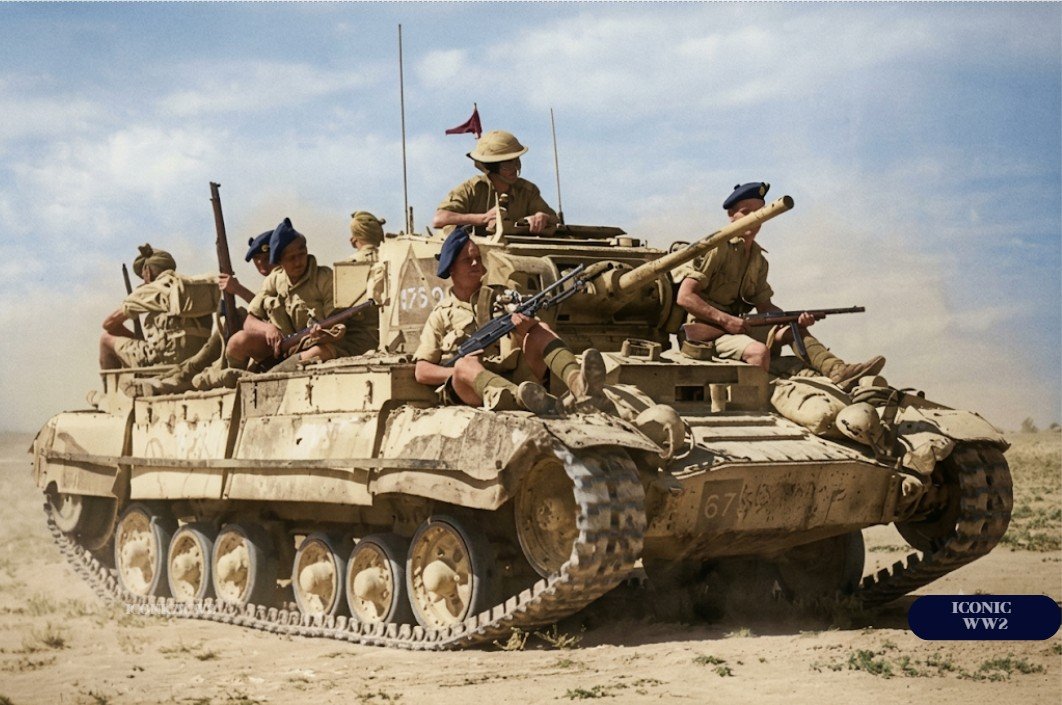
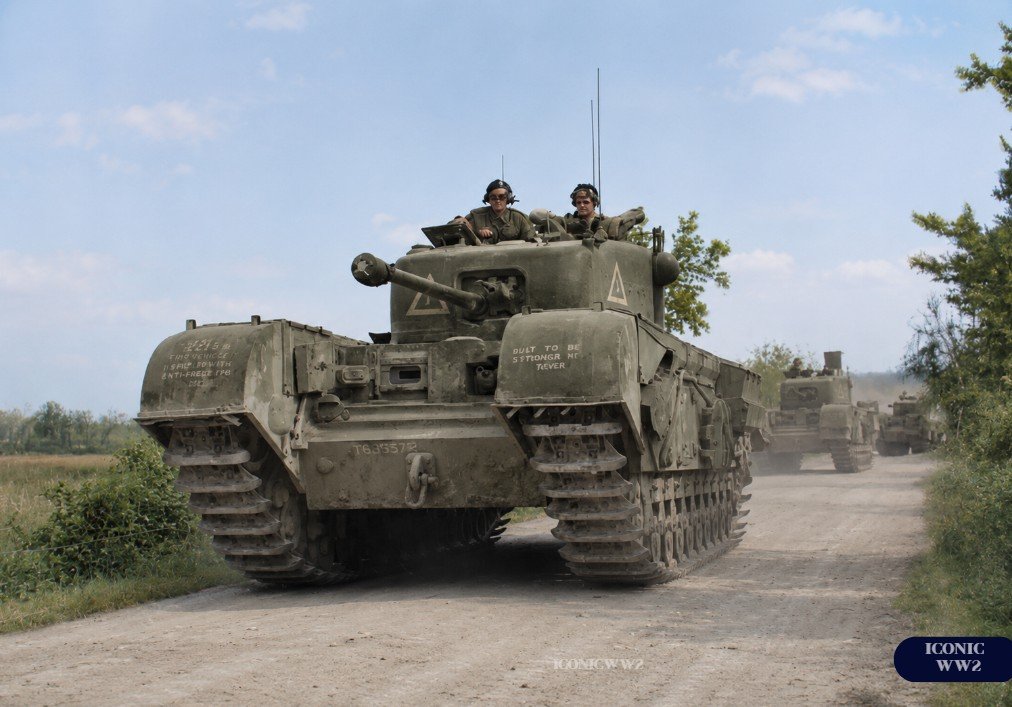
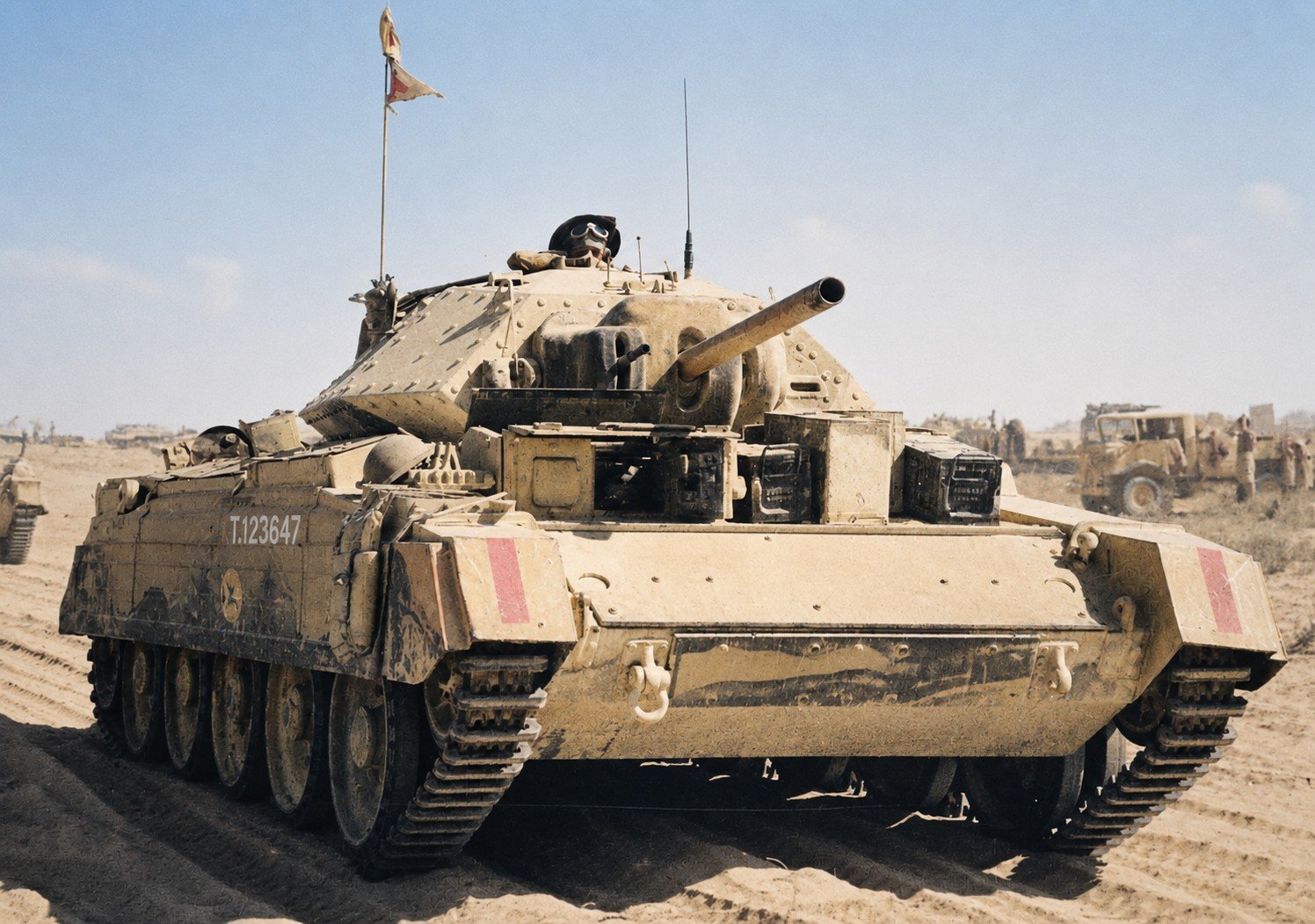
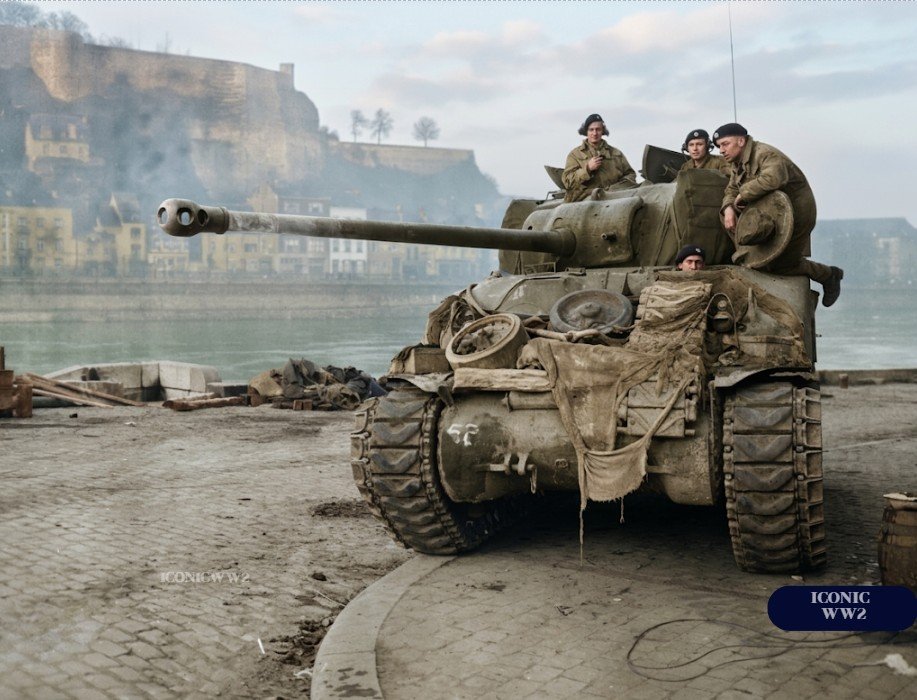
British tank doctrine between the wars split armour into two rigid families. Cruiser tanks were to be fast and lightly armoured, racing through gaps like cavalry; infantry tanks were to be slow and immensely thick-skinned, advancing at a walking pace alongside the foot soldiers they protected. The Matilda II was the supreme expression of the second idea — a tank built around armour above all else.
Designed in the late 1930s as a successor to the tiny machine-gun-armed Matilda I, the Mk II was a far more serious vehicle: heavily armoured, armed with a real anti-tank gun, and shaped by the conviction that an infantry tank's first duty was to survive the storm of fire that broke up infantry attacks. It was complex and expensive to build, but when it reached the battlefield it proved, for a time, almost unstoppable.
The Matilda's defining feature was its armour. With up to 78mm on the hull and turret front — far thicker than that of any contemporary German or Italian tank — it was effectively immune to the standard anti-tank guns of 1940. German and Italian gunners watched their rounds bounce off it in disbelief, and only the famous 88mm flak gun, pressed into the anti-tank role, could reliably destroy it.
That protection came at the usual price. The Matilda was painfully slow, managing only around 24 km/h on roads and far less across country, driven by a complicated twin-engine arrangement. Its 2-pounder (40mm) gun was a decent anti-tank weapon for its day, but it fired no high-explosive shell — a crippling gap that left the tank poorly equipped to deal with the anti-tank guns and infantry positions that were its real enemies.
Above all, the Matilda could not grow. Its narrow turret ring left no room to fit a larger gun, so as the war went on and bigger weapons appeared, the tank that had been nearly invincible in 1940 could not be up-gunned to keep pace. Its moment of dominance, though spectacular, was destined to be brief.
Several marks of the Matilda II appeared, differing mainly in engines and detail equipment, and the basic vehicle was adapted to a wide range of specialised roles — the mine-clearing Matilda Scorpion with its flailing chains, flamethrower versions such as the Australian Matilda Frog, dozer and bridging variants among them.
When the Matilda was withdrawn from front-line European service it found a remarkable second life in the Pacific. Large numbers were supplied to Australia, whose forces used the tough, well-protected tanks in the close jungle fighting of New Guinea and Borneo right through to the end of the war — long after the type had vanished from the deserts where it made its name. A number were also sent to the Soviet Union under Lend-Lease.
The Matilda's reputation was forged in North Africa. During Operation Compass in late 1940 it spearheaded the British offensive that shattered the Italian army in Egypt and Libya, its armour shrugging off the fire of the Italian M13/40s and anti-tank guns ranged against it. To the men who faced it, and to those who rode it to victory, it became the "Queen of the Desert."
Its secret was armour. Up to 78 mm thick, the Matilda’s hull and turret were proof against almost every anti-tank weapon it met in 1940, and it could grind forward through the fire of the Italian M13/40s and their guns all but untouched. Slow it certainly was — barely walking pace across country — but for the infantry it escorted, a near-invulnerable tank was worth far more than a fast one.
Its dominance ended abruptly with the arrival of Rommel and the Afrika Korps. Denied a high-explosive round, the Matilda struggled against German anti-tank screens, and Rommel's tactic of luring British armour onto concealed 88mm guns proved its undoing. At the disastrous Battle of Gazala and in the cauldron battles of 1942 the slow, under-gunned infantry tanks were picked apart, and the Matilda was steadily withdrawn from the desert in favour of newer designs.
Yet even in eclipse it had earned its place. For a crucial year, when Britain stood at her most exposed, the Matilda had been one of the few weapons that could meet the enemy and win — a symbol of dogged resilience in the worst of times.
Around 2,987 Matilda IIs were built, and for a brief, vivid period it was arguably the best tank in the world at the one thing it was designed to do: survive. Its thick armour made it the terror of the early desert war and the saviour of more than one hard-pressed British attack, and it remains one of the iconic Allied tanks of the war's opening years.
Its weaknesses — glacial speed, a gun with no high-explosive shell, and a turret too small to up-gun — meant its reign was short, and it was soon overtaken by more balanced designs. But the Matilda is remembered with real affection as the unbeatable "Queen of the Desert" of 1940–41, the heavily-armoured workhorse that stood firm when Britain had little else, and soldiered on in the jungles of the Pacific to the very end.
- Peter Chamberlain & Chris Ellis, British and American Tanks of World War Two (Arms & Armour Press).
- David Fletcher, Matilda Infantry Tank 1938–45 (Osprey, New Vanguard).
Iconic WW2 is free, ad-free and tracker-free — kept going only by the time it takes to research, restore and colorize each machine. If this profile was worth your read, you can help the archive grow.
| Manufacturer | Vulcan Foundry (design) |
| Also built by | Ruston · LMS · Harland & Wolff & others |
| Nation | United Kingdom |
| Role | Infantry tank |
| Service Entry | 1939 |
| Crew | 4 (commander, gunner, loader, driver) |
| Units Built | ~2,987 |
| Matilda II (Mk I–V) | Engine & detail improvements |
| Matilda Scorpion | Mine-flail clearing tank |
| Matilda Frog / Murray | Australian flamethrower tanks |
| Matilda CDL | Searchlight "canal defence light" |
| Lend-Lease | Supplied to USSR & Australia |
| Engine | 2× AEC / Leyland diesels |
| Type | Twin 6-cyl diesel |
| Power | ~190 hp (combined) |
| Note | Reliable but underpowered for the weight |
| Road Speed | ~24 km/h |
| Cross-country Speed | ~13 km/h |
| Range (road) | ~257 km |
| Suspension | Bogie "Japanese"-type with skirts |
| Length | 5.61 m |
| Width | 2.59 m |
| Height | 2.52 m |
| Combat Weight | ~25 t |
| Main Gun | QF 2-pounder (40 mm) |
| Secondary | 7.92 mm Besa MG |
| Hull Front Armour | up to 78 mm |
| Turret Front Armour | up to 75 mm |
| Limitation | No HE round; turret too small to up-gun |