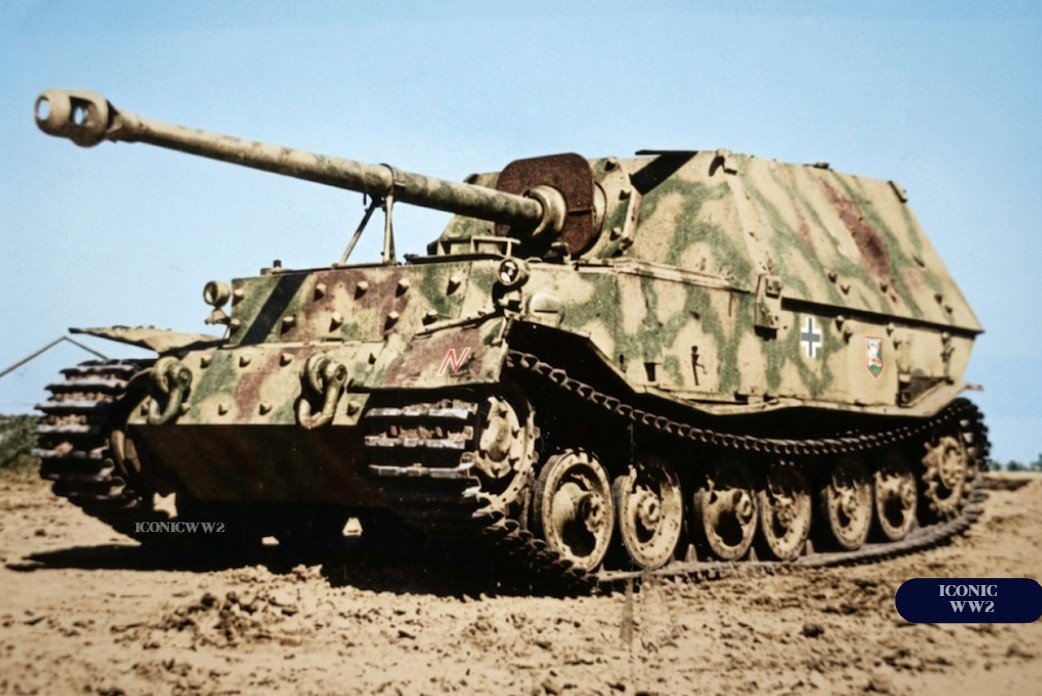
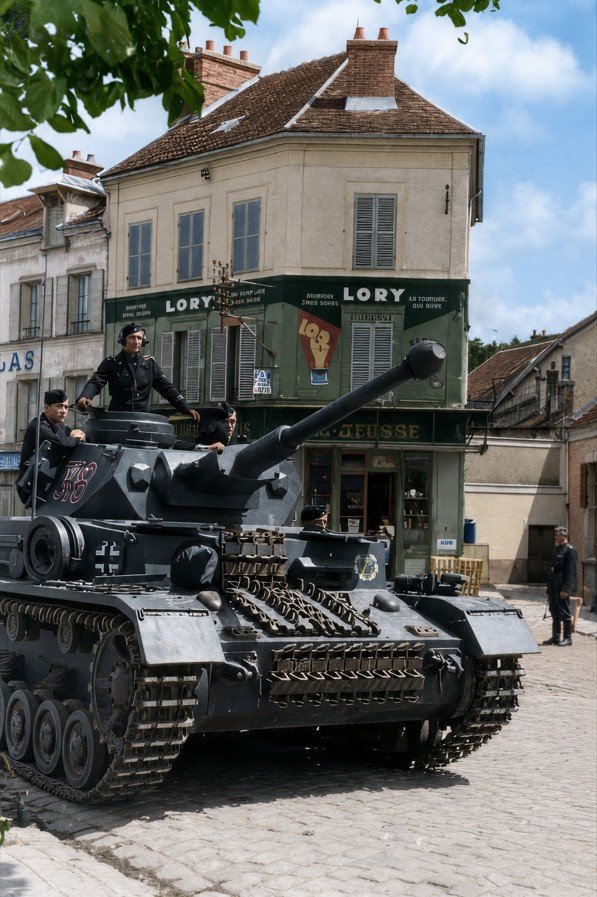
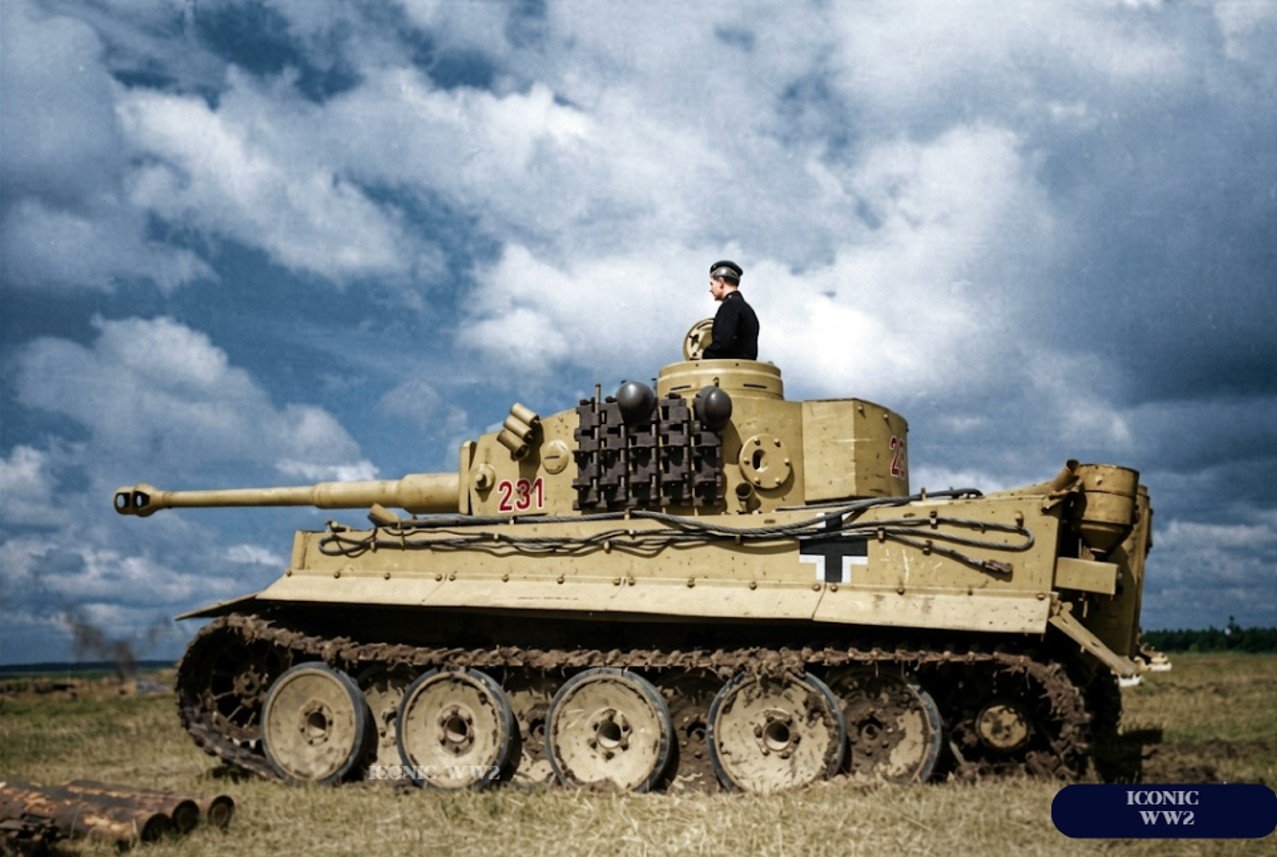
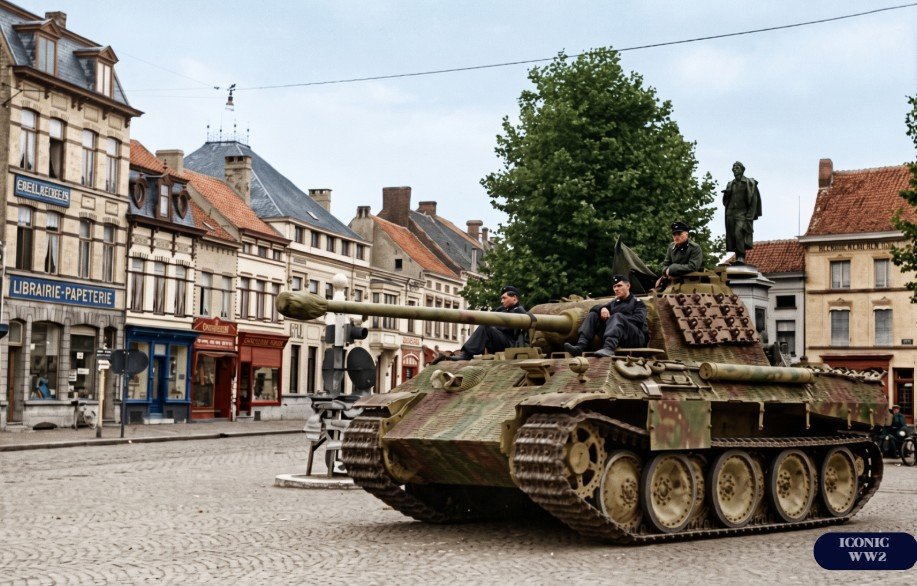
The Sturmgeschütz was not conceived as a tank at all, but as a weapon for the infantry. In the mid-1930s a memorandum attributed to Erich von Manstein argued that the foot soldier needed an armoured gun of his own — a vehicle that could roll forward with the infantry and blast apart the machine-gun nests, bunkers and anti-tank guns that broke up an assault. Crucially, this assault artillery would belong to the artillery arm, not the panzer divisions, and would be crewed by gunners rather than tankers.
The answer was to mount a gun in a fixed, fully armoured casemate on the proven chassis of the Panzer III. Dispensing with a rotating turret kept the vehicle low, simple and cheap, and freed up weight for thicker frontal armour and a bigger gun than the host tank could carry. Built by Alkett and later MIAG, the first Sturmgeschütz IIIs entered service in 1940 — and went on to become the most-produced German armoured fighting vehicle of the entire war.
The early models — the Ausf. A through E — carried the same short-barrelled 7.5 cm StuK 37 L/24 howitzer as the early Panzer IV, ideal for hurling high-explosive in close support but almost useless against armour. In its intended role it was excellent, and it proved its worth in the opening campaigns in France, the Balkans and the first months in Russia.
Then, as with so much German armour, the shock of the Soviet T-34 and KV-1 changed everything. From 1942 the StuG was rearmed with the long, high-velocity 7.5 cm StuK 40 in the Ausf. F, G and definitive late models, transforming the humble assault gun into a formidable tank destroyer. Its low silhouette made it hard to see and harder to hit, it could be dug in or fought from ambush, and its frontal armour was thickened to 80 mm and given bolt-on side skirts.
Above all, the StuG was cheap and quick to build. Without a turret it cost far less than a gun tank and could be produced in enormous numbers by an industry that was always straining to keep pace with losses. When the main Alkett plant was bombed, production of a near-identical assault gun was even shifted onto the Panzer IV chassis as the StuG IV. The trade-off was the fixed casemate: the StuG could not traverse its gun, and had to turn its whole hull to aim — a real handicap in a fast-moving tank fight or a close-range ambush from the flank.
The line divides cleanly into the short-gun assault versions (A–E) of 1940–42 and the long-gun tank-killer versions (F, F/8 and the definitive G) that dominated from 1942 to the end of the war. The Ausf. G, with its roomier superstructure, commander's cupola and eventually a remote machine gun and Saukopf cast mantlet, was built in by far the greatest numbers.
Two important relatives rounded out the family. The StuH 42 mounted a 10.5 cm howitzer in the same hull to restore the dedicated infantry-support punch the up-gunned StuG had lost, and the StuG IV put the same casemate on a Panzer IV chassis when Panzer III production ended. Together they made the Sturmgeschütz one of the most widespread armoured vehicles in German service.
The StuG III fought on every front the German Army did, from the assault batteries of 1940 to the rubble of 1945. Conceived as an infantry-support assault gun, it gave the foot soldier a measure of armoured support he otherwise lacked; but once up-gunned with the long 7.5 cm StuK 40, it became a lethal tank-killer.
In that role it earned an extraordinary record: by some measures the StuG was the highest-scoring German armoured vehicle of the war, credited with an enormous tally of Allied and Soviet tanks. Cheaper and faster to build than a turreted tank — around 10,000 of all StuG III variants were produced — it was turned out in numbers no German tank could match, and it accounted for more enemy armour than any of them.
Its virtues suited the defensive war Germany increasingly fought after 1943. Cheap, reliable, low and easy to conceal, the StuG was the ideal ambush weapon — lying hidden in a tree line or hull-down behind a rise, knocking out advancing tanks before they could locate it. Whole brigades of assault guns plugged gaps in the line that there were no longer enough tanks to fill.
Its weaknesses were the price of its cheapness. The fixed gun made it vulnerable when caught in a fluid, close-range melee or struck from the flank, and it lacked the all-round flexibility of a true tank. But for a nation fighting outnumbered and on the defensive, a plentiful, deadly, easily-built gun carrier was exactly what was needed — and the StuG was supplied to numerous German allies and served on in several armies for years after 1945.
The Sturmgeschütz III is the great unsung workhorse of the German army. It began life as a specialist infantry-support vehicle and grew, almost by accident, into the Wehrmacht's most numerous armoured vehicle and one of its most effective tank-killers — a triumph of the simple, buildable and good-enough over the complex and the rare.
With well over 10,000 built, it did more of Germany's actual armoured fighting than the glamorous Tiger and Panther combined, and at a fraction of the cost. Turretless and unassuming, the StuG embodied a hard truth of the late war: that on the defensive, a cheap gun that could be hidden, massed and replaced was worth far more than a wonder weapon that was always too few. It remains the definitive assault gun of the Second World War.
- Thomas L. Jentz, Panzer Tracts No. 8: Sturmgeschütz.
- Peter Müller & Wolfgang Zimmermann, Sturmgeschütz III: Backbone of the German Infantry (History Facts).
- Bruce Culver, Sturmgeschütz III in Action (Squadron/Signal).
- Hilary L. Doyle & Thomas L. Jentz, Sturmgeschütz III & IV 1942–45 (Osprey, New Vanguard).
Iconic WW2 is free, ad-free and tracker-free — kept going only by the time it takes to research, restore and colorize each machine. If this profile was worth your read, you can help the archive grow.
| Manufacturer | Alkett (Daimler-Benz design) |
| Also built by | MIAG · Alkett |
| Nation | Germany |
| Role | Assault gun / tank destroyer |
| Designation | Sd.Kfz. 142 |
| Service Entry | 1940 |
| Crew | 4 (commander, gunner, loader, driver) |
| Units Built | ~10,000+ (most-produced German AFV) |
| Ausf. A–E | Short 7.5 cm L/24 assault gun |
| Ausf. F / F/8 | First long 7.5 cm StuK 40 |
| Ausf. G | Definitive, most-produced model |
| StuH 42 | 10.5 cm howitzer support version |
| StuG IV | Same casemate on Panzer IV chassis |
| Engine | Maybach HL 120 TRM |
| Type | V-12 petrol |
| Power | ~300 hp |
| Base | Panzer III chassis |
| Road Speed | ~40 km/h |
| Cross-country Speed | ~20 km/h |
| Range (road) | ~155 km |
| Combat Weight | ~23.9 t (Ausf. G) |
| Length (with gun) | 6.85 m |
| Hull Length | 5.56 m |
| Width | 2.95 m |
| Height | 2.16 m (very low) |
| Combat Weight | ~23.9 t |
| Main Gun | 7.5 cm StuK 40 L/48 |
| Secondary | 7.92 mm MG 34 (remote on late G) |
| Front Armour | up to 80 mm |
| Side Skirts | Schürzen (5 mm) |
| Limitation | Fixed casemate — no gun traverse |