By the mid-1930s the Royal Navy — the service that had pioneered the aircraft carrier — found its carrier fleet ageing and largely made up of awkward conversions from other ship types. What it needed was a modern carrier designed from the keel up to operate aircraft, built within the tonnage limits of the naval treaties but incorporating all the hard-won lessons of two decades of naval aviation.
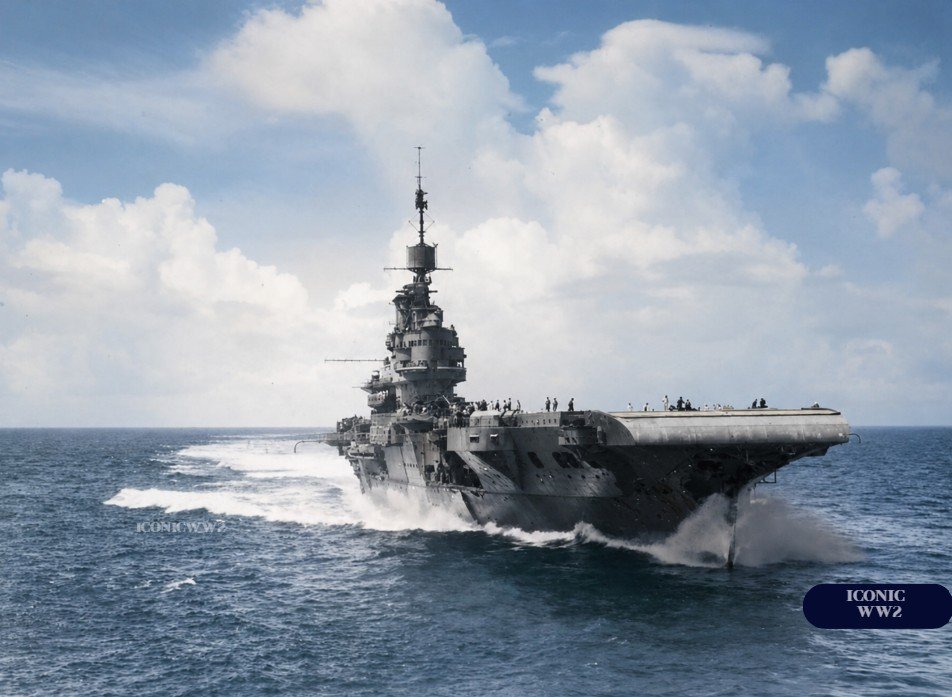
The answer was HMS Ark Royal, laid down at Cammell Laird on the Mersey and commissioned in 1938. With her two full-length hangar decks, three aircraft lifts and a long flight deck carried out over the stern, she could embark a powerful air group of around sixty aircraft — and she became, in the public mind, the very symbol of the Royal Navy's air arm in the opening years of the war.
Ark Royal was a fast, capable and handsome ship, able to make around 31 knots and to operate and recover large strikes quickly. Her design packed an unusually large air group onto a treaty-limited hull by using two superimposed hangars, and her long, overhanging flight deck gave her aircraft the room they needed to launch and land. For her day she was among the most efficient carriers afloat.
Her aircraft, however, were a mixed blessing. Through inter-service politics the Fleet Air Arm had been starved of modern designs, and Ark Royal went to war flying types like the obsolescent Fairey Swordfish — a fabric-covered torpedo biplane so antiquated it seemed a museum piece. Yet the slow, sturdy “Stringbag,” flown with extraordinary courage, would prove one of the most effective weapons in her arsenal.
Like all carriers she was acutely vulnerable to underwater damage, and her protective and damage-control arrangements — particularly her machinery and electrical layout — concealed weaknesses that would, in the end, cost her her life from a single torpedo hit that a better-subdivided ship might well have survived.
From the first weeks of the war Ark Royal was in the thick of the action, hunting the pocket battleship Graf Spee in the South Atlantic, fighting off air attack in the North Sea, and covering the Norwegian campaign. She then became the carrier of the famous Force H, based at Gibraltar, guarding the western Mediterranean and the vital convoys to besieged Malta.
So prominent was she that German propaganda made a special target of her, repeatedly and triumphantly announcing that she had been sunk — only for the ship to reappear, unmistakably afloat. The taunting radio question “Where is the Ark Royal?” became a running joke in Britain and a point of pride for her crew, much as the Americans' USS Enterprise was reported sunk again and again in the Pacific.
Ark Royal's place in history was secured in May 1941. When the German battleship Bismarck broke out into the Atlantic, sank HMS Hood and then slipped her pursuers while running for France, it fell to Force H — and to Ark Royal — to stop her. With the German ship close to the protection of Luftwaffe air cover, the Royal Navy's last chance lay in the carrier's aircraft.
In appalling weather, the Swordfish of Ark Royal flew off into rain and heavy seas to attack. After a near-disastrous first strike on the wrong ship, a second strike pressed home, and a single torpedo struck Bismarck's stern and jammed her rudder, locking the great battleship into a helpless circle. Unable to steer away, Bismarck was caught and destroyed by the British battle fleet the next morning.
It was one of the most decisive air strikes of the naval war, delivered by obsolete biplanes from Ark Royal's deck — the moment that, more than any other, made the carrier famous and avenged the loss of the Hood.
It was a supreme irony. The Swordfish — the “Stringbag”, an open-cockpit biplane already obsolete when the war began — had crippled the most powerful battleship afloat where all the guns of the fleet had failed to catch her. Ark Royal, so long the target of German propaganda that had “sunk” her many times over, had struck the decisive blow of the whole Bismarck chase.
Ark Royal did not long survive her greatest triumph. On 13 November 1941, returning to Gibraltar, she was struck by a single torpedo from the German submarine U-81. The hit should not have been fatal — but flooding spread through poorly-subdivided spaces, her power and pumps failed, and over many hours the list grew beyond saving. She finally capsized and sank on 14 November, within sight of Gibraltar.
That the long, slow sinking cost the life of only one of her near-1,500 crew was a mercy; that the ship was lost at all, from a single torpedo, was a hard lesson in carrier damage control that the Royal Navy took deeply to heart. HMS Ark Royal is remembered as the most famous British carrier of the early war — the ship the enemy could never sink by boast, whose antiquated Swordfish struck the blow that doomed the Bismarck, and whose name the Royal Navy has proudly carried on ever since.
- Roger Chesneau (ed.), Conway’s All the World’s Fighting Ships 1922–1946 (Conway Maritime Press).
- David Hobbs, British Aircraft Carriers: Design, Development and Service Histories (Seaforth).
Iconic WW2 is free, ad-free and tracker-free — kept going only by the time it takes to research, restore and colorize each machine. If this profile was worth your read, you can help the archive grow.
| Name | Ark Royal (pennant 91) |
| Builder | Cammell Laird, Birkenhead |
| Nation | United Kingdom |
| Type | Fleet aircraft carrier |
| Commissioned | 16 December 1938 |
| Sunk | 14 November 1941 (U-81, off Gibraltar) |
| Crew | ~1,580 |
| Ships in Class | 1 (unique) |
| Fighters | Fairey Fulmar / Blackburn Skua |
| Torpedo-bombers | Fairey Swordfish (“Stringbag”) |
| Famous strike | Crippled Bismarck, May 1941 |
| Complement | ~50–60 aircraft |
| Machinery | 3× geared steam turbines |
| Boilers | 6 Admiralty 3-drum |
| Power | ~102,000 shp |
| Shafts | 3 |
| Max Speed | ~31 knots |
| Range | ~7,600 nmi at 20 kn |
| Standard Displacement | ~22,000 t |
| Full Load | ~27,700 t |
| Length | 243.8 m |
| Beam | 28.9 m |
| Draught | ~8.5 m |
| Main role | Force H fleet carrier (Gibraltar) |
| Key actions | Hunt for Bismarck · Malta convoys · Norway |
| Famous strike | Swordfish jammed Bismarck's rudder |
| Casualties | 1 of ~1,500 (slow sinking) |