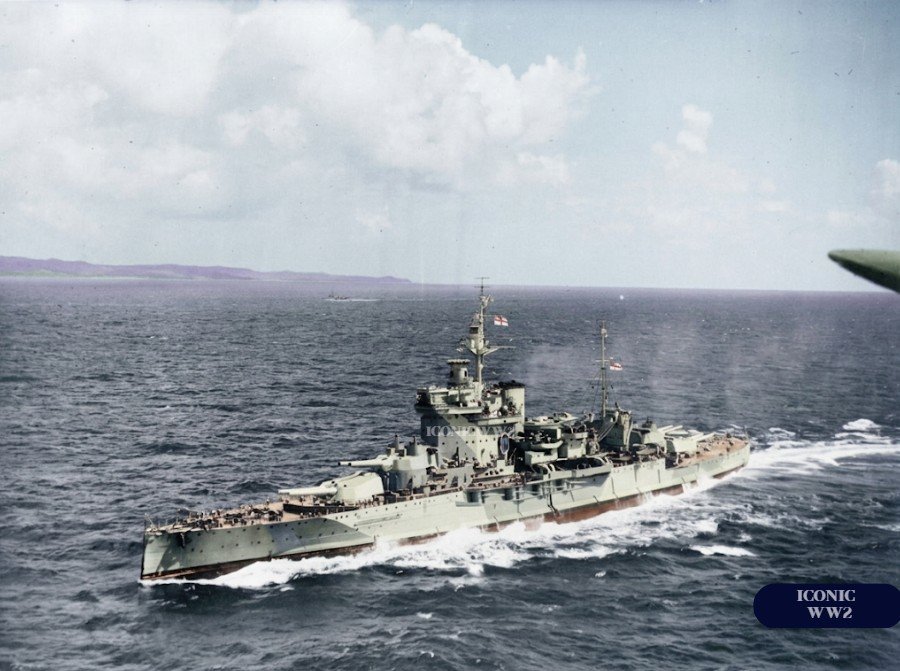
HMS Hood was the last and greatest of the battlecruisers — a type that had been the great gamble of the pre-war Royal Navy. Battlecruisers carried the heavy guns of a battleship but traded away armour for speed, on the theory that they could outrun anything they could not outfight. The Battle of Jutland in 1916 exposed the flaw in that bargain with horrifying clarity: three British battlecruisers blew up and sank with appalling loss of life when plunging shells reached their magazines.
Hood was already being designed when Jutland was fought, the lead ship of the planned four-strong Admiral class. The disaster prompted a hurried revision, and extra armour was worked into her design — but she remained at heart a fast, lightly-protected battlecruiser, not a true battleship. Her three sisters were cancelled at the end of the First World War, and Hood alone was completed, commissioned in 1920 as the largest warship in the world.
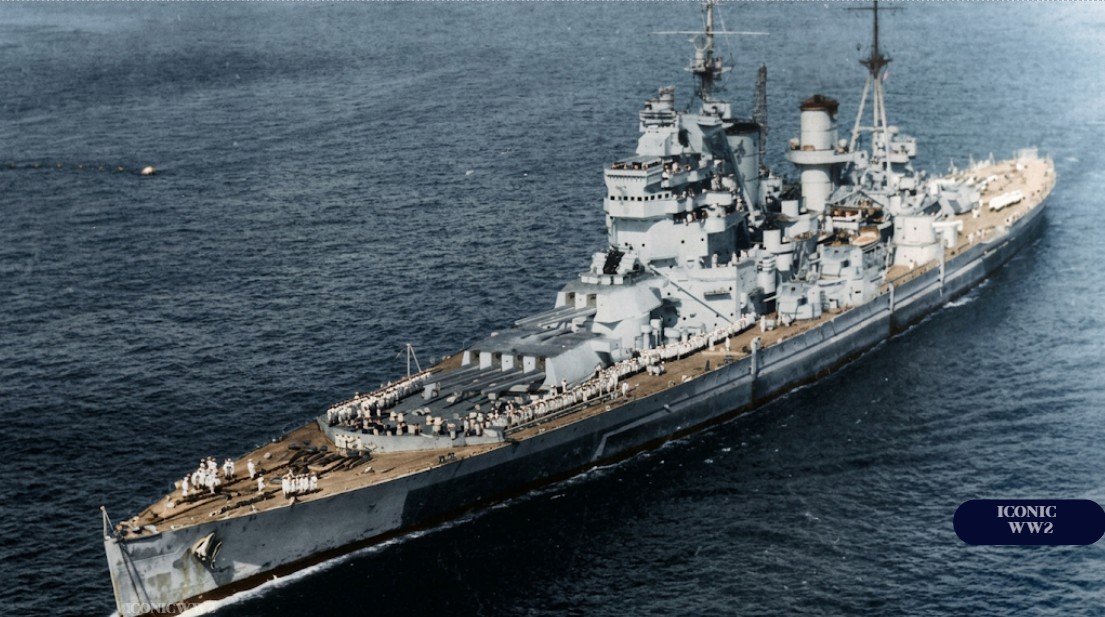
Hood was, by common consent, one of the most beautiful warships ever built — long, low and graceful, her power and elegance making her the very image of British sea power between the wars. She mounted eight 15-inch (381 mm) guns in four twin turrets, the same superb weapon carried by the Queen Elizabeth-class battleships, and at around 31 knots she was fast enough to go almost anywhere and impress everyone.
But beneath the graceful lines lay the battlecruiser's fatal compromise. Her armour, though improved after Jutland, was a patchwork that left her deck protection dangerously thin against the long-range, steeply-plunging shellfire that defined modern naval gunnery. As guns and ranges grew through the 1920s and 30s, this weakness became ever more acute — and a planned major reconstruction to fix it was repeatedly postponed and then overtaken by the outbreak of war.
By 1939 Hood was a tired ship. Two decades of hard steaming as the Royal Navy's premier showpiece had worn her machinery, and the modernisation that might have thickened her decks and renewed her engines had never come. Magnificent to look at and still heavily armed, she went to war carrying a hidden, twenty-year-old flaw into an age of gunnery she had never been built to survive.
For twenty years Hood was the most famous warship in the world — the embodiment of the Royal Navy and of British imperial power. In 1923–24 she led the "Empire Cruise," a circumnavigation of the globe that showed the flag in ports across the Empire and made her familiar to millions. To the British public she was simply "The Mighty Hood," a symbol of naval supremacy that seemed permanent and unchallengeable.
That very fame would magnify the shock of her loss. When war came she served with the Home Fleet and at Force H, taking part in the painful action against the French fleet at Mers-el-Kébir in 1940. But her destiny lay in the North Atlantic, where in May 1941 she was sent to intercept the most dangerous warship Germany had yet sent to sea.
In May 1941 the German battleship Bismarck and the heavy cruiser Prinz Eugen broke out into the Atlantic to raid the convoys. Hood, flying the flag of Vice-Admiral Lancelot Holland, was dispatched with the new battleship HMS Prince of Wales to intercept them. On the morning of 24 May 1941, the two forces met in the icy waters of the Denmark Strait.
The British closed the range head-on to shorten the time their thin-decked flagship was exposed to plunging fire — but it was not enough. After only a few minutes of firing, a salvo from Bismarck straddled Hood. A shell is believed to have plunged through her deck armour and detonated a main magazine. In an instant the great ship was torn apart by a cataclysmic explosion, broke in two, and sank in around three minutes.
Of her company of 1,418 men, only three survived. The destruction of the Royal Navy's most famous and beloved warship, in minutes and almost without warning, sent a profound shock through Britain — and turned the hunt for the Bismarck into a national obsession that would not rest until the German battleship was herself sent to the bottom three days later.
The loss was as much psychological as material. For a generation Hood had been the living symbol of the Royal Navy — shown off in ports around the world, known to every schoolchild in Britain. To see her annihilated in three minutes by a single German salvo struck at the nation’s very sense of itself, and the Admiralty’s response was blunt: “Sink the Bismarck.” The Royal Navy would spend the next three days doing exactly that.
HMS Hood was the proudest warship of her age and, for a generation, the very symbol of British naval might — beautiful, fast, heavily armed and seemingly invincible. Her sudden annihilation in the Denmark Strait was one of the most shocking moments of the war at sea, a blow to British morale out of all proportion to the loss of a single ship.
Her fate was the final, terrible verdict on the battlecruiser concept: that speed and big guns could never make up for armour too thin to survive a modern shell. The wreck, discovered in 2001, lies broken on the floor of the Denmark Strait and is protected as a war grave for the 1,415 men who died with her. "The Mighty Hood" endures as the most poignant warship in Royal Navy history — magnificent, flawed, and lost in a heartbeat.
- Roger Chesneau (ed.), Conway’s All the World’s Fighting Ships 1922–1946 (Conway Maritime Press).
- Bruce Taylor, The Battlecruiser HMS Hood: An Illustrated Biography 1916–1941 (Seaforth Publishing).
Iconic WW2 is free, ad-free and tracker-free — kept going only by the time it takes to research, restore and colorize each machine. If this profile was worth your read, you can help the archive grow.
| Class | Admiral |
| Builder | John Brown & Co., Clydebank |
| Nation | United Kingdom |
| Type | Battlecruiser |
| Commissioned | 15 May 1920 |
| Sunk | 24 May 1941 (Denmark Strait) |
| Crew | ~1,420 |
| Ships in Class | 1 completed (3 cancelled) |
| Hood | Only Admiral-class ship completed |
| Sisters | Anson, Howe, Rodney — all cancelled 1919 |
| Destroyed by | KMS Bismarck (24 May 1941) |
| Survivors | 3 of 1,418 |
| Machinery | 4× Brown-Curtis geared turbines |
| Boilers | 24 Yarrow |
| Power | ~144,000 shp |
| Shafts | 4 |
| Max Speed | ~31 knots |
| Range | ~5,300 nmi at 20 kn |
| Standard Displacement | ~42,000 t |
| Full Load | ~48,000 t |
| Length | 262.3 m |
| Beam | 31.8 m |
| Draught | ~9.8 m |
| Main Battery | 8× 381 mm /42 (4×2) |
| Secondary | 12× 140 mm + AA & torpedoes |
| Belt Armour | up to 305 mm |
| Weakness | Thin deck armour vs plunging fire |