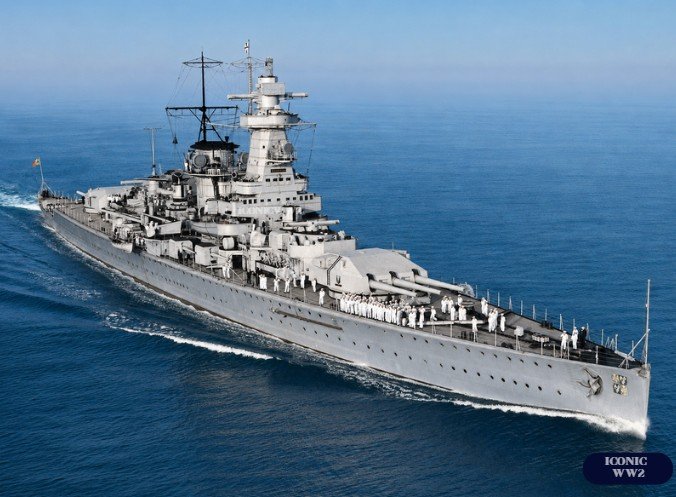
As Nazi Germany tore up the disarmament restrictions of the Versailles Treaty in the mid-1930s, the rebuilt Kriegsmarine set out to construct a fleet of modern capital ships capable of challenging the Royal Navy on the world's oceans. The centrepiece of this ambition was a pair of immensely powerful fast battleships, the Bismarck class — the largest warships Germany had ever built and, when completed, among the most formidable afloat anywhere.
The lead ship, Bismarck, was laid down at the Blohm & Voss yard in Hamburg and commissioned in August 1940. Named for Otto von Bismarck, the architect of German unification, she was conceived for a specific and dangerous purpose: not to fight pitched fleet battles, but to break out into the Atlantic and fall upon the convoys that were Britain's lifeline, threatening to sever the supply route on which the island nation depended for survival.
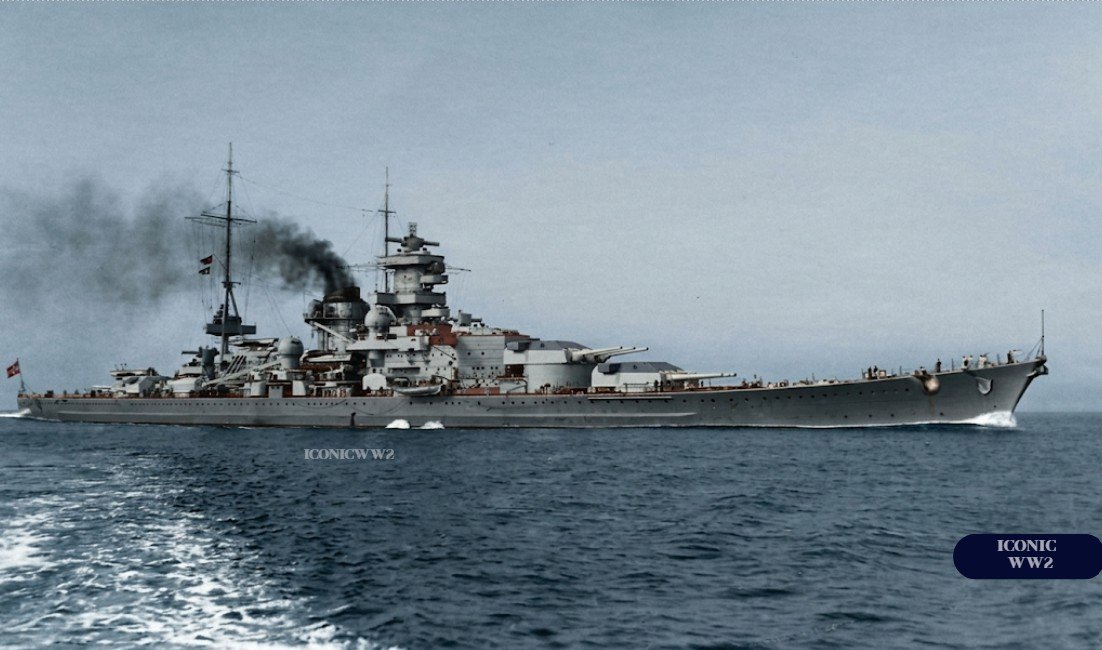
Bismarck was a superb piece of naval engineering, built to a refined evolution of First World War German design principles. Her main battery of eight 380mm (15-inch) guns in four twin turrets was served by an exceptionally accurate fire-control system, and she was protected by a thick, well-distributed armour scheme that made her extraordinarily hard to sink. Capable of around 30 knots, she combined heavy firepower with high speed.
Her protective scheme emphasised survivability above all — a dense armoured raft and fine subdivision that allowed her to keep floating and fighting long after a lesser ship would have gone down. This toughness would be demonstrated, terribly, in her final hours.
She was not without flaws. Her armour layout, optimised for the shorter ranges of an earlier era, left some vulnerability to plunging long-range fire, and like all battleships of her generation she was acutely exposed to the new menace of carrier-borne aircraft — a weakness that would prove her undoing. But in a gun duel, ship to ship, Bismarck was as dangerous an opponent as existed in 1941.
Bismarck’s one and only sortie began on 19 May 1941, when she slipped out of Gotenhafen in company with the heavy cruiser Prinz Eugen, under the command of Admiral Günther Lütjens. Their orders were to break into the open Atlantic and fall on the convoys, and secrecy was everything — but it did not last. Steaming north toward Norway the squadron was sighted, and on 21 May a British reconnaissance aircraft photographed the two ships at anchor near Bergen. The Admiralty now knew the most powerful ship in the German navy was loose.
Lütjens chose the Denmark Strait, the narrow, ice-strewn passage between Iceland and Greenland, to slip into the Atlantic — but the Royal Navy was watching it. On the evening of 23 May the heavy cruisers HMS Suffolk and HMS Norfolk found the raiders and, with Suffolk using her radar to hold contact through fog, snow and drifting ice, clung to them through the night, shadowing from the edge of visibility and radioing a steady stream of position reports. Those signals brought the heaviest ships of the Home Fleet racing to cut Bismarck off.
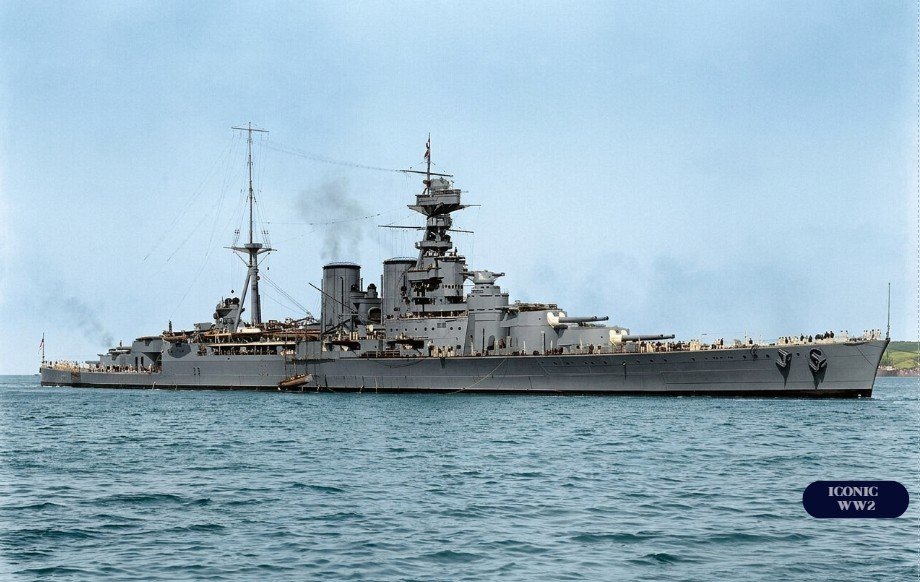
At dawn on 24 May 1941, out of the Denmark Strait haze came the ships the shadowers had summoned: the battlecruiser HMS Hood — the pride of the Royal Navy and for twenty years the very symbol of its power — and the brand-new battleship HMS Prince of Wales. What followed was one of the most famous actions in naval history, and one of the shortest.
Within minutes, a salvo from Bismarck plunged into Hood and detonated a main magazine. The 48,000-ton battlecruiser was torn in two by a cataclysmic explosion and sank in around three minutes, taking 1,415 men with her. There were just three survivors. The loss of the Hood — a symbol of British sea power for two decades — sent a shock through Britain and turned the pursuit of Bismarck into a national obsession; Churchill’s order was as blunt as it was famous: “Sink the Bismarck.”
But the victory came at a price. Prince of Wales had landed hits that ruptured a fuel tank, leaving Bismarck trailing oil and unable to reach the far Atlantic. Her commander, Admiral Lütjens, broke off the raid and turned for the safety of occupied France.
What followed was the greatest warship hunt of the war. The Royal Navy flung dozens of ships across the Atlantic to find and destroy Bismarck. After temporarily losing contact, the British relocated her — and on the evening of 26 May, obsolete Fairey Swordfish torpedo biplanes from the carrier HMS Ark Royal struck the decisive blow. A single torpedo jammed Bismarck's rudder, locking her into a slow circle and leaving her unable to steer away from her pursuers.
Through that long night the crippled battleship awaited her end. At dawn on 27 May 1941 the battleships HMS King George V and HMS Rodney, with supporting cruisers, closed in and battered Bismarck with hundreds of heavy shells, reducing her upper works to a blazing wreck. Yet her armoured hull refused to sink. Finally, raked by gunfire and struck by torpedoes — and, by the testimony of survivors, with scuttling charges set by her own crew — she rolled over and went down. Of a company of more than 2,200 men, only around 110 were saved.
Whether British torpedoes or German scuttling charges delivered the final blow has been debated ever since; the wreck, found by Robert Ballard in 1989, shows a hull remarkably intact on the seabed — a testament to how hard she had been to kill.
KMS Bismarck enjoyed one of the shortest and most dramatic careers of any great warship: a single sortie, one of the most stunning gunnery victories in naval history, and then annihilation, all within the space of nine days. She destroyed the Hood and humiliated the Royal Navy, then was hunted down and overwhelmed in a pursuit that gripped the world.
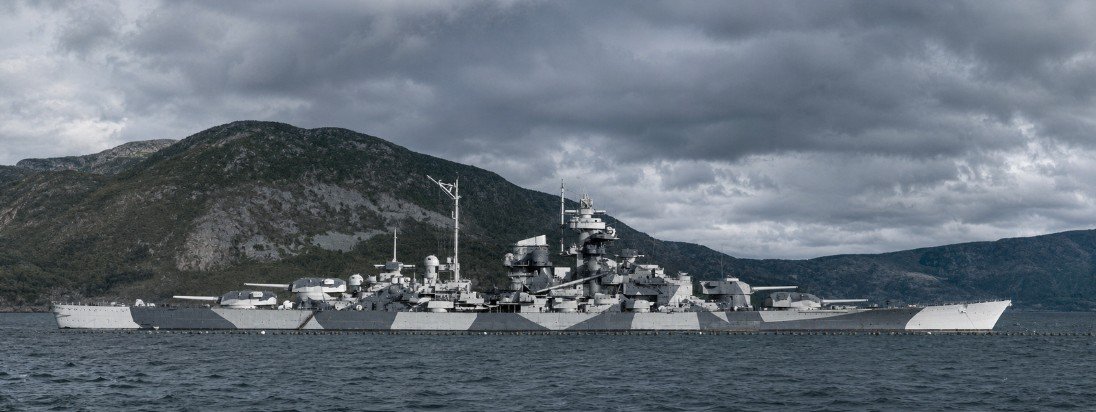
Her loss carried a lesson that echoed throughout the war at sea: that even the mightiest, best-protected battleship could be crippled by a single torpedo from a flimsy biplane, and that the age of the gun-armed capital ship was passing. Her sister Tirpitz, never risked in the Atlantic, spent the rest of the war hiding in the Norwegian fjords until RAF bombers found her in 1944 — the same lesson, delivered twice. Powerful, beautiful and doomed, Bismarck remains the most famous battleship of the Second World War — a symbol both of German naval ambition and of its swift, total defeat.
- Ludovic Kennedy, Pursuit: The Sinking of the Bismarck (Collins, 1974).
- Burkard Baron von Müllenheim-Rechberg, Battleship Bismarck: A Survivor’s Story (Naval Institute Press, 1980) — by her senior surviving officer.
- Robert D. Ballard, The Discovery of the Bismarck (Madison Press, 1990).
- Niklas Zetterling & Michael Tamelander, Bismarck: The Final Days of Germany’s Greatest Battleship (Casemate, 2009).
Iconic WW2 is free, ad-free and tracker-free — kept going only by the time it takes to research, restore and colorize each machine. If this profile was worth your read, you can help the archive grow.
| Class | Bismarck |
| Builder | Blohm & Voss, Hamburg |
| Nation | Germany |
| Type | Fast battleship |
| Commissioned | 24 August 1940 |
| Sunk | 27 May 1941 |
| Crew | ~2,200 |
| Ships in Class | 2 (Bismarck, Tirpitz) |
| Bismarck | Lost on first sortie, 1941 |
| Tirpitz | Sister ship; sunk 1944 by RAF |
| Famous Victim | HMS Hood (24 May 1941) |
| Crippled by | Swordfish torpedo (rudder) |
| Machinery | 3× geared steam turbines |
| Boilers | 12 Wagner high-pressure |
| Power | ~150,000 shp |
| Shafts | 3 |
| Max Speed | ~30 knots |
| Range | ~8,500 nmi at 19 kn |
| Standard Displacement | ~41,700 t |
| Full Load | ~50,300 t |
| Length | 251 m |
| Beam | 36 m |
| Draught | ~9.3–10.2 m |
| Main Battery | 8× 380 mm /47 (4×2) |
| Secondary | 12× 150 mm + 16× 105 mm AA |
| Belt Armour | up to 320 mm |
| Wreck Found | 1989, by Robert Ballard |