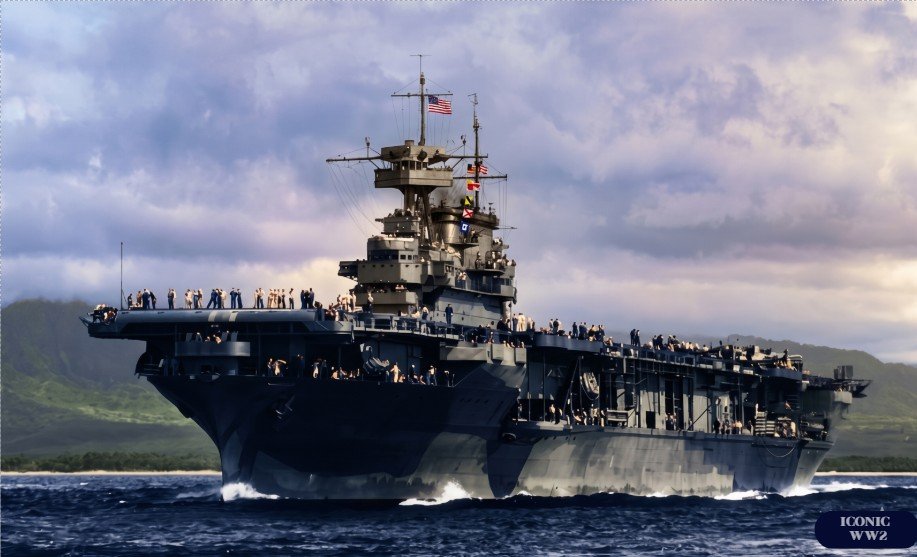
Hornet was the third and last of the Yorktown class, ordered in 1938 when war clouds made a repeat of a proven design faster than waiting for something new. Built — like her sisters Yorktown and Enterprise — at Newport News Shipbuilding in Virginia, she was commissioned on 20 October 1941 under Captain Marc A. Mitscher, the future commander of the fast carrier task forces.
She had barely seven weeks of peace. When Pearl Harbor put the American battle line on the bottom, Hornet was still shaking down off the East Coast with a green crew and a greener air group — and the Pacific war would give her no time to grow up slowly. Her entire combat career would last just over a year, and almost every week of it mattered.
The Yorktown-class formula gave Hornet a big air group — about 90 aircraft handled by three elevators on an unarmoured wooden flight deck — on roughly 20,000 tons standard displacement. Nine boilers and four geared turbine sets delivered 120,000 shaft horsepower and 32.5 knots, with eight 127 mm dual-purpose guns and a growing crop of light anti-aircraft weapons for self-defence.
American doctrine treated the flight deck as replaceable and put its faith in speed, aircraft and damage control rather than armour. In Hornet’s case that faith would be tested to the limit: her final day proved the class could absorb astonishing punishment — and that no amount of damage control can save a carrier the fleet has to leave behind.
On 2 April 1942 Hornet steamed out of San Francisco Bay with sixteen USAAF B-25 Mitchell bombers lashed to her flight deck — an experiment nobody had tried in war: launching twin-engined Army bombers from a carrier. With her own aircraft struck below, she was defenceless, so Enterprise rode escort. The target was Tokyo itself.
On the morning of 18 April 1942 a Japanese picket boat sighted the force some 1,200 km from Japan — well short of the planned launch point. Rather than turn back, Lieutenant Colonel James Doolittle led all sixteen bombers off Hornet’s pitching deck within an hour. The bombs were militarily light; the shock was not. The raid humiliated Japan’s high command and pushed it toward the decisive gamble Admiral Yamamoto wanted — the operation against Midway.
At Midway on 4 June 1942, Hornet’s air group paid the battle’s heaviest price. Torpedo Squadron 8, led by Lieutenant Commander John Waldron, found the Japanese carriers alone and attacked without fighter cover: all fifteen Devastators were shot down, and only Ensign George Gay survived, floating amid the burning enemy fleet. Her dive bombers missed the enemy entirely that morning — but the sacrifice of the torpedo squadrons helped pull the defending Zeros down to sea level just before the dive bombers of Enterprise and Yorktown arrived overhead. On 6 June, Hornet’s Dauntlesses returned the debt, helping smash the heavy cruiser Mikuma.
The autumn of 1942 turned her into the fleet’s last card. In the grinding Solomons campaign, Wasp was torpedoed and sunk, Saratoga torpedoed and sent to the yard, Enterprise bombed and under repair — until, for a stretch of October, Hornet was the only operational Allied fleet carrier in the entire Pacific.
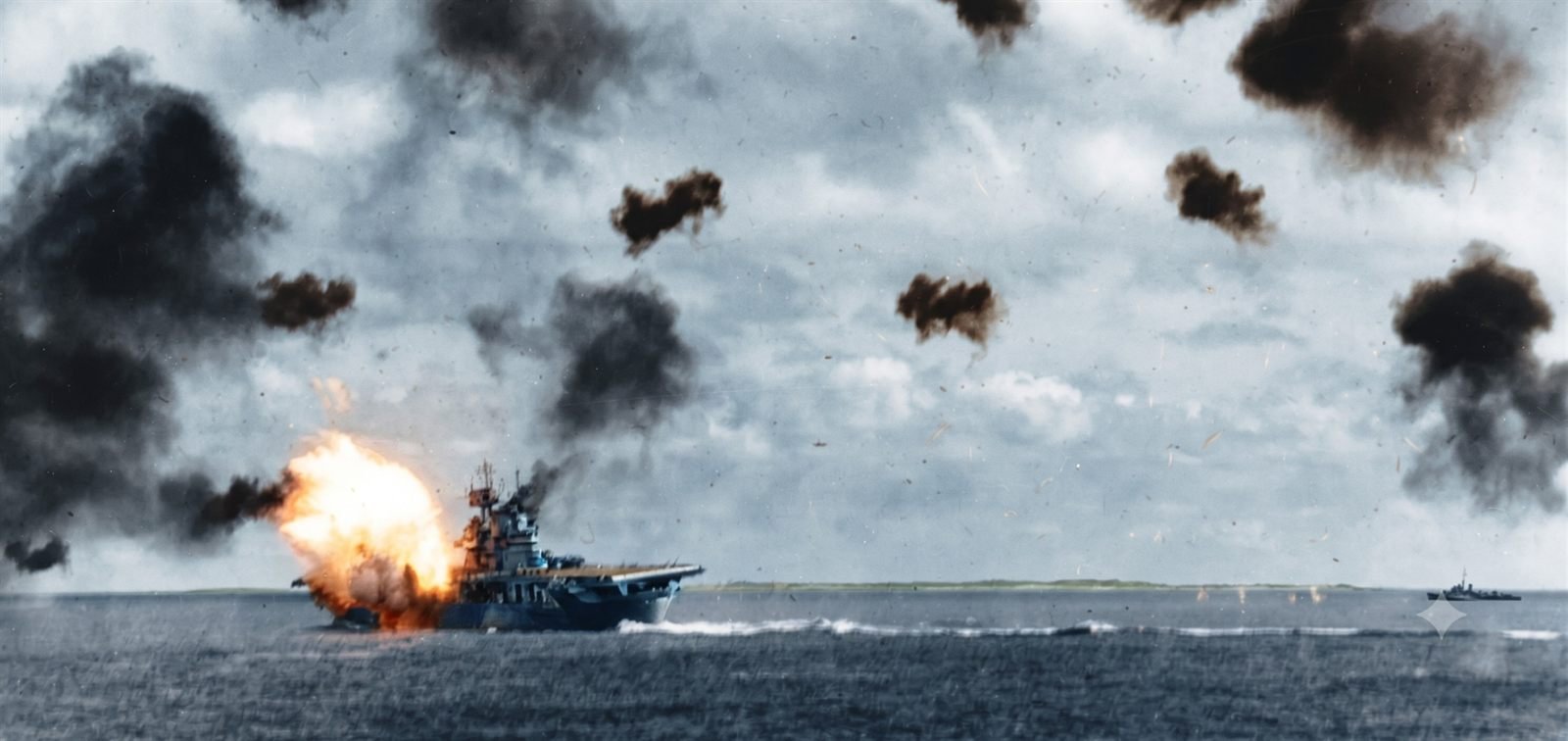
On 26 October 1942, covering the Guadalcanal campaign, Hornet met four Japanese carriers at the Battle of the Santa Cruz Islands. Her strike crippled the fleet carrier Shōkaku with multiple bomb hits, but the Japanese found her first and in one savage quarter-hour put three bombs, two aerial torpedoes and two crashing aircraft into her. Dead in the water and burning, she refused to sink: the cruiser Northampton took her under tow, and repair parties nearly had her ready to raise steam when a second strike drove another torpedo home.
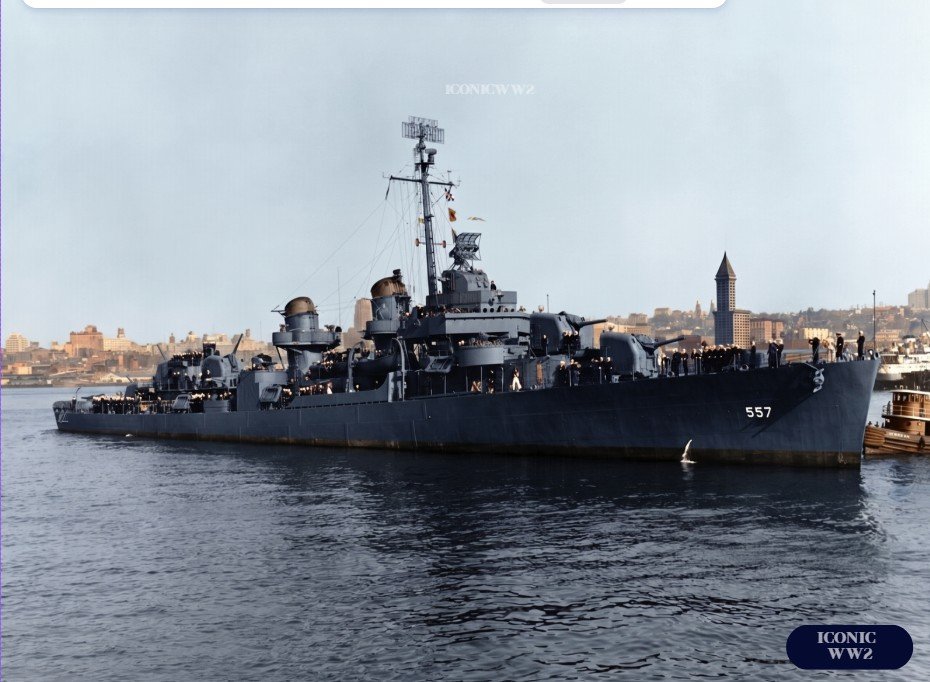
The order came to abandon and scuttle. The destroyers Mustin and Anderson fired sixteen torpedoes — many of them duds or misses, in keeping with the Navy’s torpedo troubles of 1942 — and more than 400 rounds of 127 mm shellfire, and still she floated. It took four 610 mm “Long Lance” torpedoes from the Japanese destroyers Makigumo and Akigumo to send her down in the early hours of 27 October 1942. She took 140 of her ~2,900 crew with her — one year and one week after commissioning.
No American fleet carrier would ever again be lost to enemy action — Hornet was the last. Her career was among the shortest of any major warship of the war, and among the most consequential: the Tokyo raid she launched set in motion the Japanese defeat at Midway, the battle her own squadrons bled to win.
The name did not stay on the bottom. Within a year the Essex-class carrier CV-12 was renamed Hornet in her honour and fought to Tokyo Bay. The original was found in February 2019 by the research vessel Petrel, resting upright more than 5,000 metres down off the Solomon Islands — her guns still trained skyward.
- Roger Chesneau (ed.), Conway’s All the World’s Fighting Ships 1922–1946 (Conway Maritime Press).
- Norman Friedman, U.S. Aircraft Carriers: An Illustrated Design History (Naval Institute Press).
Iconic WW2 is free, ad-free and tracker-free — kept going only by the time it takes to research, restore and colorize each machine. If this profile was worth your read, you can help the archive grow.
| Builder | Newport News Shipbuilding |
| Nation | United States |
| Class | Yorktown-class carrier (3rd) |
| Laid Down | 25 September 1939 |
| Commissioned | 20 October 1941 |
| Fate | Sunk 27 Oct 1942, Santa Cruz |
| Doolittle Raid | 18 April 1942 — 16 B-25s |
| Midway | 4–6 June 1942 |
| Santa Cruz | 26 October 1942 |
| Service Life | 1 year and 1 week |
| Wreck Found | February 2019, ~5,300 m deep |
| Machinery | 4× geared turbines, 9 boilers |
| Power | 120,000 shp |
| Max Speed | 32.5 knots |
| Range | ~12,500 nmi @ 15 knots |
| Length | ~251 m overall |
| Beam | 25.4 m (waterline) |
| Draft | ~7.9 m |
| Displacement | ~20,000 t standard |
| Air Group | ~90 aircraft |
| Guns | 8× 127 mm/38 dual-purpose |
| Anti-aircraft | 16× 28 mm + 32× 20 mm (1942) |
| Belt | 64–102 mm |
| Fighters | F4F Wildcat (VF-8) |
| Dive Bombers | SBD Dauntless (VB-8, VS-8) |
| Torpedo | TBD Devastator (VT-8) |
| Special, April | 16× B-25B Mitchell (USAAF) |