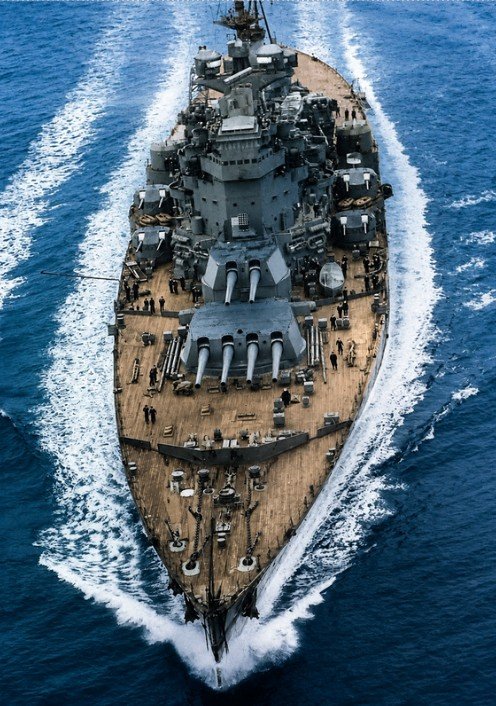
Prince of Wales was the second of the five King George V-class battleships — Britain’s answer, within treaty limits, to the new European battle fleets. Laid down at Cammell Laird in Birkenhead on 1 January 1937, she carried her class’s unusual signature: a main battery of ten 356 mm (14-inch) guns, mounted in two massive quadruple turrets and one twin — a calibre chosen for treaty compliance, backed by some of the thickest belt armour afloat at up to 374 mm.
She was bombed while fitting out in 1940, commissioned on 19 January 1941, and rushed toward service so fast that history caught her half-ready: when she sailed to intercept the Bismarck in May 1941, civilian technicians from Vickers were still aboard, working on her temperamental new turrets.
On roughly 36,700 tons standard, the class combined heavy protection — a belt up to 374 mm and a thick armoured deck — with a secondary battery of sixteen 133 mm dual-purpose guns and a top speed of about 28 knots from 110,000 shaft horsepower. She was among the first battleships designed from the keel up with air attack in mind, and carried early-war radar for search and gunnery.
The weak point was the new quadruple turret machinery: complex, tightly packed and un-debugged in 1941. At Denmark Strait her main battery suffered repeated stoppages in the middle of the action — a new ship fighting before her time, with shipyard hands passing tools while the guns fired.
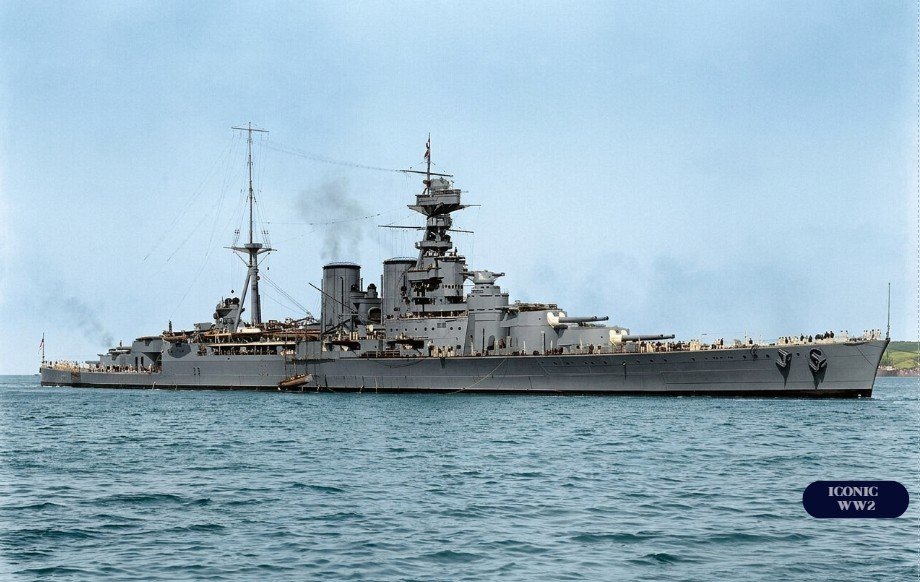
On 24 May 1941 Prince of Wales followed HMS Hood into action against Bismarck and Prinz Eugen. Eight minutes in, Hood exploded and was gone with all but three of her crew. The brand-new battleship suddenly stood alone against the most powerful warship in the Atlantic, taking hits — one smashed through the compass platform, killing nearly everyone on the bridge around Captain Leach — while her untested turrets jammed gun by gun.
Before she broke off, she had put three 356 mm shells into Bismarck. One, forward, opened her bow to the sea and cut her off from around 1,000 tons of fuel — the wound that cancelled Bismarck’s Atlantic raid and sent her running for France, into the path of the Swordfish and the Home Fleet. The avenger of Hood, in a real sense, was the ship that had watched her die.
Ten weeks later, patched up, she carried Winston Churchill in secrecy across the Atlantic to Placentia Bay, Newfoundland, where between 9 and 12 August 1941 he met Franklin D. Roosevelt aboard her and the USS Augusta. From those meetings came the Atlantic Charter — the eight-point declaration of war aims that became the founding text of the United Nations.
The image of that Sunday service on her quarterdeck — British and American sailors singing hymns side by side, months before America entered the war — made Prince of Wales, for a moment, the most symbolically important ship in the world. That autumn she also fought Italian aircraft escorting a Malta convoy on Operation Halberd.
In late 1941 Churchill sent her east as a deterrent: flagship of Force Z, arriving at Singapore on 2 December with the battlecruiser Repulse. The hope was that two capital ships would cow the Japanese; the flaw was that they had come without the aircraft carrier meant to shield them, which had run aground on the way out.
When Japan struck a week later, Admiral Tom Phillips took both ships north against the invasion convoys off Malaya — again without air cover, trusting to speed, gunfire and radar. It was a gamble against precisely the threat the Royal Navy had not yet learned to fear: massed, shore-based naval torpedo bombers.
On the morning of 10 December 1941, off Kuantan, some 85 Japanese naval bombers — G3M and G4M of the 22nd Air Flotilla — found Force Z. An early torpedo hit wrecked a port propeller shaft; the shaft kept turning as it tore the hull open along its length, and the flooding knocked out power, and with it the pumps, the steering and most of the anti-aircraft turrets.
Crippled and barely able to manoeuvre, Prince of Wales was struck by further torpedoes and a bomb, and capsized at 13:18 — eleven months and one hemisphere from her commissioning — taking down 327 men, Admiral Phillips and Captain Leach among them. Repulse was already gone; the escorting destroyers pulled more than 2,000 survivors from the oil-covered sea, while a flight of RAF fighters arrived overhead just too late to help.
Prince of Wales and Repulse were the first capital ships ever sunk in the open sea, free to manoeuvre and shoot back, by aircraft alone. Two days after Pearl Harbor — where the battleships had been moored and surprised — the lesson off Kuantan allowed no excuses: the battleship no longer ruled the sea; the aircraft did. Churchill later wrote that in all the war he never received a more direct shock.
Few ships have packed so much history into eleven months: the death of Hood, the wounding of Bismarck, the birth of the Atlantic Charter, the end of the battleship era. Her wreck lies off Malaysia in about 68 metres of water, a designated war grave.
- Roger Chesneau (ed.), Conway’s All the World’s Fighting Ships 1922–1946 (Conway Maritime Press).
- Alan Raven & John Roberts, British Battleships of World War Two (Arms & Armour Press).
- Martin Middlebrook & Patrick Mahoney, Battleship: The Loss of the Prince of Wales and Repulse (Penguin).
Iconic WW2 is free, ad-free and tracker-free — kept going only by the time it takes to research, restore and colorize each machine. If this profile was worth your read, you can help the archive grow.
| Builder | Cammell Laird, Birkenhead |
| Nation | United Kingdom |
| Class | King George V (2nd of 5) |
| Laid Down | 1 January 1937 |
| Commissioned | 19 January 1941 |
| Fate | Sunk 10 Dec 1941, off Kuantan |
| Denmark Strait | 24 May 1941 — 3 hits on Bismarck |
| Atlantic Charter | 9–12 August 1941 |
| Operation Halberd | September 1941, Malta convoy |
| Force Z | Singapore, December 1941 |
| Losses | 327 of ~1,600 aboard |
| Machinery | 4× geared turbines, 8 boilers |
| Power | 110,000 shp |
| Max Speed | ~28 knots |
| Range | ~15,600 nmi @ 10 knots |
| Length | 227.1 m overall |
| Beam | 31.4 m |
| Draft | ~10.5 m |
| Displacement | ~36,700 t standard |
| Main Battery | 10× 356 mm (2 quad + 1 twin) |
| Secondary | 16× 133 mm dual-purpose |
| Light AA | ~50× 40 mm pom-pom + 20 mm |
| Radar | Type 281 search + gunnery sets |
| Belt | up to 374 mm |
| Main Deck | up to 149 mm |
| Turrets | up to 324 mm |
| Weakness | Port shaft run — fatal torpedo hit |