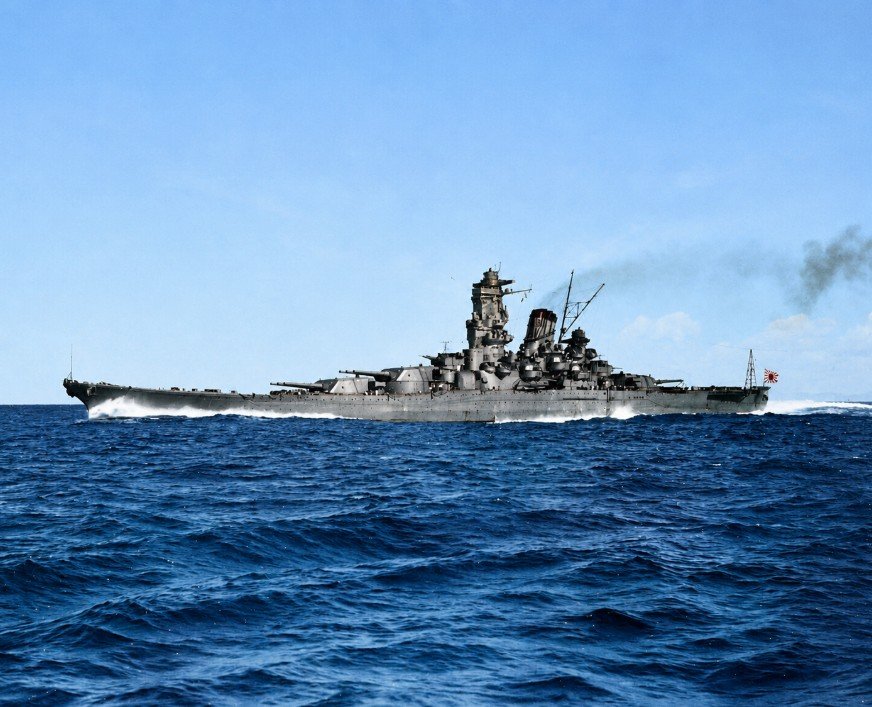
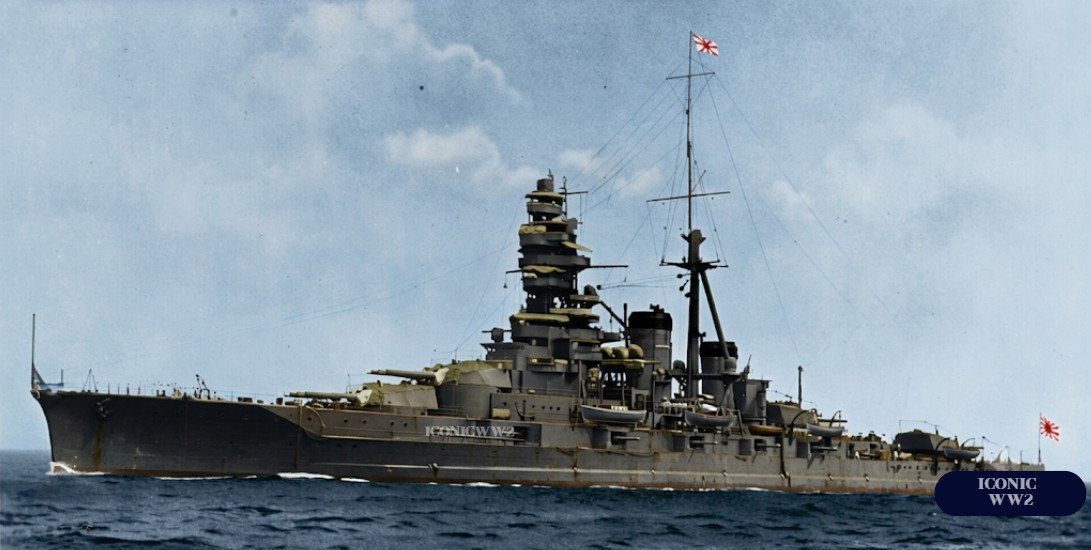
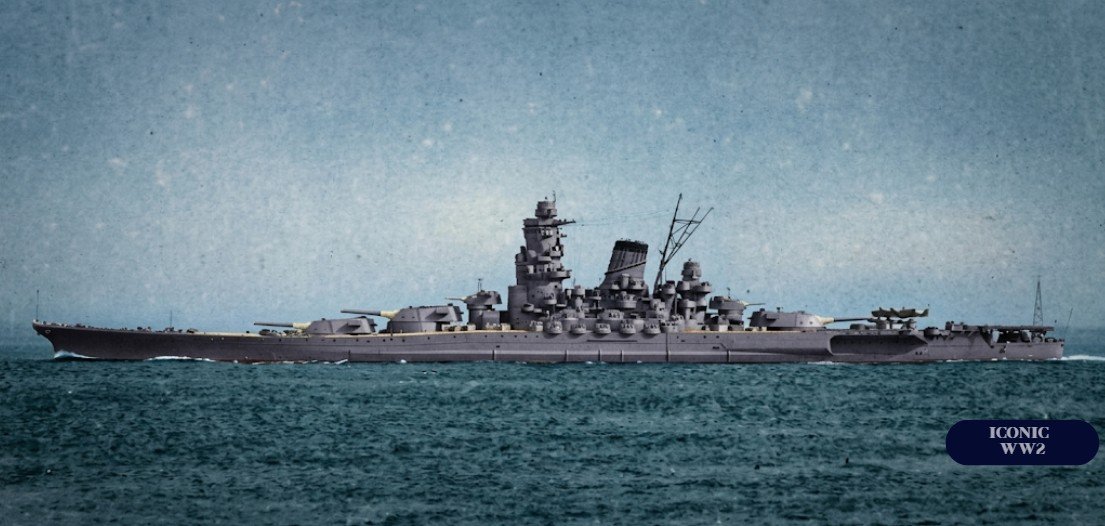
Commissioned on 25 November 1920, Nagato was the lead ship of a two-vessel class and a genuine landmark in the history of the battleship: the first warship in the world to carry 16-inch (410 mm) guns, beating the American Colorado class and Britain’s Nelson into service. She had been ordered as a centrepiece of Japan’s ambitious “Eight-Eight Fleet” programme — a bid for a battle line of eight battleships and eight battlecruisers that the Washington Naval Treaty would soon cut short.
That treaty froze the world’s heavy-gun fleets and left Nagato among the “Big Seven,” the seven capital ships worldwide permitted to mount 16-inch guns. For the next two decades she was the pride and the flagship of the Imperial Japanese Navy, and one of the most famous warships in Japan — her silhouette familiar from schoolbooks and postcards as the very symbol of national naval power.
Nagato’s main battery was eight 41 cm (16.1 in) /45 guns in four twin turrets, supported by a secondary battery of twenty 14 cm guns and, in her later years, a heavy anti-aircraft outfit; her armoured belt reached about 305 mm. But her most remarkable early quality was speed. Designed for about 26.5 knots on roughly 80,000 shp, she was among the fastest battleships in the world at commissioning — a capability the Japanese deliberately concealed, publicly understating her as a 23-knot ship.
Like most surviving capital ships of her generation she was rebuilt for the modern war. A major reconstruction at Kure between 1934 and 1936 added deck armour and torpedo bulges, replaced her machinery, trunked her funnels and raised her bridge into the towering “pagoda” mast that became her trademark. The work pushed her full-load displacement to around 46,000 tonnes and, with all that added weight, trimmed her top speed to about 25 knots.
From August 1939 Nagato flew the flag of Admiral Isoroku Yamamoto, Commander-in-Chief of the Combined Fleet, lying at the fleet anchorage of Hashirajima in the Inland Sea. It was from Nagato, on 2 December 1941, that the coded order “Niitakayama nobore 1208” — “Climb Mount Niitaka” — was relayed to Admiral Nagumo’s carrier striking force, the final confirmation that the attack on Pearl Harbor would go ahead.
Yet the flagship that launched the carrier war would be made a bystander by it. In February 1942 Yamamoto transferred his flag to the vast new Yamato, and Nagato — like nearly every battleship on earth — found herself eclipsed by the aircraft carrier she had helped send to war. The age of the big gun she had once defined was already ending.
For much of the middle war Nagato swung at anchor, a strategic reserve too precious and too fuel-hungry to risk. She was present but unengaged at Midway in June 1942, steaming with Yamamoto’s Main Body far behind the four carriers lost in a single morning, and thereafter spent long months at Truk and in home waters. Japan’s chronic shortage of oil increasingly chained her battle line to harbour.
It was a frustrating existence for the fleet’s proudest ship — built to lead a line of battle the war never called upon. Not until the Japanese navy staked everything on one last throw in the autumn of 1944 would Nagato finally be sent into the kind of surface action she had been designed for two decades earlier.
Nagato sailed with Vice-Admiral Kurita’s Center Force to the Battle of Leyte Gulf in October 1944. In the Sibuyan Sea on 24 October she took two bomb hits from American carrier aircraft while, beside her, the giant Musashi was overwhelmed and sank. The next morning, off Samar, Nagato at last fired her 41 cm main guns at an enemy ship — the first and only time in her career — pouring nearly a hundred main-battery rounds at the escort carriers and destroyers of the American “Taffy 3.”
The ferocious defence put up by those thin-skinned ships helped turn Kurita back short of the invasion fleet, and Nagato retired to Japan, damaged once more by air attack. She had finally fought her surface battle — a generation late, and against the very carrier aircraft that had made her kind obsolete.
Nagato spent the last months of the war at Yokosuka as a camouflaged, largely immobile anti-aircraft battery, hit again in the American carrier raids of July 1945 but still afloat at the surrender — the only Japanese battleship to survive the war. Surrendered intact to the United States, she was then expended in the most spectacular way imaginable: as a target in Operation Crossroads, the atomic-bomb tests at Bikini Atoll in the summer of 1946.
She rode out the air burst of test Able on 1 July 1946 with only moderate damage. The underwater shot of test Baker on 25 July was another matter, leaving her slowly flooding and listing with no crew aboard to fight it. Through the following days she settled unseen, and on the night of 29–30 July 1946 the old flagship quietly capsized and sank — outliving, by almost a year, every other capital ship of the fleet she had once led.
Nagato is doubly historic: a pioneering design that first brought the 16-inch gun to the battle line, and one of the last surviving symbols of a battleship era the aircraft carrier had already ended. For twenty years the most celebrated warship in Japan, she went to her grave beneath the flash of the very weapon that opened a new age entirely.
Her wreck lies upside-down in about 33 m of water at Bikini, her great screws uppermost — today one of the most famous wreck dives in the world, and a fitting monument to a ship that stood at both the beginning and the end of the age of the battleship.
- William H. Garzke & Robert O. Dulin, Battleships: Axis and Neutral Battleships in World War II (Naval Institute Press).
- Mark Stille, Imperial Japanese Navy Battleships 1941–45 (Osprey, New Vanguard).
- Steve Wiper, Nagato Class Battleships (Warship Pictorial).
Iconic WW2 is free, ad-free and tracker-free — kept going only by the time it takes to research, restore and colorize each machine. If this profile was worth your read, you can help the archive grow.
| Class | Nagato |
| Builder | Kure Naval Arsenal |
| Nation | Japan |
| Type | Battleship |
| Commissioned | 25 November 1920 |
| Fate | Sunk at Bikini, 29–30 Jul 1946 |
| Shaft Power | ~80,000 shp |
| Max Speed (built) | 26.5 knots |
| Max Speed (rebuilt) | ~25 knots |
| Range | ~8,650 nmi at 16 kn |
| Length (rebuilt) | ~224.9 m |
| Beam | ~34.6 m |
| Full Load (rebuilt) | ~46,000 t |
| Crew | ~1,330 |
| Main Battery | 8× 410 mm /45 (4×2) |
| Secondary | 20× 140 mm |
| Belt Armour | ~305 mm |
| Distinction | First 16-inch-gun battleship |