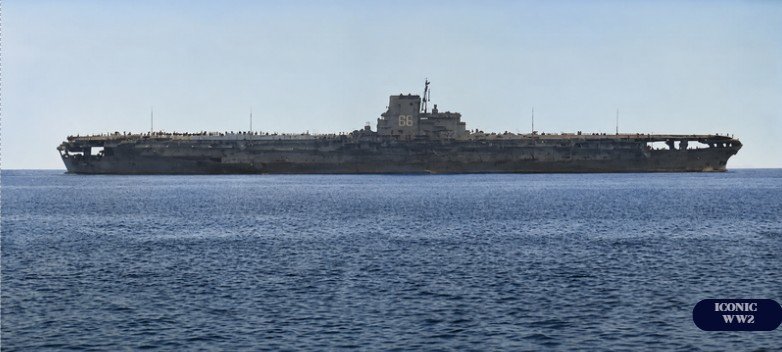
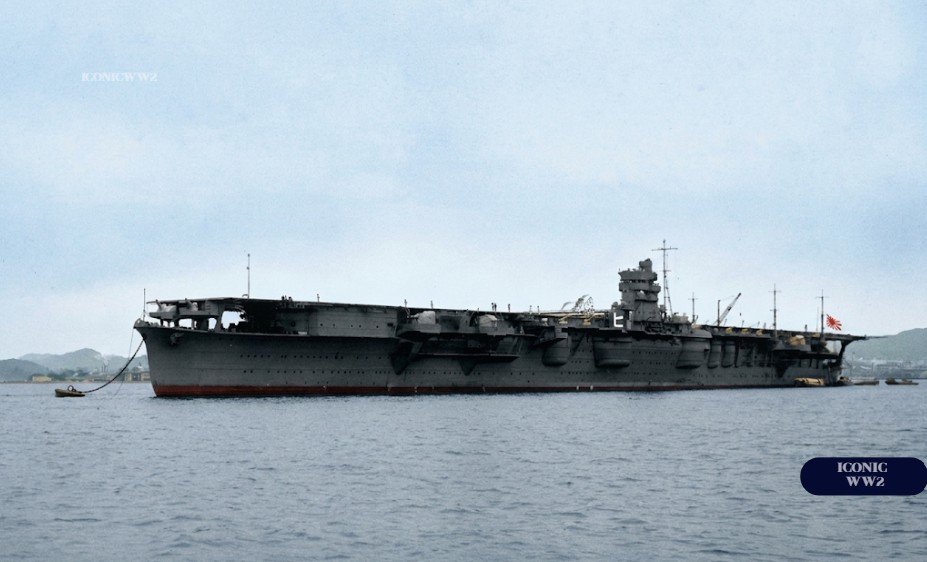
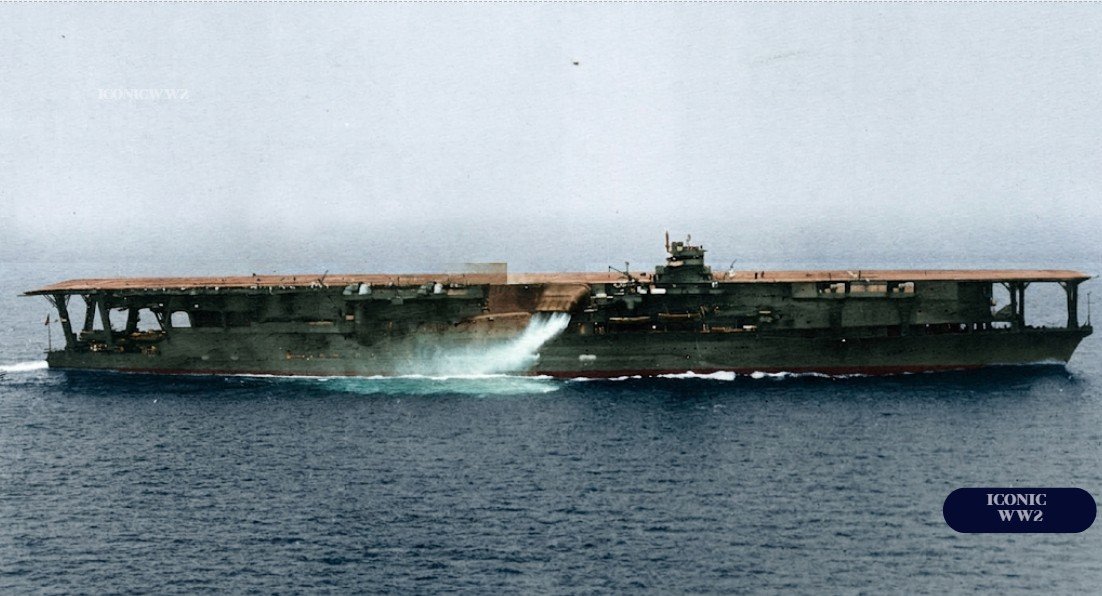
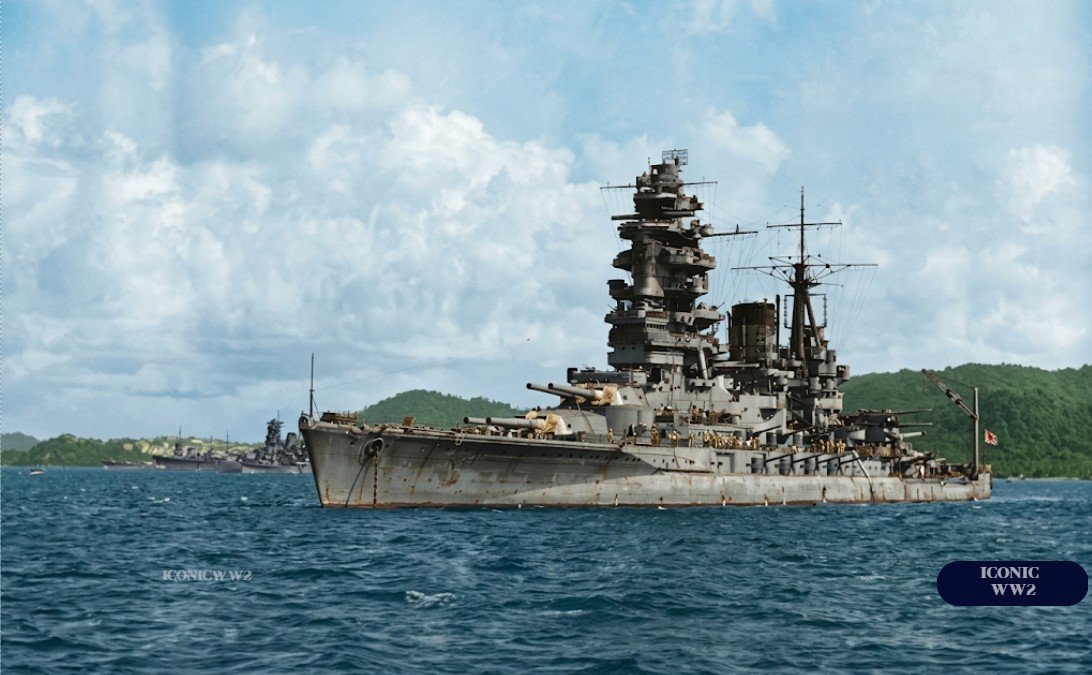
Akagi was born of a treaty and a change of mind. Laid down in 1920 as one of a class of fast battlecruisers, her construction was halted by the Washington Naval Treaty of 1922, which capped the world's battle fleets and would have seen her hull scrapped on the slipway. But the treaty contained a loophole: two such doomed capital-ship hulls could be converted into aircraft carriers. Japan, like the United States with its Lexington and Saratoga, seized the chance, and Akagi's battlecruiser hull — long, fast and powerfully engined — was rebuilt into a carrier.
Named after a volcano, Akagi was completed in 1927 as one of Japan's first large fleet carriers. Her early form was strange to modern eyes: three separate flight decks stacked at different levels were meant to let aircraft launch and land simultaneously, and twin gun turrets recalled her capital-ship origins. Experience quickly showed the multi-deck idea to be a blind alley, and between 1935 and 1938 she was completely reconstructed with a single full-length flush flight deck and a small island, emerging as one of the most capable carriers afloat.
In her reconstructed form Akagi could operate an air group of around 66 aircraft — a mix of Mitsubishi A6M Zero fighters, Aichi D3A dive-bombers and Nakajima B5N torpedo-bombers — the finest carrier strike package in the world in 1941. Her battlecruiser machinery gave her a high speed of about 31 knots, fast enough to keep pace with any fleet, and her great length made her a steady platform from which to fly off heavily-laden strike aircraft.
Like all the early Japanese carriers, however, she carried hidden frailties. Her aviation fuel and ordnance handling arrangements left her dangerously vulnerable to fire, her damage-control organisation was less developed than her American counterparts', and her unarmoured flight deck and hangars offered little protection against bombs. These were the weaknesses of a pioneering design — and they would prove mortal.
Above all, Akagi was the heart of a revolutionary idea: the concentration of several fast carriers into a single massed striking force. As flagship of the First Air Fleet she embodied the doctrine that the carrier, not the battleship, was now the decisive weapon at sea — a doctrine the Imperial Japanese Navy would demonstrate to the world more dramatically than anyone.
From April 1941 Akagi served as flagship of the Kidō Butai — the "Mobile Force" — the elite carrier striking fleet built around six fast carriers and the most powerful naval aviation force on earth. Commanded at sea by Vice-Admiral Chūichi Nagumo, with the brilliant aviators Minoru Genda and Mitsuo Fuchida aboard, she was the centrepiece of a fleet that for six months ranged across a third of the globe and seemed all but unstoppable.
It was a concentration of carrier power the world had never seen, and from Akagi's flag bridge the opening blows of Japan's Pacific war were directed. Where the Kidō Butai sailed, it brought a weight of air attack that no enemy fleet or base could withstand.
On the morning of 7 December 1941, Akagi launched the first and second waves of aircraft that struck the United States Pacific Fleet at Pearl Harbor. From her deck rose part of the force that sank or crippled the American battle line and announced, in a single stroke, the arrival of the carrier as the master weapon of naval war. It was the high point of her career and of Japanese naval aviation.
In the months that followed Akagi seemed to carry victory in her wake. Her aircraft struck Rabaul, helped raid Darwin in February 1942, and ranged into the Indian Ocean, where the Kidō Butai sank British warships and bombed Ceylon, driving the Royal Navy from its eastern waters. For half a year Akagi and her sisters were the most successful naval force in the world, undefeated and seemingly invincible.
But the very success of the carriers had made Japan over-confident, and the failure to destroy the American carriers at Pearl Harbor left the decisive enemy still at sea. The reckoning came in June 1942.
At the Battle of Midway on 4 June 1942, Akagi sailed as Nagumo's flagship at the head of four carriers of the Kidō Butai. In a few catastrophic minutes the tide of the Pacific war turned. As her crews frantically rearmed and refuelled aircraft on her hangar decks — switching ordnance amid a confusion of orders — American SBD Dauntless dive-bombers from USS Enterprise plunged out of the sky almost unopposed.
Akagi was hit by only a small number of bombs, but they fell among her packed, fuelled and armed aircraft and the open ordnance of her hangars. The result was a chain of uncontrollable fires and explosions that her damage-control parties could not master. Burning out of control and abandoned, the proud flagship was finally scuttled by Japanese torpedoes early on 5 June, going down with her three sister carriers Kaga, Sōryū and Hiryū in a single, irreversible disaster.
In one day Japan lost four fleet carriers and the irreplaceable core of her naval air arm. The Kidō Butai that Akagi had led to Pearl Harbor was broken forever, and with it Japan's hope of winning the Pacific war.
IJN Akagi was the most important warship in the navy that, for a few months, dominated the Pacific. From her deck came the strike on Pearl Harbor that opened the war and proved beyond argument that the aircraft carrier had supplanted the battleship as the arbiter of sea power. As flagship of the Kidō Butai she presided over the most spectacular run of victories in modern naval history.
And then, at Midway, the same revolution she had helped unleash destroyed her — annihilated not by an enemy fleet's guns but by a handful of dive-bombers that found her at the worst possible moment. Akagi's career traces the whole arc of the carrier war in miniature: the triumph of naval air power, and the terrible vulnerability of even the finest carrier to a few well-aimed bombs. She remains the emblem of Japan's brief Pacific ascendancy — and of its sudden, total reversal.
- Jonathan Parshall & Anthony Tully, Shattered Sword: The Untold Story of the Battle of Midway (Potomac, 2005).
- Mark R. Peattie, Sunburst: The Rise of Japanese Naval Air Power 1909–1941 (Naval Institute Press).
- Gordon W. Prange, Miracle at Midway (McGraw-Hill, 1982).
Iconic WW2 is free, ad-free and tracker-free — kept going only by the time it takes to research, restore and colorize each machine. If this profile was worth your read, you can help the archive grow.
| Name | Akagi (赤城 — "Red Castle") |
| Builder | Kure Naval Arsenal |
| Nation | Japan |
| Type | Fleet aircraft carrier |
| Laid down as | Amagi-class battlecruiser, 1920 |
| Commissioned | 25 March 1927 |
| Reconstructed | 1935–1938 (single flight deck) |
| Sunk | 5 June 1942 (Midway) |
| Crew | ~1,630 |
| Ships in Class | 1 (unique) |
| Fighters | Mitsubishi A6M Zero |
| Dive-bombers | Aichi D3A "Val" |
| Torpedo-bombers | Nakajima B5N "Kate" |
| Complement | ~66 aircraft |
| Machinery | 4× geared steam turbines |
| Boilers | 19 Kampon |
| Power | ~133,000 shp |
| Shafts | 4 |
| Max Speed | ~31 knots |
| Range | ~8,200 nmi at 16 kn |
| Standard Displacement | ~36,500 t |
| Full Load | ~41,300 t |
| Length | 260.7 m |
| Beam | 31.3 m |
| Draught | ~8.7 m |
| Main role | Carrier strike — Kidō Butai flagship |
| Gun battery | 6× 200 mm + heavy AA |
| Famous action | Pearl Harbor, 7 Dec 1941 |
| Fate | Scuttled after dive-bomber hits, Midway |