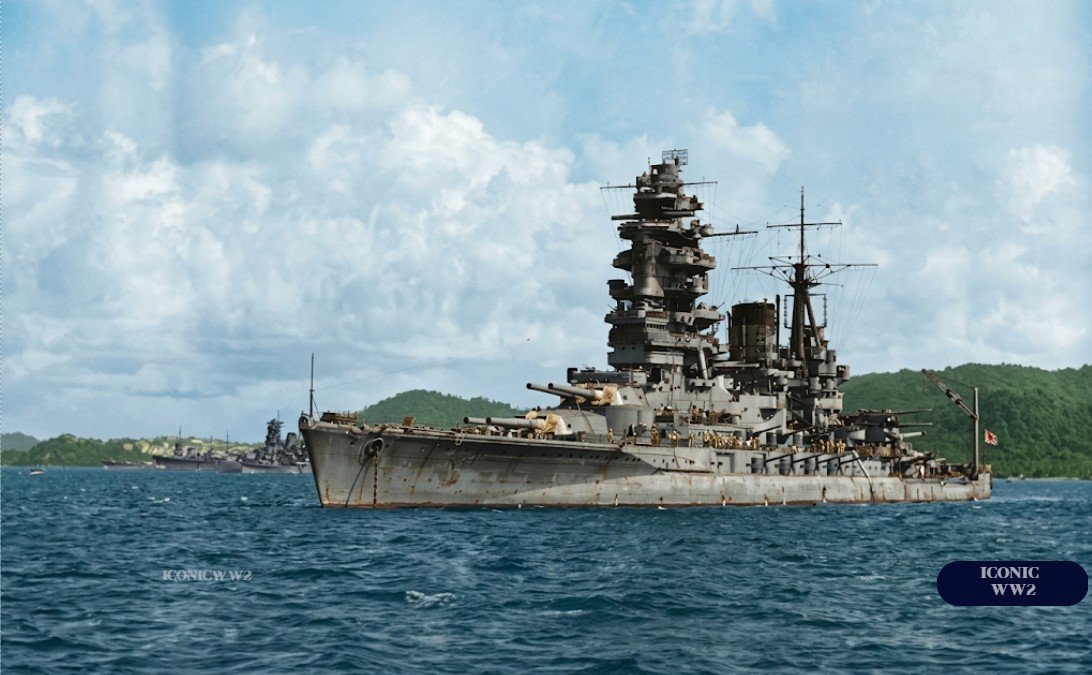
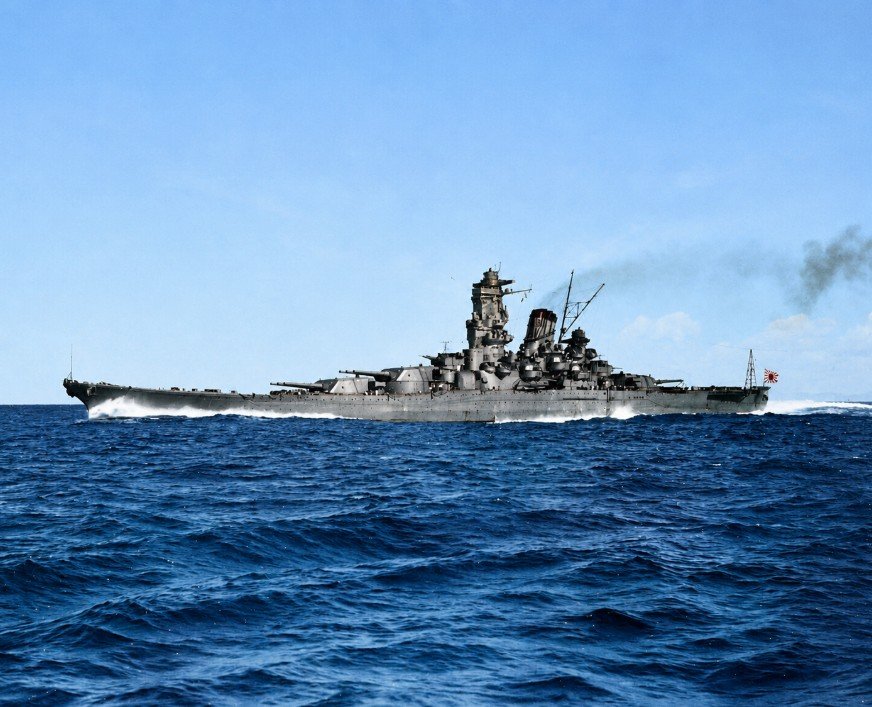
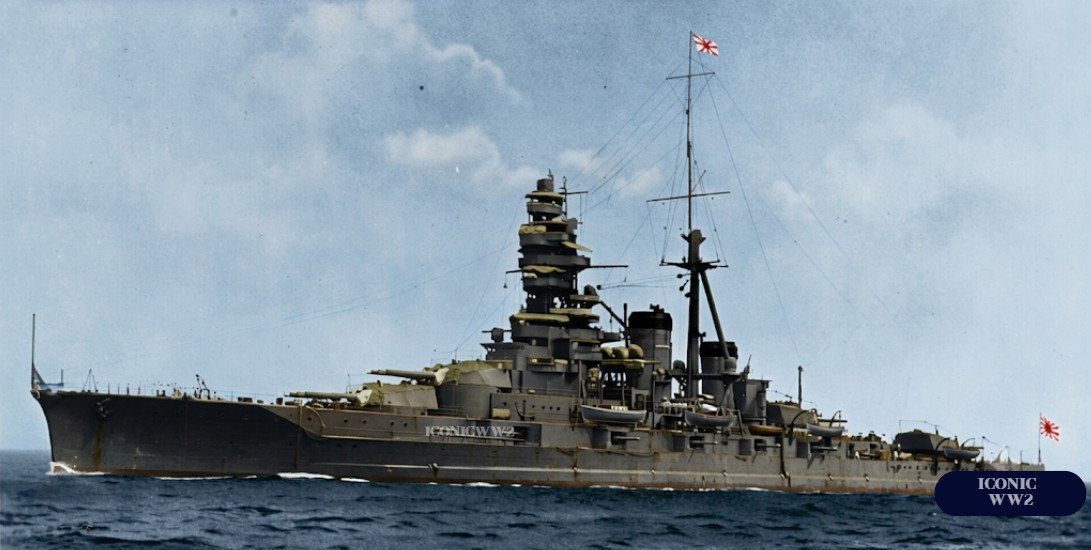
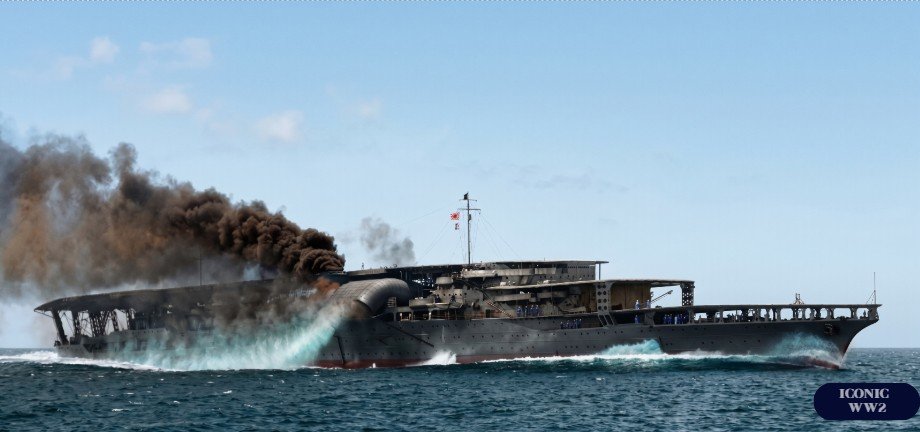
Musashi was the second of the Yamato-class giants — the answer Japan built to a problem it could not solve any other way. Unable to match American shipyards ship for ship, the Imperial Japanese Navy gambled on individual supremacy: battleships so large and so heavily gunned that each could, in theory, take on several enemies at once. Two were completed to the design; a third hull became the carrier Shinano.
She was built in the deepest secrecy at the Mitsubishi yard in Nagasaki, a working city where concealment was far harder than at the naval arsenal that built Yamato. Enormous rope screens were hung around the slipway, and the launch on 1 November 1940 was so vast an event — she displaced water enough to swamp nearby boats — that it had to be managed like a state secret. She was commissioned on 5 August 1942.
Musashi shared her sister’s staggering scale: over 70,000 tons at full load, the largest battleships ever built, armed with nine 460 mm (18.1-inch) guns — the heaviest naval artillery ever mounted afloat, each firing a 1.5-tonne shell to some 42 km. Her armour was on the same scale: a main belt up to 410 mm and turret faces of 650 mm, meant to shrug off the heaviest shellfire at battle range.
What that design could not answer was the aircraft. Like Yamato she carried a heavy anti-aircraft battery — 127 mm dual-purpose guns and, by 1944, well over a hundred 25 mm automatic cannon — but the 25 mm was a poor weapon, hand-trained and short-ranged, and no amount of it could seal the sky over a ship the size of a small town. Her protection was built against a kind of battle that, by the time she was ready, the war had already left behind.
For most of her career Musashi did what Yamato did: she waited. The two giants spent long months at the Truk anchorage, held back as a priceless strategic reserve for the decisive fleet battle that Japanese doctrine still expected — and which never came on the terms they wanted. Fuel shortages, and the sheer value placed on them, kept the biggest guns in the navy idle while the carrier war was lost around them.
In February 1943 Musashi became fleet flagship, and in 1943 she carried the ashes of Admiral Yamamoto home after his death. She had her first brush with the enemy in March 1944 when the submarine USS Tunny put a torpedo into her bow off the Palaus — a foretaste. By the autumn of 1944, with the Americans landing in the Philippines, the reserve could be held back no longer.
On 24 October 1944, steaming with the Centre Force toward Leyte Gulf, Musashi entered the Sibuyan Sea and the concentrated fury of Admiral Halsey’s carrier aircraft. Wave after wave of Helldivers and Avengers from the US Third Fleet singled her out; over the course of the day she was struck, by American estimate, by around 17 bombs and 19 torpedoes.
No warship had ever absorbed such punishment. She took hours to die — down by the bow, listing, her speed bleeding away as flooding outran her damage-control parties — and finally capsized and sank in the early evening, taking over 1,000 of her roughly 2,400 crew with her. The scale of the effort needed to sink one ship was itself a verdict: the battleship’s day was over.
Musashi’s loss was not in vain by the logic of the plan — the air attacks that destroyed her drew American strength away and let the rest of the Centre Force slip through the San Bernardino Strait to fall on the escort carriers off Samar the next morning, where the destroyer USS Johnston and her sisters made their famous stand. But the strategic result was catastrophic for Japan, and the loss of a Yamato-class ship to aircraft alone confirmed the lesson twice over when Yamato herself followed in April 1945.
The wreck lay unfound for seventy years. In March 2015 a research team funded by Paul Allen located Musashi more than 1,000 metres down in the Sibuyan Sea — one of her huge chrysanthemum bow crests and a main-gun turret clearly visible, a war grave and a monument to an idea that the aircraft carrier had already overtaken.
Musashi and her sister were the largest, most powerful, most expensive battleships ever built — and between them they sank not a single enemy capital ship. They were superb answers to a question the war stopped asking: their 460 mm guns, designed to smash an American battle line, never once fired at one.
Her true epitaph is written in the arithmetic of her sinking. It took the massed air groups of a fleet the better part of a day and dozens of hits to put her under — proof of how magnificently she was built, and of how completely the weapon that killed her had replaced the weapon she was.
- Janusz Skulski, The Battleship Yamato (Anatomy of the Ship, Conway) — covers the Yamato class.
- William H. Garzke & Robert O. Dulin, Battleships: Axis and Neutral Battleships in World War II (Naval Institute Press).
- Thomas J. Cutler, The Battle of Leyte Gulf, 23–26 October 1944 (Naval Institute Press).
Iconic WW2 is free, ad-free and tracker-free — kept going only by the time it takes to research, restore and colorize each machine. If this profile was worth your read, you can help the archive grow.
| Builder | Mitsubishi, Nagasaki |
| Nation | Japan |
| Class | Yamato (2nd of 2) |
| Launched | 1 November 1940 |
| Commissioned | 5 August 1942 |
| Fate | Sunk 24 Oct 1944, Sibuyan Sea |
| Fleet flagship | February 1943 |
| Torpedoed | March 1944, USS Tunny (bow) |
| Sibuyan Sea | 24 October 1944 |
| Losses | ~1,000+ of ~2,400 crew |
| Wreck found | March 2015, ~1,000 m deep |
| Machinery | 4× steam turbines, 12 boilers |
| Power | ~150,000 shp |
| Max Speed | 27 knots |
| Range | ~7,200 nmi @ 16 knots |
| Length | 263 m overall |
| Beam | 38.9 m |
| Draft | ~11 m |
| Displacement | ~72,000 t full load |
| Main Battery | 9× 460 mm (3×3) |
| Secondary | 12× 155 mm → 6× later |
| Dual-purpose | 12–24× 127 mm |
| Light AA | 120+ × 25 mm (1944) |
| Main Belt | up to 410 mm |
| Turret Face | 650 mm |
| Deck | 200–230 mm |
| Weakness | Air attack, not gunfire |