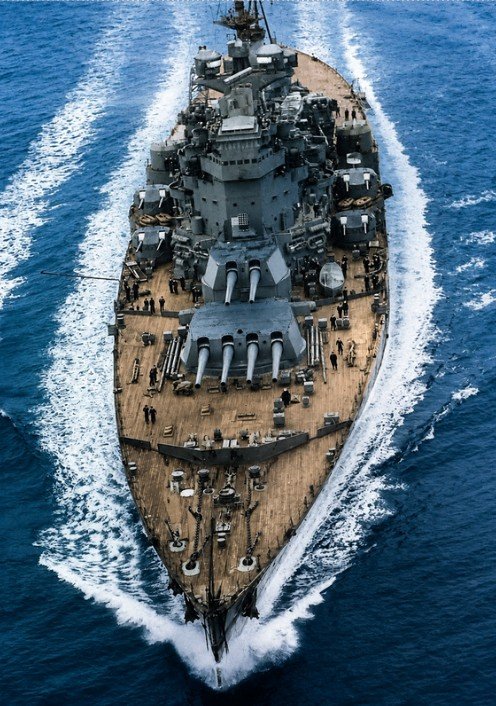
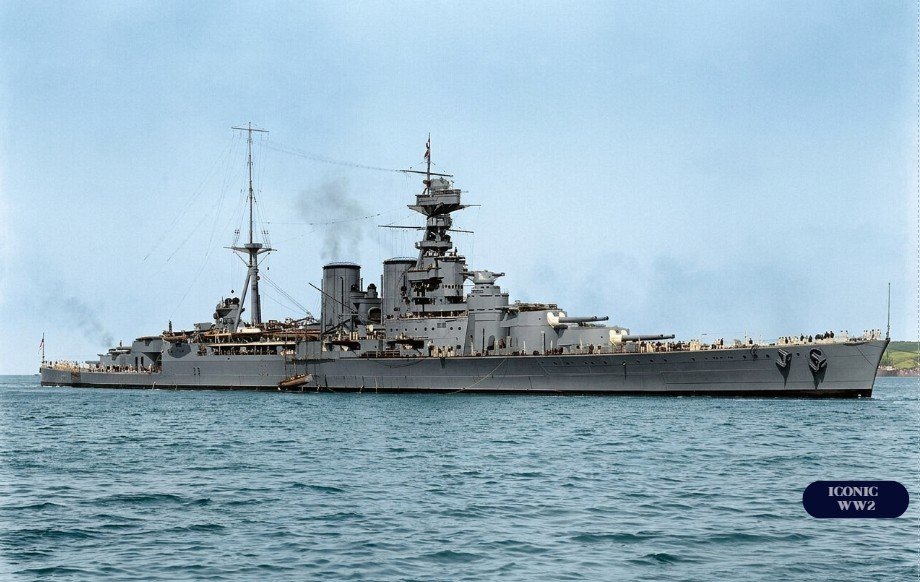
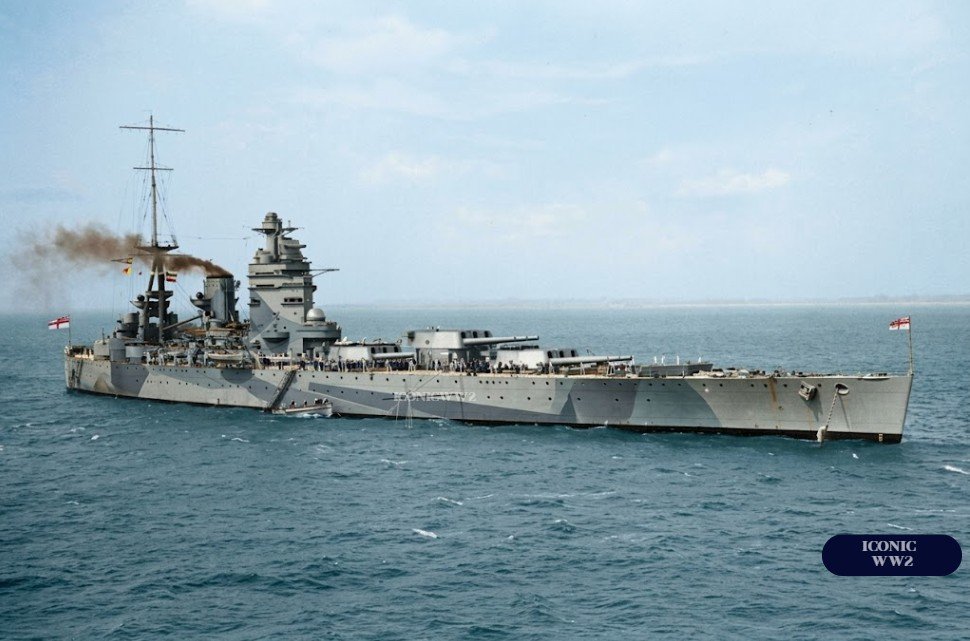
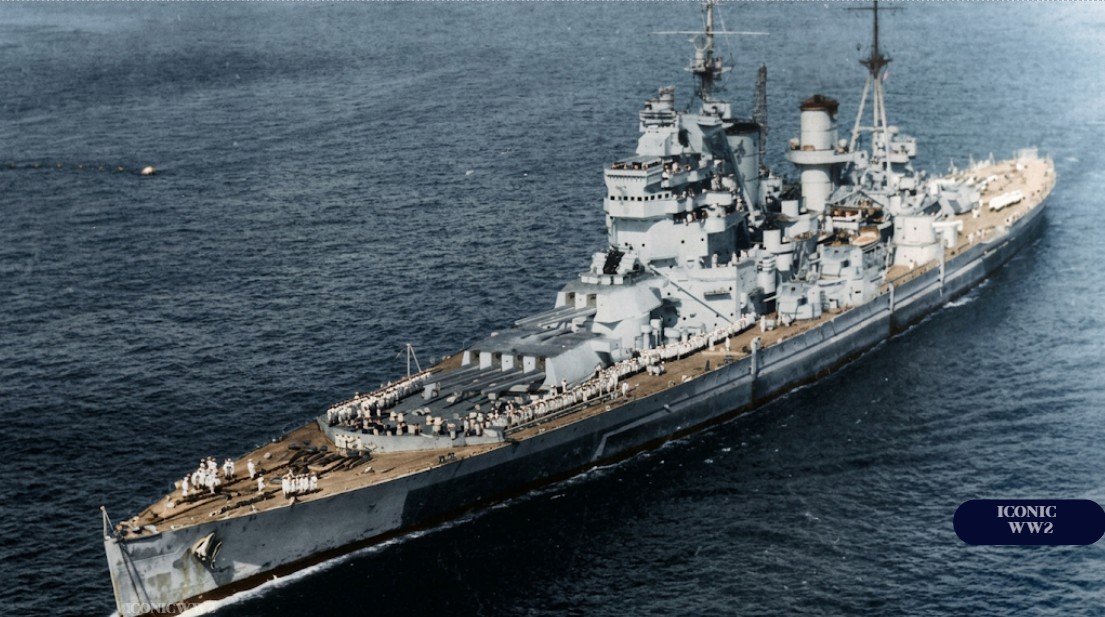
When Fascist Italy began building the powerful Littorio-class battleships in the 1930s, France was compelled to answer. The result was the Richelieu class — the largest, fastest and most powerful battleships France ever built, designed to dominate the western Mediterranean and protect the French Atlantic coast and her overseas empire.
Richelieu herself was laid down at the great naval arsenal of Brest and was the very embodiment of French naval ambition on the eve of the Second World War. She was a thoroughly modern design — fast, heavily armoured and bristling with the most advanced guns France could produce — and she promised to make the Marine Nationale a force to be reckoned with. History, however, would deny her the clean career her designers imagined.
Richelieu's most striking feature was her main armament: eight 380mm (15-inch) guns mounted in just two enormous quadruple turrets, both placed forward of the superstructure. This unusual all-forward arrangement — shared only with Britain's Nelson class — concentrated her firepower and shortened the heavily armoured citadel she had to protect, but meant she could not fire her main guns directly astern.
The design was a model of efficiency. By grouping the heavy turrets together, French engineers saved weight and armour, freeing displacement for a powerful machinery plant. Richelieu could make over 32 knots, fast enough to run with cruisers and to choose or refuse battle as she wished — a vital quality in the confined waters of the Mediterranean.
She was well protected, with a thick armoured belt and deck designed to resist the heaviest enemy shells, and she carried a strong secondary and anti-aircraft battery. In firepower, speed and protection Richelieu stood comparison with any battleship afloat — a genuine match for the Italian Littorios she had been built to face.
Richelieu was commissioned in a desperate hour. In June 1940, with German armies overrunning France, she was still completing at Brest. To keep her out of enemy hands she made a dramatic dash for the safety of French North and West Africa, sailing while still unfinished and reaching Dakar in French West Africa.
France's surrender created an agonising problem for her former ally. Britain, terrified that the powerful French fleet might fall under German control, demanded that French warships join the Allies, sail to neutral ports, or be disarmed. When negotiations failed, the Royal Navy attacked the French squadron at Mers-el-Kébir in July 1940, killing nearly 1,300 French sailors — a tragedy that poisoned relations between the former allies.
Richelieu, lying at Dakar, became a target in her own right. In July and September 1940 British and Free French forces struck at the port to neutralise her or win her over to the Allied cause. Though damaged by air attack and a torpedo, Richelieu's powerful guns helped beat off the assault, and the Battle of Dakar ended as a humiliating Allied failure.
For two years she lay at Dakar under the flag of Vichy France — a magnificent battleship immobilised by politics, neither fighting the Axis nor able to join the Allies, a symbol of France's divided and tragic position in the war.
Everything changed in late 1942. The Allied landings in North Africa and the German occupation of the rest of France swung French West Africa to the Allied side, and Richelieu at last joined the war against the Axis. She sailed to the United States, where she was thoroughly refitted and modernised with new radar and a vastly strengthened anti-aircraft armament.
Renewed and rearmed, Richelieu served with the British Home Fleet, covering operations off Norway, before sailing east to join the British Eastern Fleet in the Indian Ocean and Pacific. There she bombarded Japanese positions and supported the closing campaigns against Japan, ending the war as a respected member of the Allied fleet — the same ship that had once fired on Allied forces at Dakar.
Few warships had a stranger or more poignant career than Richelieu. Built to lead a proud navy, she instead became a prisoner of France's catastrophe — fleeing her builders unfinished, fired upon by her former allies, immobilised under Vichy, and finally redeemed as a fighter in the Allied cause. Her story is, in miniature, the whole tragedy of France in the Second World War.
Yet she survived it all. Richelieu returned to a liberated France after the war, served the rebuilt French navy for years, and remained a symbol of national pride. Distinctive in design and dramatic in history, she endures as the finest battleship France ever sent to sea, and as a reminder of how deeply the politics of 1940 cut through even the steel of a great warship.
- Roger Chesneau (ed.), Conway’s All the World’s Fighting Ships 1922–1946 (Conway Maritime Press).
- John Jordan & Robert Dumas, French Battleships 1922–1956 (Seaforth Publishing).
Iconic WW2 is free, ad-free and tracker-free — kept going only by the time it takes to research, restore and colorize each machine. If this profile was worth your read, you can help the archive grow.
| Class | Richelieu |
| Builder | Arsenal de Brest |
| Nation | France |
| Type | Fast battleship |
| Commissioned | July 1940 (incomplete) |
| Fate | Survived war; scrapped 1968 |
| Crew | ~1,550 |
| Distinction | All-forward main battery |
| Richelieu | Survived the war; served to 1960s |
| Jean Bart | Sister ship; completed post-war |
| Vichy service | Held at Dakar, 1940–1942 |
| Allied service | Home & Eastern Fleets, 1943–1945 |
| Machinery | 4× geared steam turbines |
| Boilers | 6 Sural-Indret |
| Power | ~150,000 shp |
| Shafts | 4 |
| Max Speed | ~32 knots |
| Range | ~9,500 nmi at 15 kn |
| Standard Displacement | ~37,800 t |
| Full Load | ~47,500 t |
| Length | 247.9 m |
| Beam | 33 m |
| Draught | ~9.6 m |
| Main Battery | 8× 380 mm /45 (2×4) |
| Secondary | 9× 152 mm |
| Belt Armour | 250–330 mm |
| Layout | Both main turrets forward |