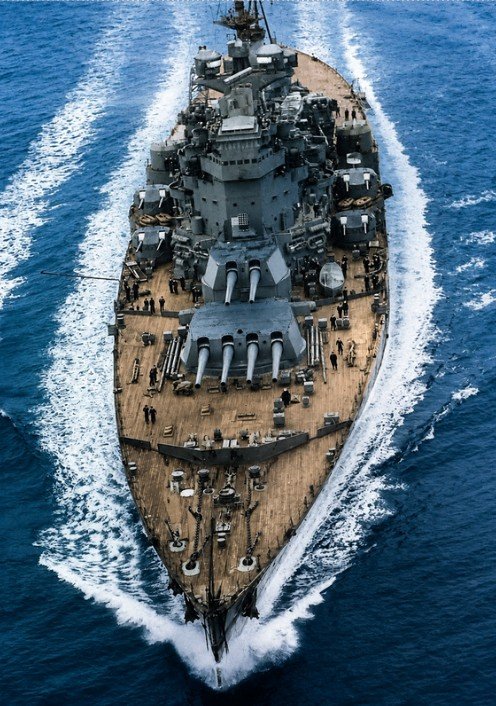
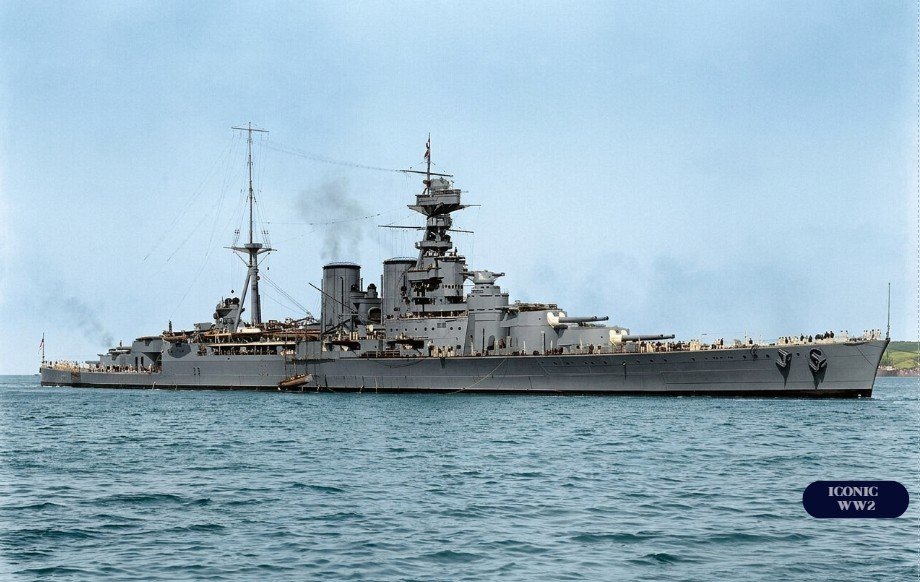
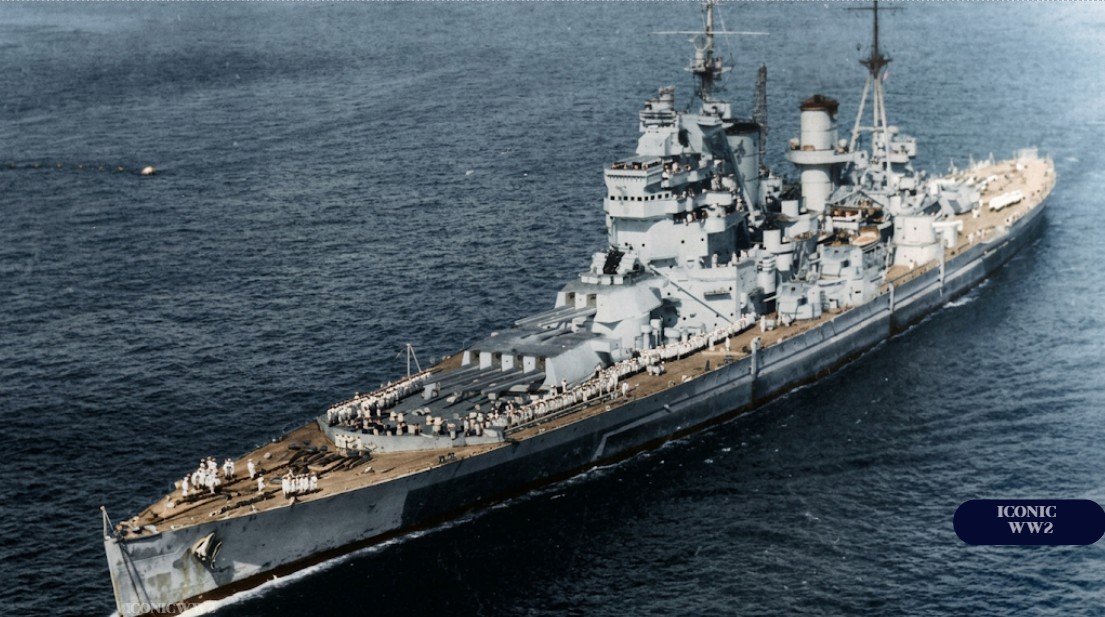
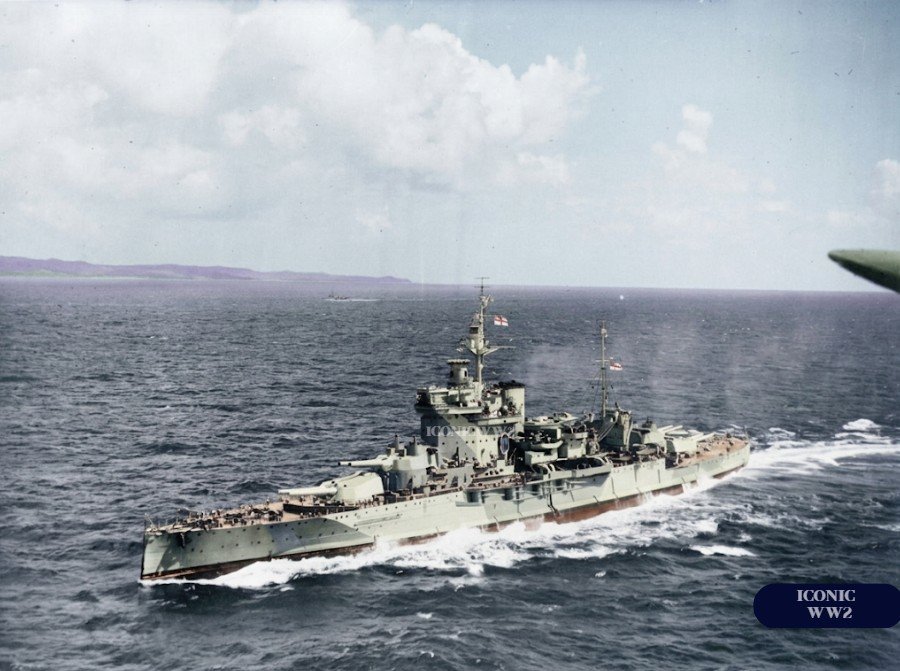
HMS Rodney and her sister Nelson were the only British battleships built under the restrictions of the 1922 Washington Naval Treaty, which capped new capital ships at 35,000 tons. To pack the heaviest possible armament and armour into that limit, the designers adopted a radical and unmistakable layout: all nine 16-inch (406 mm) guns grouped in three triple turrets forward of the bridge, with the superstructure pushed well aft.
The arrangement saved weight on the armoured citadel — only the forward two-thirds of the ship needed heavy protection — but it gave the Nelsons a strange, top-heavy silhouette and a blind arc directly astern. Commissioned in 1927, they were the most powerfully armed battleships in the world for over a decade.
Rodney's 406 mm /45 Mk I guns were the only 16-inch weapons the Royal Navy ever fielded, firing a heavy shell to defeat armour at long range. To stay within treaty weight she carried an 'all-or-nothing' armour scheme concentrated over the citadel: a main belt up to 356 mm (14 in) and a thick armoured deck, making the Nelsons among the best-protected ships of their day.
The price was paid in speed. With machinery of only about 45,000 shp driving roughly 38,000 t full load, Rodney managed just ~23 knots — slow even by the standards of the 1920s, and a serious handicap against fast opponents. Her novel forward-mounted machinery and guns also produced persistent vibration and blast problems. She was a floating heavy battery: immensely strong and hard-hitting, but ponderous.
Only two ships were completed — Nelson and Rodney — their numbers limited by the same treaty that shaped them. Nicknamed the 'Nelsols' after a class of slow wartime oilers (Nelson + Olna), the pun captured their unhurried pace.
Despite their oddities, both gave long and valuable service through the Second World War in the Atlantic, the Mediterranean and home waters, and both survived the conflict to be scrapped in 1948–49. Rodney's name would be made in a single dramatic morning in 1941.
On 27 May 1941, three days after Bismarck had sunk HMS Hood, the crippled German battleship — her steering wrecked by a Swordfish torpedo — was brought to battle by the Home Fleet. Rodney, together with the battleship King George V and supporting cruisers, closed in for the kill.
Rodney opened fire at about 16,000 m and, as the range fell, her nine 16-inch guns smashed Bismarck's superstructure, turrets and command positions with devastating effect — at one point closing to under 3,000 m to fire almost point-blank. Within roughly 90 minutes Bismarck was a blazing, silenced wreck, finished off by torpedoes and scuttling charges. Rodney had fired several hundred 16-inch rounds and reduced Germany's mightiest warship to a hulk.
It was the single most famous action of any British battleship in the war, and it cemented Rodney's place in naval history as the ship that avenged the Hood.
Bismarck was the famous morning, but Rodney’s war ran on for three more hard years. In August 1942 she fought through Operation Pedestal, the convoy that saved Malta, her heavy anti-aircraft batteries in action for days; in November she covered the Torch landings, duelling shore batteries at Oran, and in 1943 she supported the invasions of Sicily and the Italian mainland.
On D-Day and through the summer of 1944 her 16-inch guns fired hundreds of rounds against targets far inland — including German armour concentrations around Caen at ranges beyond 25 km — and in August she methodically demolished the coastal battery on Alderney. By then she had steamed some 156,000 nautical miles on wartime service, her never-refitted machinery held together, as her crew liked to say, by habit and wire.
HMS Rodney was a creature of the disarmament era — an ungainly compromise forced into 35,000 tons, slow and awkward, yet carrying the heaviest broadside in the Royal Navy. For most of her career her shortcomings were obvious and her opportunities few.
But on one morning in May 1941 every quality the designers had bought at the cost of speed paid off at once: nine 16-inch guns and the armour to stand in close, hammering Bismarck into ruin. Rodney is remembered not for grace or pace, but for that overwhelming weight of fire — the slow, strange battleship that ended the career of the fast, beautiful one.
- Iain Ballantyne, HMS Rodney (Warships of the Royal Navy, Pen & Sword).
- William H. Garzke & Robert O. Dulin, British, Soviet, French and Dutch Battleships of World War II (Naval Institute Press).
- S. W. Roskill, The War at Sea 1939–1945 (HMSO) — the official history.
Iconic WW2 is free, ad-free and tracker-free — kept going only by the time it takes to research, restore and colorize each machine. If this profile was worth your read, you can help the archive grow.
| Class | Nelson |
| Builder | Cammell Laird, Birkenhead |
| Nation | United Kingdom |
| Type | Battleship |
| Commissioned | 10 November 1927 |
| Fate | Scrapped 1948 |
| Crew | ~1,360 |
| Ships in Class | 2 |
| Nelson | Served Atlantic & Med; scrapped 1949 |
| Rodney | Sank the Bismarck, 1941 |
| Machinery | 2× geared steam turbines |
| Boilers | 8 Admiralty |
| Power | ~45,000 shp |
| Shafts | 2 |
| Max Speed | ~23 knots |
| Range | ~7,000 nmi at 16 kn |
| Standard Displacement | ~33,700 t |
| Full Load | ~38,000 t |
| Length | 216.4 m |
| Beam | 32.3 m |
| Draught | ~9.1 m |
| Main Battery | 9× 406 mm /45 (3×3, all forward) |
| Secondary | 12× 152 mm + 6× 120 mm AA |
| Belt Armour | up to 356 mm |
| Deck Armour | up to ~160 mm |