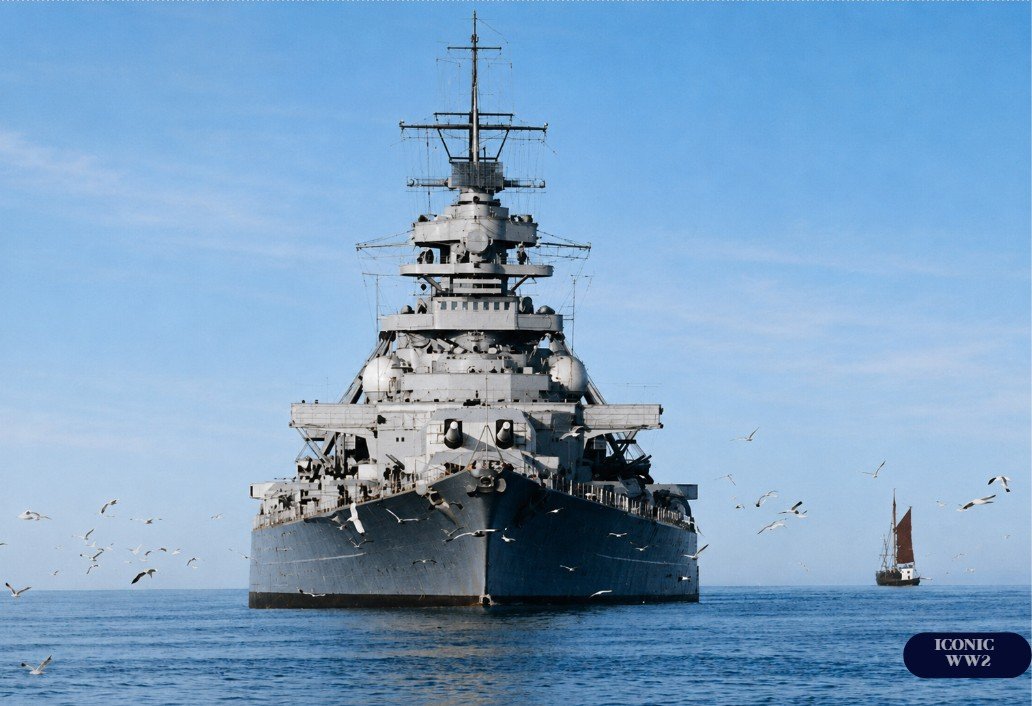
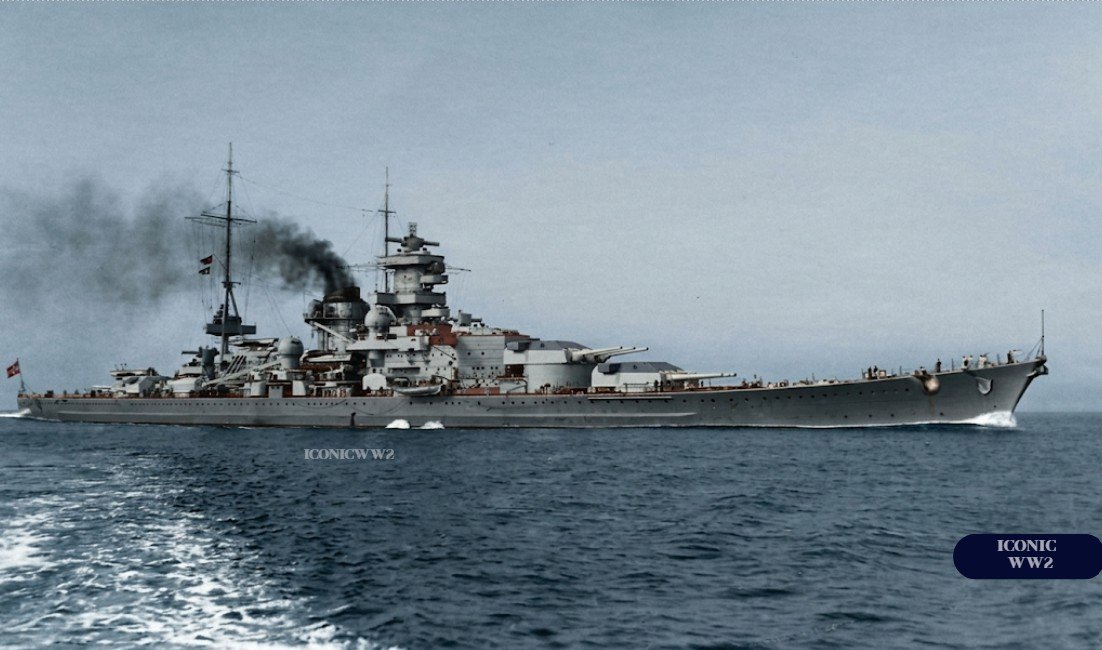
Tirpitz was the second and last of the Bismarck-class battleships, laid down at Wilhelmshaven in 1936, launched on 1 April 1939 and commissioned on 25 February 1941. Named after Grand Admiral Alfred von Tirpitz, architect of the Imperial German High Seas Fleet, she was slightly heavier than her famous sister, displacing about 52,600 tonnes at full load — the largest battleship ever completed by a European navy.
She entered service just months after Bismarck’s dramatic sortie and destruction in May 1941. That loss cast a long shadow: Hitler, wary of risking another capital ship in the open Atlantic, would keep Tirpitz on a far tighter leash — a decision that shaped her entire, curiously bloodless, career.
Like Bismarck, Tirpitz carried a main battery of eight 38 cm (15 in) SK C/34 guns in four twin turrets, backed by twelve 15 cm secondaries and a heavy anti-aircraft outfit of sixteen 10.5 cm, sixteen 3.7 cm and dozens of 2 cm guns. Protection was on the scale of a fast battleship: a main belt of about 320 mm, an armoured deck of roughly 100–120 mm and turret faces up to 360 mm.
Her twelve boilers fed three sets of geared turbines producing around 163,000 shp, driving the 251 m hull at nearly 31 knots. Unlike Bismarck she was also fitted with above-water torpedo tubes. On paper she was a superbly balanced and dangerous ship; in practice she would fire her main guns in anger against an enemy only once in her life.
From early 1942 Tirpitz was based in the fjords of northern Norway — Trondheim, and later Kåfjord near the North Cape. From there she threatened the Arctic convoys carrying supplies to the Soviet Union, and her mere existence forced the Royal Navy to hold powerful battleship and carrier forces in northern waters that might otherwise have gone to the Mediterranean or the Pacific.
This was the strategy of the “fleet in being”: a warship that shapes the enemy’s dispositions simply by being a latent threat. Her most notorious effect came in July 1942, when a mistaken report that she had sailed prompted the Admiralty to scatter convoy PQ 17; the dispersed merchantmen were then annihilated piecemeal by U-boats and aircraft — a catastrophe Tirpitz caused without firing a shot. Sheltered, camouflaged and endlessly menacing, she became known to the Germans as the “Lonely Queen of the North.”
The first blow to reach her came from craft fifteen metres long. On 22 September 1943 six British X-craft midget submarines, towed across the North Sea, attempted to penetrate the triple net defences of Kåfjord; two, X6 (Lieutenant Donald Cameron) and X7 (Lieutenant Godfrey Place), got through and dropped their two-tonne Amatex side-charges beneath the battleship before their crews were captured.
The explosions heaved the 50,000-tonne ship bodily out of the water, wrecking turbines, generators and fire-control equipment and jamming two main turrets. Tirpitz was out of action for six months — and Cameron and Place received the Victoria Cross, awarded while they were still prisoners of war.
Patched up again by the spring of 1944, Tirpitz was hunted relentlessly from the air. On 3 April 1944, carrier aircraft of the Fleet Air Arm struck her in Operation Tungsten, Barracuda dive-bombers scoring some fifteen hits that killed over a hundred of her crew — though her armoured deck kept the damage above the waterline, and further carrier raids through the summer achieved little against her nets and smoke screens.
The decisive weapon was the RAF’s 12,000 lb (5,443 kg) “Tallboy” earthquake bomb, designed by Barnes Wallis and carried by the Lancasters of Nos. 617 and 9 Squadrons. In Operation Paravane on 15 September 1944, flying from a base in northern Russia, they drove a Tallboy through her bow — flooding her forward and leaving her, in truth, no longer seaworthy. The Germans towed her south to Tromsø to serve as a static coastal battery, a move that fatally brought her within reach of Lancasters flying from Scotland.
A first attempt from the new anchorage, Operation Obviate on 29 October 1944, was foiled at the last moment when cloud rolled across the target and the Tallboys fell wide. The Lancasters returned two weeks later. On 12 November 1944, in Operation Catechism, they caught Tirpitz under a clear sky, and the German fighters based nearby — through error and delay — never intervened.
At least two Tallboys struck home and others burst alongside, tearing open her hull; a magazine detonated, and the great battleship rolled over and capsized within minutes. Around 1,000 of her crew were trapped inside the upturned hull; rescuers cutting through the steel over the following hours saved fewer than ninety. The largest warship Germany ever built had been destroyed at her moorings, having never fought an enemy ship.
Tirpitz is the great paradox of the Second World War at sea: one of the most powerful battleships ever built, which spent almost her entire career at anchor and fired her main guns at an enemy only once — the bombardment of the Allied base at Spitsbergen in September 1943. She never once dueled another warship.
Yet as a fleet in being she may have served Germany better immobile than she ever could have at sea. For three years her mere presence in the Norwegian fjords tied down British battleships, carriers and cruisers, distorted the whole Arctic convoy campaign and forced operation after operation to be mounted against her. She was destroyed without ever proving what she could do — and that latent, unrealised threat was precisely her value. Her wreck was largely broken up for scrap after the war.
- Niklas Zetterling & Michael Tamelander, Tirpitz: The Life and Death of Germany’s Last Super Battleship (Casemate, 2009).
- Patrick Bishop, Target Tirpitz (HarperPress, 2012).
- John Sweetman, Tirpitz: Hunting the Beast (Sutton).
- William H. Garzke & Robert O. Dulin, Battleships: Axis and Neutral Battleships in World War II (Naval Institute Press).
Iconic WW2 is free, ad-free and tracker-free — kept going only by the time it takes to research, restore and colorize each machine. If this profile was worth your read, you can help the archive grow.
| Class | Bismarck |
| Builder | Kriegsmarinewerft, Wilhelmshaven |
| Nation | Germany |
| Type | Fast battleship |
| Commissioned | 25 February 1941 |
| Fate | Capsized 12 Nov 1944 (Tallboys) |
| Machinery | 12 boilers, 3× geared turbines |
| Shaft Power | ~163,000 shp |
| Max Speed | 30.8 knots |
| Range | ~8,900 nmi at 19 kn |
| Length | 251 m |
| Beam | 36 m |
| Draught | ~10.6 m |
| Full Load | ~52,600 t |
| Crew | ~2,600 |
| Main Battery | 8× 380 mm /52 (4×2) |
| Secondary | 12× 150 mm + 16× 105 mm AA |
| Light AA | 16× 37 mm + ~72× 20 mm |
| Torpedoes | 8× 533 mm (above-water) |
| Belt Armour | ~320 mm |
| Turret Face | ~360 mm |