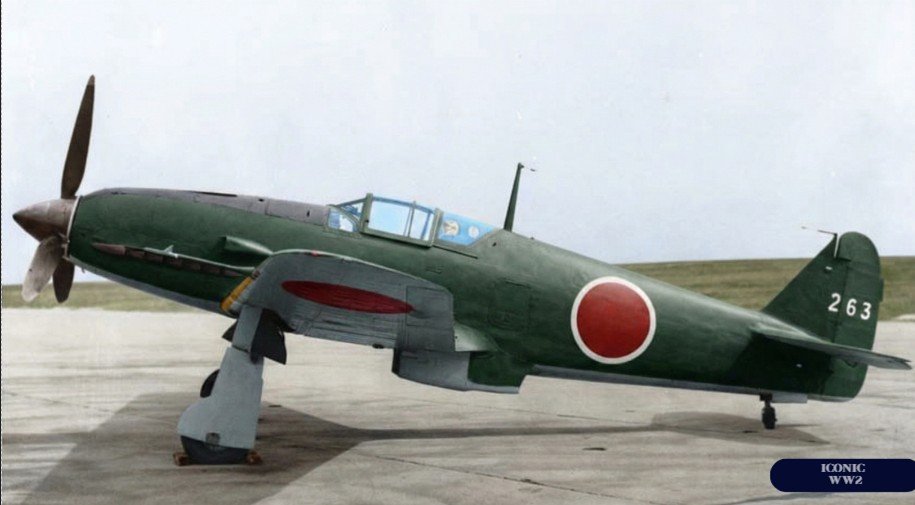
By 1942 the Imperial Japanese Army Air Force faced an uncomfortable truth. Its frontline fighters — the nimble but lightly built Ki-43 Hayabusa chief among them — had been designed around the pre-war cult of the dogfight, trading armour, firepower and speed for sheer turning agility. Against the faster, heavier and better-protected American fighters now appearing in the Pacific, that bargain no longer held. The Army needed a thoroughly modern fighter that could climb, dive and shoot with the best the Allies could field.
The task fell to the Nakajima Aircraft Company and its design team under chief engineer T. Koyama, who had already produced the Ki-43 and Ki-44. Their answer, the Ki-84 Hayate (“Gale”), was conceived from the outset as a balanced fighter: fast and well-armed, yet still agile enough to satisfy Army pilots raised on manoeuvre combat. The prototype first flew in the spring of 1943, and from the beginning it showed exceptional promise.
At the heart of the Hayate sat the Nakajima Ha-45 Homare, an 18-cylinder twin-row radial that packed close to 2,000 hp into a remarkably compact cowling. It gave the Ki-84 a maximum speed approaching 690 km/h and a rate of climb that startled Allied test pilots — when supplied with proper fuel and a sound engine, captured examples flown post-war in the United States out-accelerated and out-climbed both the P-47 and the P-51 at medium altitudes.
Crucially, the Hayate broke with Japanese tradition by carrying armour protection and self-sealing fuel tanks from the start, making it far more able to absorb battle damage than the fragile fighters that preceded it. Standard armament was heavy by Japanese standards — two 20mm Ho-5 cannon and two 12.7mm machine guns — and later sub-types pushed this further still.
But the Homare was a temperamental engine even in peacetime, and Japan in 1944 was no longer at peace. Deteriorating manufacturing standards, poor-quality fuel and inadequately heat-treated landing-gear steel meant that the aircraft rolling off the lines rarely matched the brilliance of the prototypes. Engines ran rough, hydraulics failed and undercarriage legs snapped on landing. The Ki-84's tragedy was that it was a world-class design strangled by a collapsing industrial base.
The principal production model was the Ki-84-Ia, with its mixed cannon-and-machine-gun armament. The Ki-84-Ib replaced the cowling machine guns with a second pair of 20mm cannon for four-cannon firepower, while the Ki-84-Ic was a dedicated bomber-destroyer carrying 30mm weapons to tackle the B-29.
As light alloys grew scarce, Nakajima developed metal-sparing versions: the Ki-84-II used wooden rear fuselage and fittings, and the experimental all-wood Ki-106 and steel Ki-113 were attempts to build the fighter from non-strategic materials. Few of these reached service before the war ended.
The Hayate entered combat in China in the late summer of 1944 and was quickly thrown into the desperate defensive battles of the war's final year. It fought over the Philippines during the American landings, defended Formosa and Okinawa, and served in the home defence of Japan against the B-29 raids, where its speed and climb made it one of the few Army fighters with a realistic chance of intercepting the bombers at altitude.
On paper it was the answer the Army had waited for. The Hayate was fast — around 630 km/h — well-armed with two cannon and two heavy machine guns, and unlike earlier Japanese fighters it carried armour and self-sealing tanks. Test pilots on both sides rated a good example the equal of the P-51 and P-47 it had to face.
In the hands of an experienced pilot flying a well-built example, the Ki-84 was a dangerous opponent that earned genuine respect from Allied airmen. Yet such conditions were increasingly rare. Serviceability rates were dismal, replacement pilots were poorly trained, and fuel was so degraded that many aircraft could not reach their rated performance. The fighter that should have restored parity to the Army air arm instead spent its career fighting a losing battle against both the enemy and its own faltering supply chain.
But a good example was the exception. Rushed production and poor late-war materials meant brittle landing gear and unreliable engines; degraded fuel robbed the aircraft of its rated performance; and the pilots sent to fly it were a shadow of the prewar cadre. Around 3,500 were built, but the Ki-84’s reputation rests on what it might have been as much as on what it achieved.
Around 3,500 Hayate were built, making it the most numerous of Japan's late-war Army fighters and, by common consent, the finest the IJAAF fielded in quantity. On paper and in the hands of skilled pilots it was a match for anything the Allies flew over the Pacific.
Its story, though, is inseparable from the circumstances of its birth. The Ki-84 arrived too late, in too poor a state of manufacture, and amid too complete a collapse of Japanese air power to alter the course of the war. The measure of that gap sits in the post-war American tests: a well-built example on proper fuel out-climbed and out-accelerated the P-47 and the P-51 — performance the type rarely reached in Japanese service.
- René J. Francillon, Japanese Aircraft of the Pacific War (Putnam).
- William Green, Warplanes of the Second World War (Macdonald).
- Bill Gunston, The Illustrated Encyclopedia of Combat Aircraft of World War II (Salamander Books).
Iconic WW2 is free, ad-free and tracker-free — kept going only by the time it takes to research, restore and colorize each machine. If this profile was worth your read, you can help the archive grow.
| Manufacturer | Nakajima Aircraft Company |
| Designer | T. Koyama (design team) |
| Nation | Japan |
| Role | Fighter / Interceptor |
| First Flight | March 1943 |
| Service Entry | August 1944 |
| Allied Codename | "Frank" |
| Units Built | ~3,500 |
| Ki-84-Ia | 2× 20mm + 2× 12.7mm |
| Ki-84-Ib | Four 20mm cannon |
| Ki-84-Ic | Bomber-destroyer, 30mm |
| Ki-84-II | Wooden rear fuselage |
| Ki-106 / Ki-113 | All-wood / steel prototypes |
| Engine | Nakajima Ha-45 Homare |
| Type | 18-cyl air-cooled radial |
| Power | ~1,990 hp |
| Note | Powerful but unreliable |
| Max Speed | 687 km/h @ 6,500 m |
| Service Ceiling | ~10,500 m |
| Range | ~1,700 km |
| Climb Rate | ~19 m/s |
| Wingspan | 11.24 m |
| Length | 9.92 m |
| Height | 3.39 m |
| Wing Area | 21.00 m² |
| Empty Weight | 2,660 kg |
| Max Takeoff | 4,170 kg |
| Cannon | 2× 20mm Ho-5 |
| Machine Guns | 2× 12.7mm Ho-103 |
| Bombs (optional) | 2× 250 kg |