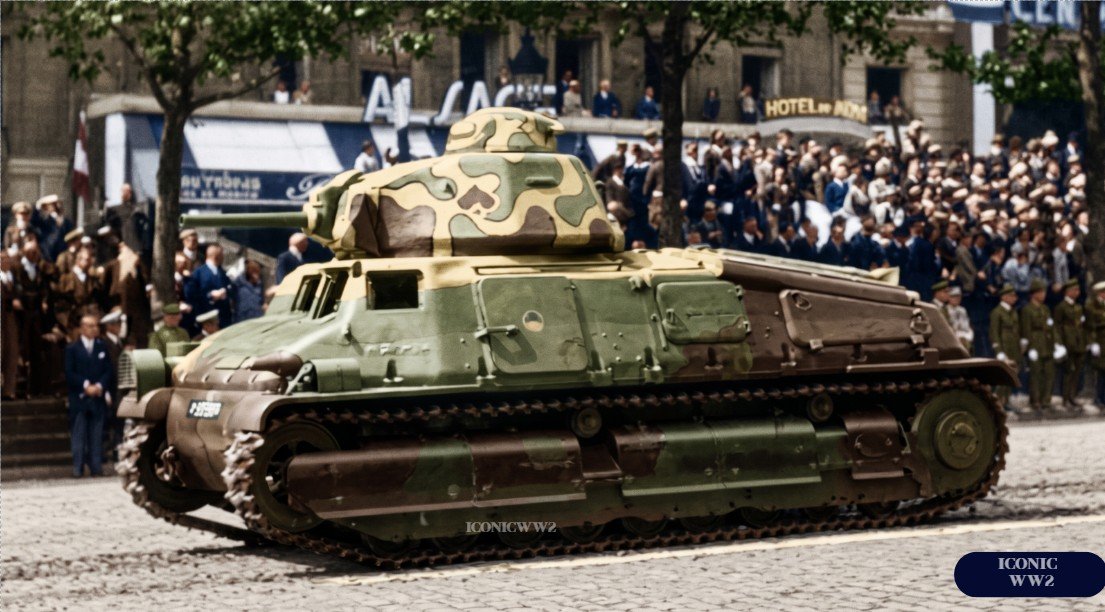
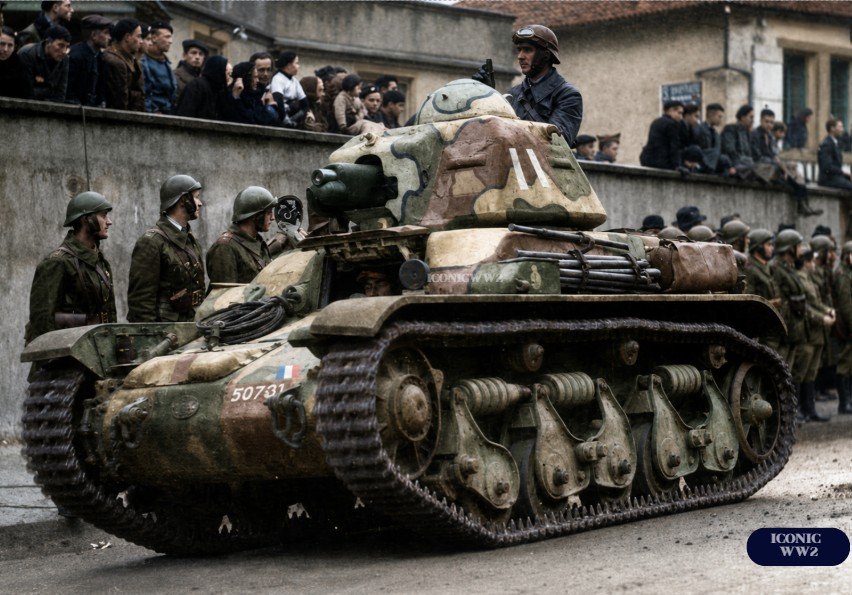
The Char B1 traced its origins to French tank doctrine of the 1920s, which envisioned a heavily armoured char de bataille able to break through fortified lines. After a long, fitful development the type entered service in 1935, and the definitive Char B1 bis followed in 1937 with thicker armour and a more powerful turret.
It was an expensive, complex machine — roughly 400 were built — and it embodied a very different philosophy from the German Panzers. Where the Panzer III spread work across five men, the B1 bis concentrated extraordinary firepower and protection in a vehicle whose crew of four was, as events would show, far too few to fight it efficiently.
The B1 bis carried an unusual two-gun armament. A 75 mm ABS SA 35 howitzer (L/17.1) was mounted low in the hull front, aimed in elevation by the gunner but in azimuth by steering the whole tank via a precise Naeder hydrostatic transmission. Above it, a one-man APX4 turret mounted a 47 mm SA 35 high-velocity gun able to defeat any German tank of 1940. Two 7.5 mm MG completed the outfit.
Protection was outstanding for its day: up to 60 mm of armour, proof against the German 37 mm and 50 mm L/42 guns at normal ranges. The price was weight and thirst — about 28 t, a road speed of only 28 km/h from its ~300 hp Renault petrol engine, and a meagre road range near 180 km that fell to roughly 150 km cross-country.
The fatal flaw lay in the one-man turret. The commander had to spot targets, lay, load and fire the 47 mm gun, and direct the driver and hull gunner all at once — a workload that left him overwhelmed in fast-moving battle. Combined with the slow speed, short range and a vulnerable side radiator grille, it turned a superbly armed and armoured tank into a tactically blunt instrument.
The B1 bis’s structural weaknesses were laid bare at Flavion on 15 May 1940, in the largest tank battle of the campaign in Belgium. The 1re Division Cuirassée, its B1 bis tanks halted to refuel after a night march — each tank burned through its fuel in around six hours — was caught static by the massed armour of the 5. and 7. Panzer-Divisionen.
Individually the French tanks fought superbly, some absorbing dozens of hits; but attacked from the flanks while immobile, starved of fuel and with no radios to coordinate a response, the division lost around 65 of its tanks in a day and ceased to exist as a fighting formation. Flavion, the day before Stonne, is the other half of the B1 bis story: magnificent armour, defeated by logistics and command.
What the B1 bis could do in favourable conditions was demonstrated at Stonne on 16 May 1940. A single tank named Eure, commanded by Capitaine Pierre Billotte, advanced into the German-held village and in one action knocked out 13 German tanks — two Panzer IV and eleven Panzer III — together with two guns.
Eure was struck by around 140 rounds; not one penetrated its 60 mm armour, and the tank drove back to French lines. The episode showed that, tank for tank, the B1 bis outclassed its German opponents in gun and armour — and that the German victory in 1940 was a triumph of concentration, radio, air power and tempo, not of superior machines.
In the Battle of France the B1 bis equipped the armoured divisions (Divisions Cuirassées), but French doctrine dispersed its tanks in support of infantry rather than concentrating them as the Germans did. Time and again, individual B1s fought well only to be stranded by fuel exhaustion, mechanical breakdown or encirclement, picked off by German 88 mm flak guns or simply abandoned when their short range ran out.
After the French surrender the Germans captured large numbers and pressed them into service as the Panzerkampfwagen B2(f), using them for occupation, training and airfield defence; several were rebuilt as flamethrower tanks (Flammpanzer) or as self-propelled artillery. A handful even fought again in 1944–45, on both sides, in the fighting in France.
The Char B1 bis is the great paradox of 1940: a tank with heavier armour and more firepower than anything the Wehrmacht fielded, yet part of an army that lost in six weeks. Its 75 mm and 47 mm guns and 60 mm armour were first-class; its one-man turret, slow speed, short range and the doctrine that scattered it were not.
More than any other vehicle, it proves that armoured warfare is won by systems and ideas as much as by steel. The B1 bis could defeat German tanks one-on-one — Stonne showed it beyond doubt — but the German way of war defeated the French army around it. It remains a powerful symbol of how a superb weapon, used wrongly, can still lose.
- Steven J. Zaloga, French Tanks of World War II (1): Infantry and Battle Tanks (Osprey, New Vanguard).
- Peter Chamberlain & Chris Ellis, Tanks of the World 1915–1945 (Cassell).
Iconic WW2 is free, ad-free and tracker-free — kept going only by the time it takes to research, restore and colorize each machine. If this profile was worth your read, you can help the archive grow.
| Manufacturer | Renault / FCM / others |
| Nation | France |
| Role | Heavy breakthrough tank |
| Service Entry | 1937 (B1 bis) |
| Crew | 4 |
| Combat Weight | ~28 t |
| Produced | ~400 (1937–1940) |
| Tank | 'Eure', Capt. Billotte |
| Kills | 13 tanks (2 Pz IV, 11 Pz III) |
| Hits taken | ~140, none penetrated |
| Outcome | Drove back to French lines |
| Engine | Renault 6-cyl petrol |
| Power | ~300 hp |
| Road Speed | ~28 km/h |
| Range | ~180 km road |
| Length | ~6.37 m |
| Width | ~2.50 m |
| Height | ~2.79 m |
| Turret | APX4, one-man |
| Hull Gun | 75 mm ABS SA 35 (L/17.1) |
| Turret Gun | 47 mm SA 35 |
| Secondary | 2× 7.5 mm MG |
| Max Armour | 60 mm; side grille vulnerable |