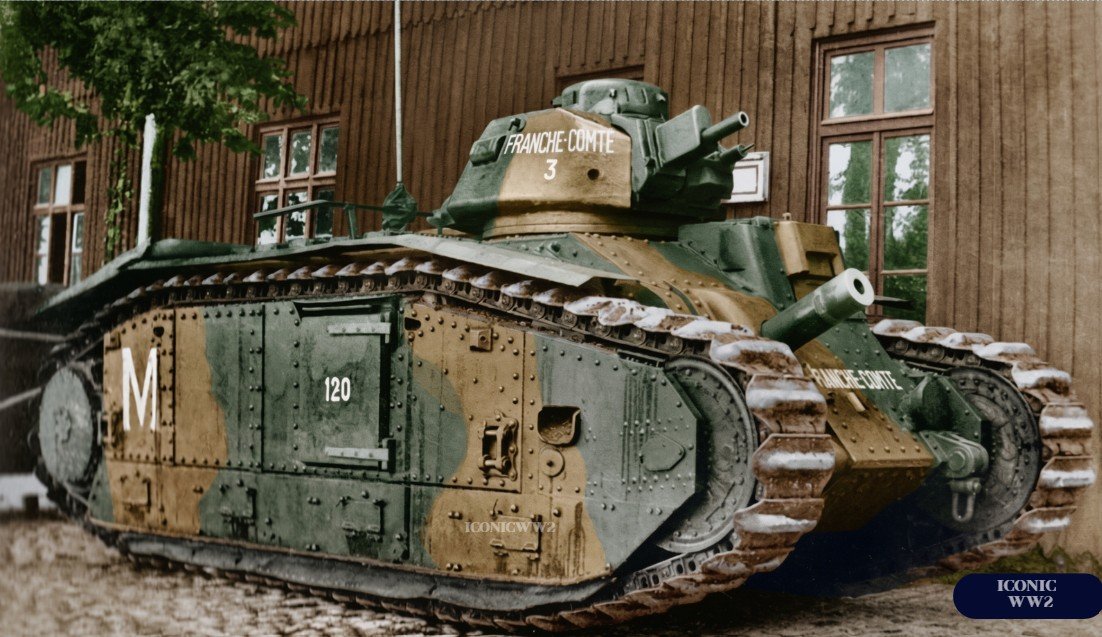
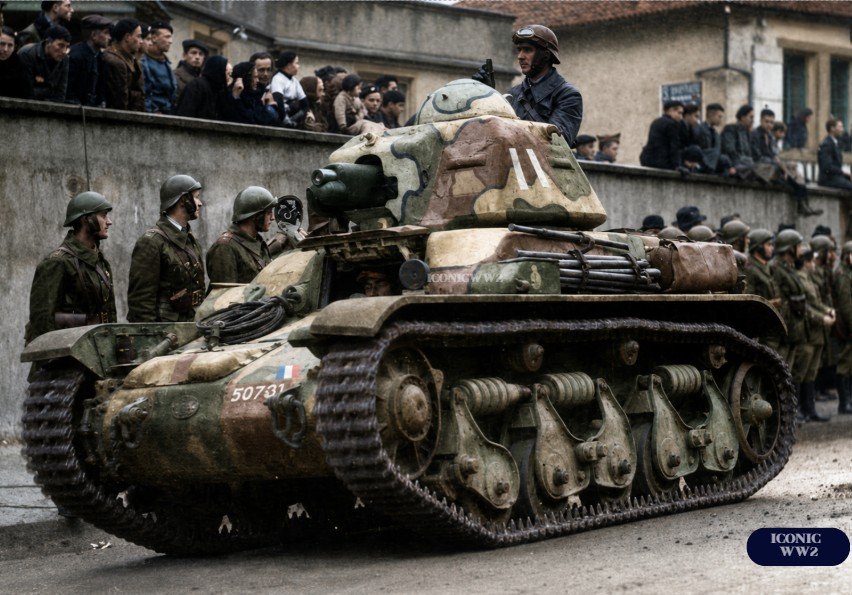
In the early 1930s the French cavalry sought a fast, well-armoured fighting machine — a char de cavalerie — to equip its new mechanised divisions, the Divisions Légères Mécaniques (DLM). The order went to SOMUA (Société d'Outillage Mécanique et d'Usinage d'Artillerie), a subsidiary of Schneider, which produced a prototype in 1935 and began deliveries the following year.
The result, the SOMUA S35 (officially Char 1935 S), was for its day a remarkably advanced design: an all-cast hull and turret, a hard-hitting 47 mm gun, and the speed to keep up with the cavalry. It is widely judged the best Allied tank available in 1940.
The S35's 47 mm SA 35 L/32 gun was the finest French tank weapon of the campaign, able to penetrate roughly 40 mm of armour at 500 m — comfortably enough to defeat the German Panzer III and Panzer IV frontally, while the German 37 mm struggled against the Frenchman. A coaxial 7.5 mm machine gun completed the armament.
Protection was exceptional for a 1936 medium. The cast hull was up to 47 mm thick and the APX 1 CE turret up to 56 mm, the rounded castings shedding shot far better than the bolted plate of contemporaries. All this on a tank of just ~19.5 t, driven by a SOMUA V-8 petrol engine of ~190 hp for a road speed near 40–45 km/h and a range of about 230 km.
Against these strengths stood one crippling flaw: a one-man turret. The commander had to observe, aim, load and fire the gun and direct the tank all at once — a workload that slashed the effective rate of fire and situational awareness. Many tanks also lacked radios, and the cast hull, though strong, was split into bolted upper and lower halves with a weakness along the join. The three-man crew was simply too small to fight the vehicle to its potential.
The S35 saw little formal variation in its short French career; a refined S40 with a flatter hull, improved suspension and a more powerful engine was developed but did not reach mass production before the defeat of June 1940.
Its most numerous "variant" was in enemy hands. Several hundred captured S35s were taken into German service as the Panzerkampfwagen 35-S 739(f), used for occupation, training and second-line duties, and some were passed to Axis allies — a testament to how sound the basic vehicle was.
Around 430 S35s were built, equipping the cavalry's DLMs. In May 1940 these divisions met the German armoured spearheads head-on at the Battle of Hannut and Gembloux (12–14 May) — the largest tank battle the world had yet seen, pitting the French DLMs against the 3rd and 4th Panzer Divisions.
It was, by the numbers, one of the best tanks in the world in 1940. A cast hull and turret gave it around 40 mm of well-formed armour, and its 47 mm gun could defeat any German tank it faced — a blend of protection, firepower and speed that no Panzer of the campaign could match on paper.
In the fighting the S35 proved its quality: its gun and armour were superior to the Panzer III and Panzer IV opposite it, and individual S35s knocked out numerous German tanks. But the French paid for the one-man turret, patchy radios and a doctrine that dispersed armour in support of infantry and cavalry rather than concentrating it for the decisive blow. The Germans, beaten tactically at points, won operationally through superior coordination and the breakthrough far to the south at Sedan.
By the armistice the surviving S35s were taken over by the Germans. The tank's combat record is the classic French paradox of 1940: a technically superior machine defeated by organisation, communications and a turret built for one man doing the work of three.
The SOMUA S35 stands as the great might-have-been of 1940 — a tank that out-gunned and out-armoured its German opponents, married to speed and a rugged cast structure, and produced in respectable numbers. On the metrics of firepower and protection it was, vehicle for vehicle, the best tank either side fielded in France.
Yet the war is not fought vehicle for vehicle. Hobbled by its one-man turret, thin radio fit and a French armoured doctrine that squandered its mechanised divisions, the S35 lost a campaign its specifications suggested it should have dominated. It remains the sharpest illustration of a hard truth of armoured warfare: that a superior tank, badly organised, beats nothing.
- Steven J. Zaloga, French Tanks of World War II (2): Cavalry Tanks and AFVs (Osprey, New Vanguard).
- Peter Chamberlain & Chris Ellis, Tanks of the World 1915–1945 (Cassell).
Iconic WW2 is free, ad-free and tracker-free — kept going only by the time it takes to research, restore and colorize each machine. If this profile was worth your read, you can help the archive grow.
| Manufacturer | SOMUA (Schneider) |
| Nation | France |
| Role | Cavalry / medium tank |
| Designation | Char 1935 S |
| Service Entry | 1936 |
| Crew | 3 (commander/gunner, driver, radio operator) |
| Units Built | ~430 |
| Engine | SOMUA V-8 petrol |
| Power | ~190 hp |
| Suspension | Semi-elliptic leaf-spring bogies |
| Fuel | ~510 L |
| Road Speed | ~40–45 km/h |
| Range (road) | ~230 km |
| Combat Weight | ~19.5 t |
| Trench Crossing | ~2.13 m |
| Length | 5.38 m |
| Width | 2.12 m |
| Height | 2.62 m |
| Combat Weight | ~19.5 t |
| Main Gun | 47 mm SA 35 L/32 |
| Penetration | ~40 mm @ 500 m |
| Secondary | 1× 7.5 mm Reibel MG |
| Hull Armour | up to 47 mm (cast) |
| Turret Armour | up to 56 mm (APX 1 CE) |
| Limitation | One-man turret |