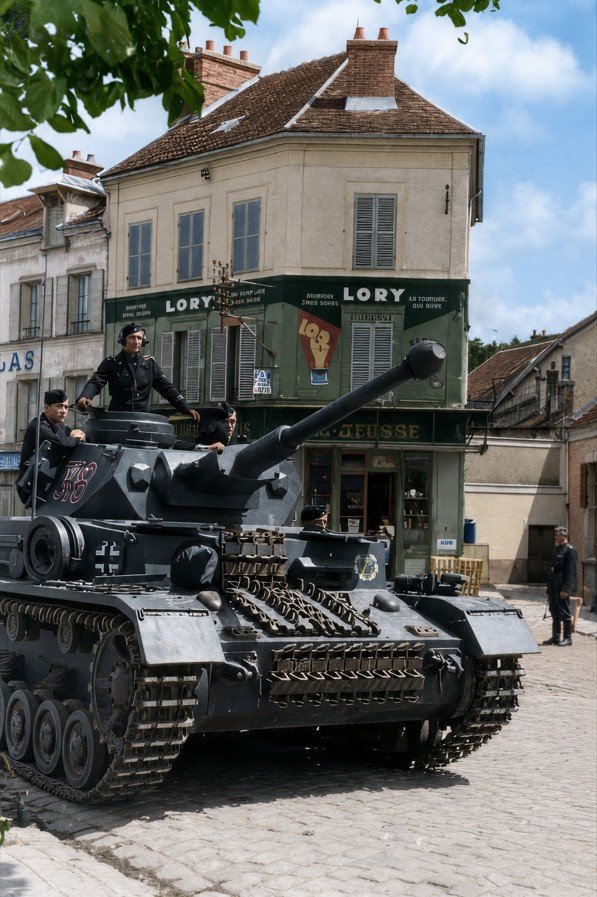
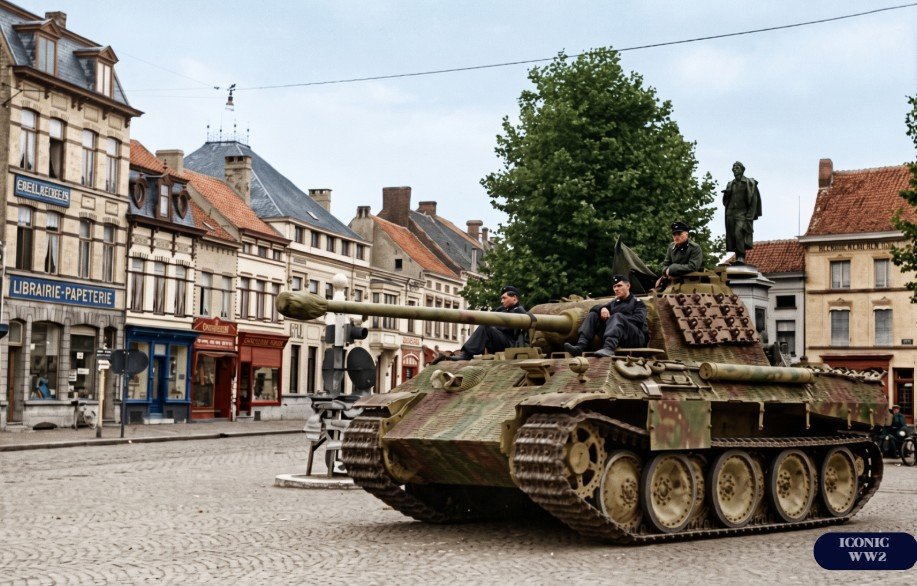
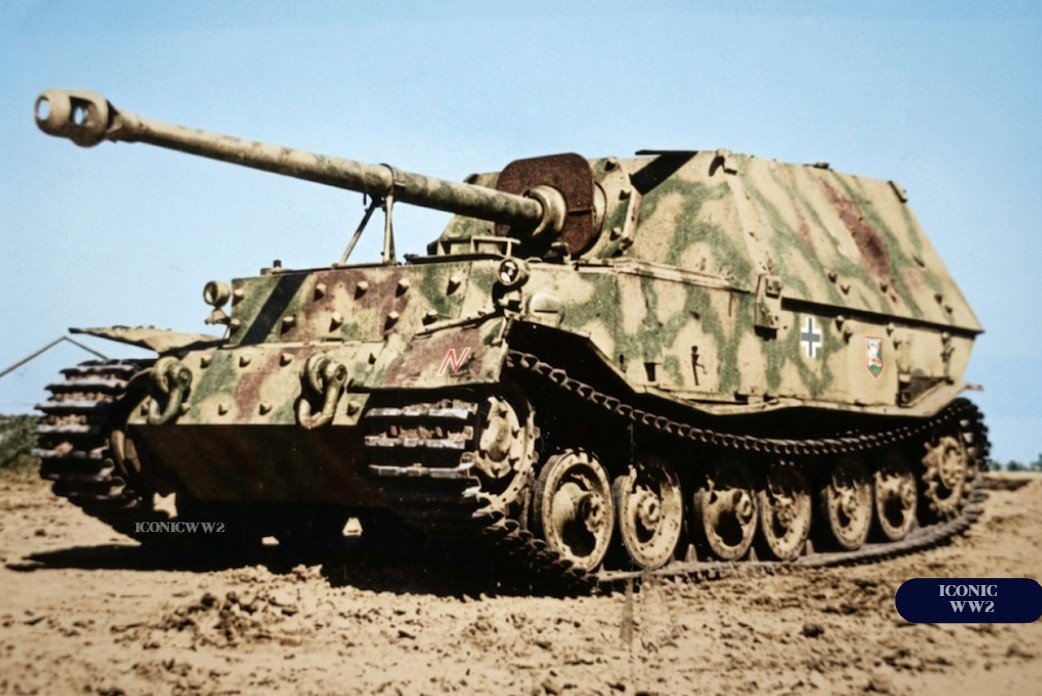
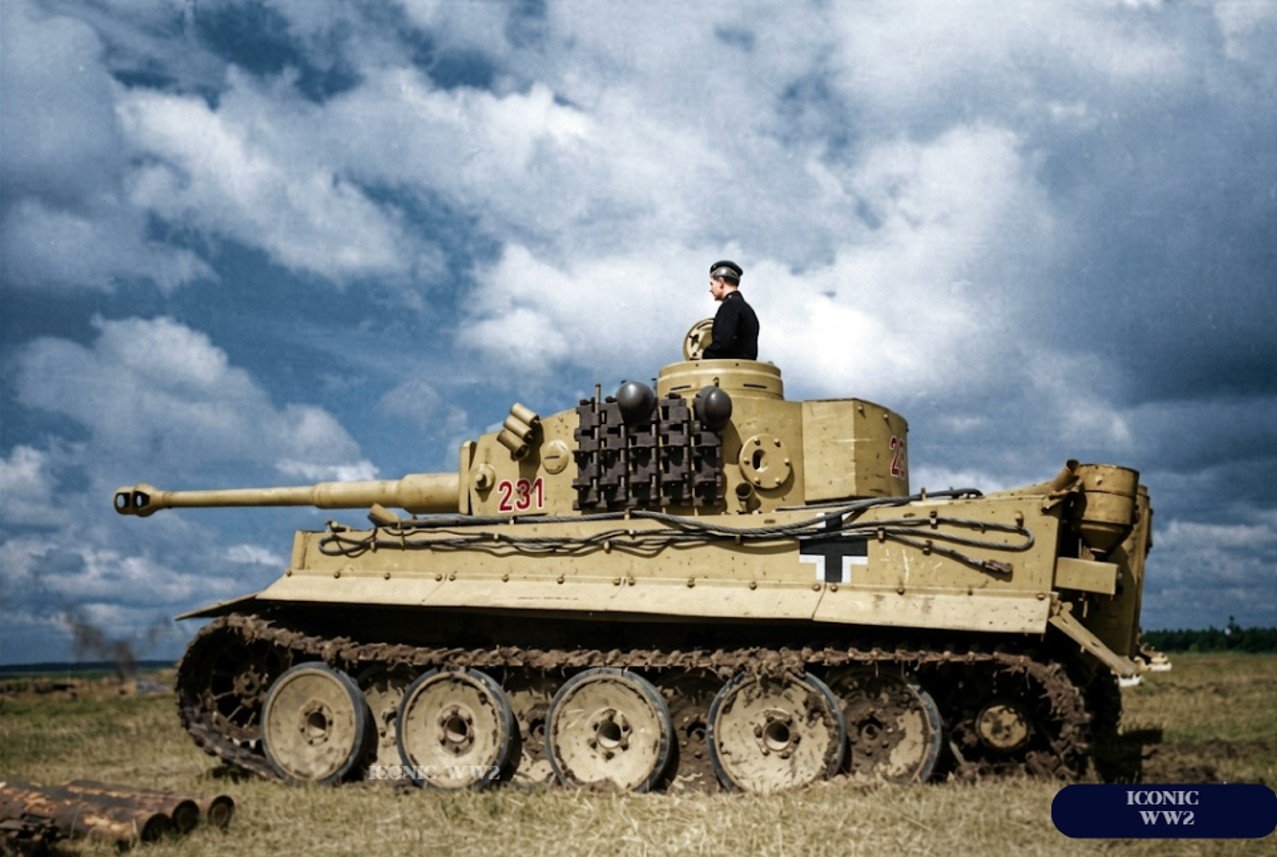
When Germany began secretly rebuilding its armoured force in the 1930s, doctrine called for two complementary medium tanks: a gun-armed vehicle to fight enemy tanks, and a heavier support tank firing high-explosive. The first of these became the Panzerkampfwagen III, designed under Daimler-Benz from 1936 and intended as the standard battle tank of the Panzer divisions.
Crucially, the design was laid out around a five-man crew — commander, gunner, loader, driver and radio-operator/hull gunner — with the commander in a dedicated cupola, free to observe rather than serve the gun. This division of labour, rare among contemporaries, gave German tanks a decisive edge in command and gunnery efficiency, and the layout became the template every modern tank would follow.
Early production models (Ausf. A–F) carried a 37 mm KwK 36 L/46.5 gun and only 15–30 mm of armour. Combat in Poland and France showed both to be marginal, and the design was rapidly improved: armour on the Ausf. F–J was thickened to 30–50 mm (often with 30 mm bolt-on plates), and the gun was upgraded first to the 50 mm KwK 38 L/42, then to the high-velocity 50 mm KwK 39 L/60 on the Ausf. J/L/M.
The standard powerplant was the Maybach HL 120 TRM, a 12-cylinder petrol engine of about 300 hp, giving the ~23 t tank a road speed near 40 km/h and a range of around 155 km. Torsion-bar suspension on six road wheels per side delivered a stable, comfortable ride that aided accurate gunnery on the move.
By 1942, however, the Panzer III had reached the limit of its small turret ring. It could not mount a gun larger than the 50 mm L/60 — inadequate against the T-34 and KV-1 — and the final combat versions reverted to a low-velocity 75 mm KwK 37 L/24 for infantry support, ceding the anti-tank role to the Panzer IV.
The Panzer III’s war can be told in inventories. In May 1940 only 349 were available for the attack in the West — among 2,439 German tanks, most far lighter — yet they formed the armoured cutting edge at Sedan and in the race to the sea. By Barbarossa in June 1941 roughly a thousand Panzer IIIs made it the backbone of the panzer force that reached the gates of Moscow.
Late production told the other half of the story: the final Ausf. N, some 700 vehicles with the short 75 mm L/24, served as close-support escort for Tiger battalions from 1943 — the one-time main battle tank ending its career as bodyguard to its successor, while its chassis lived on under more than 10,000 Sturmgeschütz III.
Production of the gun tank ran to roughly 5,770 vehicles across more than a dozen marks (Ausf. A through N). Specialised versions included the Tauchpanzer deep-wading tanks prepared for the cancelled invasion of Britain, the Flammpanzer III flamethrower, and numerous command (Befehlspanzer) and observation tanks.
Its most important legacy was the chassis. The same hull and running gear underpinned the Sturmgeschütz III assault gun — built in greater numbers than any other German armoured vehicle (over 10,000) — so that the Panzer III's components remained in front-line production long after the tank itself was withdrawn.
The Panzer III was the principal German battle tank of the victorious early campaigns. It spearheaded the Blitzkrieg in Poland (1939), France (1940) and the Balkans (1941), and formed the armoured core of Operation Barbarossa, where in mid-1941 it was still the most numerous German gun tank in service.
In the desert it was the backbone of Rommel's Afrika Korps, the 50 mm L/60 versions proving dangerous to British armour until the arrival of the up-gunned Shermans and Grants. But on the Eastern Front the shock of meeting the T-34 and KV-1 in 1941 exposed its limits, and from 1943 it was steadily relegated to secondary fronts, training and the assault-gun role.
Total losses were heavy, but the type had already done its work: it was the tank with which Germany won its greatest victories, and the proving ground for the crew layout, optics and tactics that defined the Panzerwaffe.
The Panzerkampfwagen III is less celebrated than the Tiger or Panther, yet it was far more important to Germany's early success. A sound, well-balanced 23 t medium with a five-man crew, good optics and an up-gunnable turret, it was technically modest but tactically superb in the hands of well-trained crews.
Its fatal limitation — a turret ring too small to grow beyond the 50 mm gun — ended its career as a battle tank by 1943, just as the T-34 and Sherman were hitting their stride. But through the StuG III its chassis fought to the very end of the war, making the Panzer III, in one form or another, one of the most influential armoured designs of the conflict.
- Peter Chamberlain & Hilary L. Doyle, Encyclopedia of German Tanks of World War Two (Arms & Armour Press).
- Thomas L. Jentz & Hilary L. Doyle, Panzer Tracts No. 3: Panzerkampfwagen III.
Iconic WW2 is free, ad-free and tracker-free — kept going only by the time it takes to research, restore and colorize each machine. If this profile was worth your read, you can help the archive grow.
| Manufacturer | Daimler-Benz (design) |
| Nation | Germany |
| Role | Medium battle tank |
| Service Entry | 1939 |
| Crew | 5 |
| Combat Weight | ~23 t (Ausf. M) |
| Produced | ~5,770 (1939–1943) |
| Early | 37 mm KwK 36 L/46.5 |
| Mid | 50 mm KwK 38 L/42 |
| Late | 50 mm KwK 39 L/60 |
| Support | 75 mm KwK 37 L/24 |
| Engine | Maybach HL 120 TRM V12 petrol |
| Power | ~300 hp |
| Road Speed | ~40 km/h |
| Range | ~155 km road |
| Length | ~5.56 m |
| Width | ~2.90 m |
| Height | ~2.50 m |
| Suspension | Torsion bar, 6 road wheels |
| Main Gun | 50 mm KwK 39 L/60 |
| Secondary | 2× 7.92 mm MG34 |
| Front Armour | 50 mm + 20 mm bolt-on |
| Legacy | Chassis used for StuG III (10,000+) |