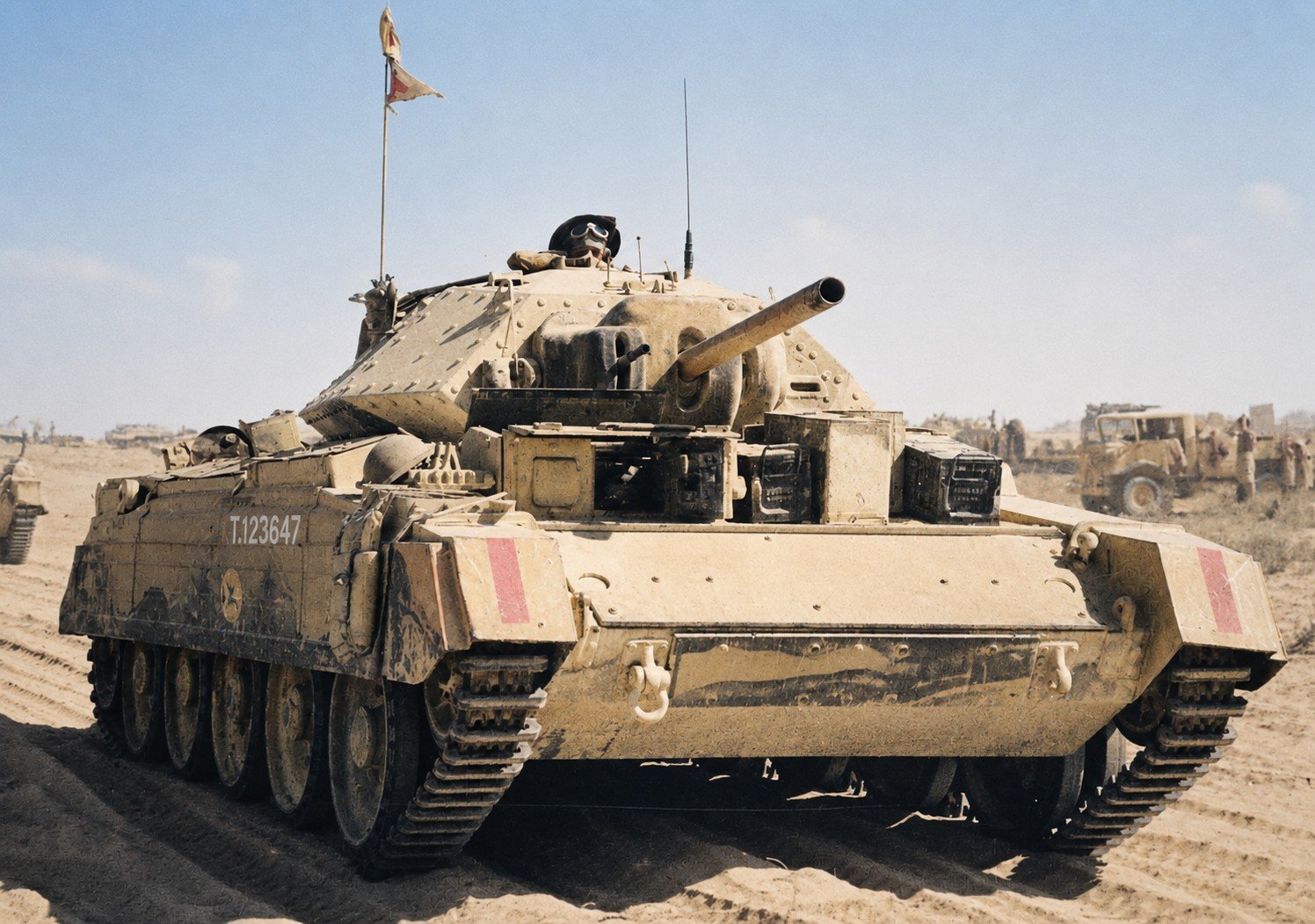
Through the first half of the war, British cruiser tanks — the fast, lightly-armoured vehicles meant to race through gaps and exploit a breakthrough, in the role once given to cavalry — had been a chronic disappointment. Designs like the Crusader were quick but mechanically fragile and under-gunned, repeatedly letting their crews down in the desert. What British armour desperately needed was a cruiser that was not only fast but reliable and properly armed.
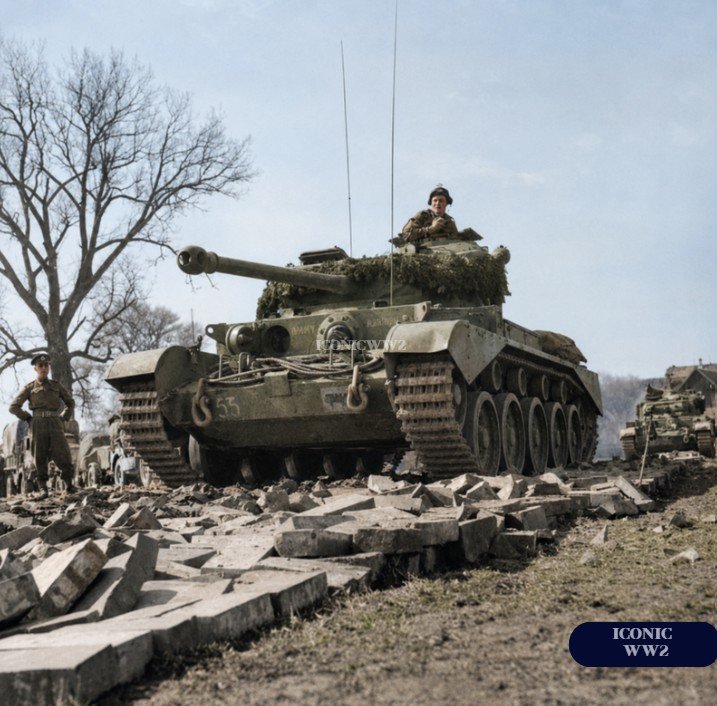
The breakthrough came from an engine. Rolls-Royce adapted its legendary Merlin aero engine — the powerplant of the Spitfire — into a detuned tank version called the Meteor, giving British designers a compact, powerful and dependable engine at last. Built around it, the Cruiser Tank Mk VIII Cromwell (A27M) entered service in 1944 and became the finest British cruiser tank to see widespread action in the war.
The Meteor transformed the Cromwell. With some 600 horsepower on tap, it made the tank genuinely fast — capable of around 64 km/h, among the quickest tanks of the war — and, just as importantly, it was reliable in a way British cruisers had never been. Mated to a Christie suspension, the Cromwell could cover ground at a pace that delighted its crews and suited the reconnaissance and exploitation role for which it was intended.
Its armament was the dual-purpose 75 mm OQF gun, the same calibre as the American Sherman's and, like it, a good all-rounder — able to fire a useful high-explosive shell as well as armour-piercing rounds. But it shared the Sherman's central failing: against the frontal armour of a Panther or Tiger the 75 mm was badly outmatched, unable to penetrate at normal ranges while those tanks could destroy it with ease.
The Cromwell's armour, up to around 76 mm at the front, was adequate but no match for the heaviest German guns. In truth it was a tank built around speed and a balanced gun rather than protection or raw hitting power — a fast, handy cruiser whose answer to the German heavies was to outmanoeuvre them, scout them out and call in heavier guns, rather than slug it out toe to toe.
The main battle version was the Cromwell IV with the 75 mm gun, while the Cromwell VI mounted a 95 mm close-support howitzer for blasting strongpoints. A near-identical sister, the Centaur, used the older Liberty engine in place of the Meteor and was largely relegated to training and specialist roles, though some Centaurs fought as 95 mm close-support tanks with the Royal Marines in Normandy.
The Cromwell's greatest legacy was its direct successor. Up-gunning the design with a powerful new 77 mm gun — derived from the deadly 17-pounder — produced the Comet, widely regarded as the best British tank to see service in the war and the vehicle that finally gave British armour a gun able to meet the German heavies on more equal terms.
The Cromwell entered service in time for the Normandy campaign of 1944, where it equipped the armoured reconnaissance regiments — most famously those of the 7th Armoured Division, the legendary “Desert Rats.” Its speed made it ideal for scouting ahead of the main force, screening flanks and exploiting gaps once the line was broken.
Speed was the Cromwell’s gift and its gamble. Its Rolls-Royce Meteor engine — a de-rated Merlin — drove it to nearly 64 km/h, faster than any German tank it would face. But at Villers-Bocage on 13 June 1944 a single Tiger under Michael Wittmann tore apart a 7th Armoured column in minutes, a brutal reminder that pace was no substitute for armour when a cruiser tank was caught at close range.
In the close, hedge-lined bocage of Normandy, where short ranges and concealed German anti-tank guns and heavy tanks made every advance perilous, the Cromwell's thin armour and ordinary gun were a serious handicap, and crews paid the price for meeting Panthers and Tigers at close quarters. But once the Allies broke out into open country, the Cromwell came into its own — racing across France and the Low Countries at a pace the heavier tanks could not match.
From the breakout to the final advance into Germany, the Cromwell did exactly what a cruiser tank was meant to do: it moved fast, ranged wide and exploited success, the speedy eyes and probing edge of the British armoured divisions in the last year of the war.
The Cromwell was the tank that finally made the British cruiser concept work. After years of fast-but-fragile failures, the marriage of a reliable, powerful Meteor engine to a sound chassis produced a genuinely quick, dependable and useful tank — even if its 75 mm gun and modest armour left it outclassed in a straight fight with the German heavies.
Around 4,000 were built, and the Cromwell served the British armoured divisions well as a fast reconnaissance and exploitation tank through the campaigns of 1944–45. Its deepest importance, though, may lie in what it led to: as the direct ancestor of the excellent Comet, and a conceptual step toward the post-war Centurion, the Cromwell stands at the turning point where British tank design finally came good.
- Peter Chamberlain & Chris Ellis, British and American Tanks of World War Two (Arms & Armour Press).
- David Fletcher, Cromwell Cruiser Tank 1943–50 (Osprey, New Vanguard).
Iconic WW2 is free, ad-free and tracker-free — kept going only by the time it takes to research, restore and colorize each machine. If this profile was worth your read, you can help the archive grow.
| Manufacturer | Nuffield Mechanizations / Leyland |
| Designation | Cruiser Tank Mk VIII (A27M) |
| Nation | United Kingdom |
| Role | Cruiser tank |
| Service Entry | 1944 |
| Crew | 5 (commander, gunner, loader, driver, hull gunner) |
| Units Built | ~4,000 |
| Cromwell IV | 75 mm OQF — main version |
| Cromwell VI | 95 mm close-support howitzer |
| Centaur | Liberty-engined sister tank |
| Comet | Up-gunned 77 mm successor |
| Engine | Rolls-Royce Meteor |
| Type | V-12 petrol (Merlin-derived) |
| Power | ~600 hp |
| Suspension | Christie |
| Road Speed | ~64 km/h |
| Cross-country Speed | ~29 km/h |
| Range (road) | ~270 km |
| Note | Among the fastest tanks of the war |
| Length | 6.35 m |
| Width | 2.91 m |
| Height | 2.49 m |
| Combat Weight | ~28 t |
| Main Gun | 75 mm OQF |
| Secondary | 2× 7.92 mm Besa MG |
| Front Armour | up to ~76 mm |
| Limitation | 75 mm weak vs heavy German armour |