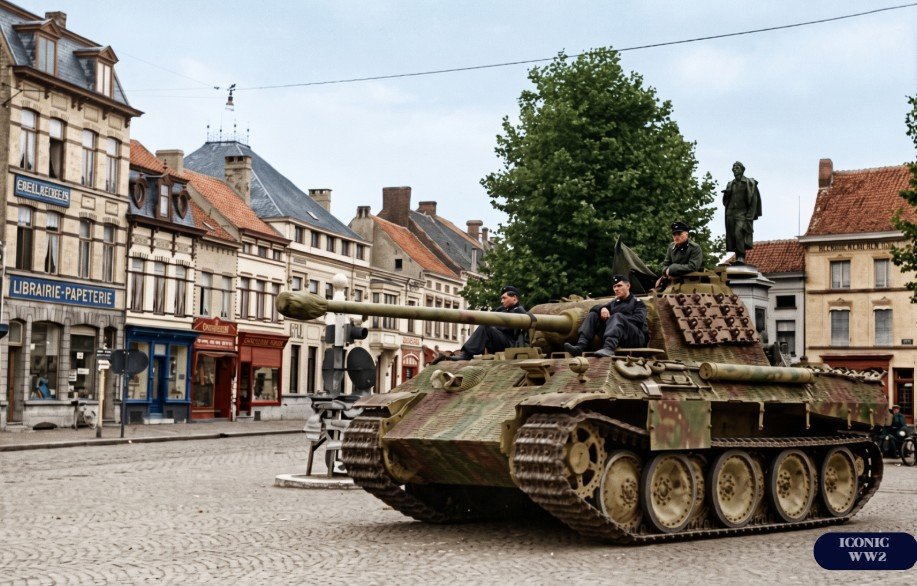
The Tiger was born of a shock. When German tanks first met the Soviet T-34 and KV-1 in the summer of 1941, their crews discovered to their horror that the standard guns of the Panzerwaffe could barely penetrate these well-armoured machines, while the Soviet tanks struck back with ease. The German Army’s existing designs had been outclassed almost overnight, and the demand for a heavy tank that could dominate any opponent on the battlefield became urgent.
Heavy-tank studies had in fact been running on a low priority since the late 1930s, but the Eastern Front gave them sudden importance. Two firms, Henschel and Porsche, were ordered to produce competing designs around a powerful new weapon — a tank version of the formidable 8.8 cm anti-aircraft gun. After trials in 1942 the more conventional and producible Henschel design was chosen, and it entered service as the Panzerkampfwagen VI Tiger.
The Tiger combined three qualities that, taken together, no Allied tank of 1942 could match: a devastating gun, very heavy armour, and a turret that could traverse a full 360 degrees to bring that gun to bear. Its 8.8 cm KwK 36 could destroy almost any enemy tank at ranges far beyond those at which its opponents could reply, and its flat 100 mm frontal plates were nearly impervious to the standard Allied anti-tank guns of the day.
These virtues came at a steep price. At nearly 57 tonnes the Tiger was enormously heavy for its time — too heavy for many bridges, a strain on its drivetrain, and a constant challenge to the engineers who had to recover or repair it. Its interleaved road wheels gave a smooth ride and excellent weight distribution but could pack with mud and ice that froze solid overnight, immobilising the tank until it was chipped free. It was thirsty, mechanically complex and slow to build, and it demanded skilled crews and a well-organised maintenance system to keep it running.
Production was therefore deliberately limited and the Tiger was treated as a special weapon. Rather than being scattered through the ordinary Panzer divisions, most were concentrated in independent heavy tank battalions (schwere Panzerabteilungen) held at corps or army level and committed where the fighting was hardest.
The Tiger I changed relatively little across its production life, a sign of how complete the basic design had been. Early vehicles used the Maybach HL 210 engine and were fitted for deep wading, while later ones received the more powerful HL 230 and simplified fittings. From 1943 the tanks were coated in Zimmerit anti-magnetic-mine paste, and the early commander’s drum cupola gave way to a safer cast cupola with periscopes.
The chassis also spawned the massive Sturmtiger, a close-assault vehicle mounting a 38 cm rocket mortar intended to flatten buildings and fortifications. But the Tiger I was never the basis for the broad family of derivatives that grew from the Panzer IV — it was too heavy, too costly and too few in number, and by 1944 it was being superseded on the production lines by the even larger Tiger II (King Tiger).
The Tiger first saw action near Leningrad in September 1942 and in Tunisia soon after, and from then until the end of the war it fought on every front. At the great tank battle of Kursk in the summer of 1943, in the bocage of Normandy, and in the long defensive battles across Russia and the West, its 8.8 cm gun let it kill at ranges where its opponents could not reply, and a single well-sited Tiger could hold up an entire advance.
Yet the wider story was one of attrition. Slow, heavy and few, Tigers were worn down by mechanical breakdown, fuel shortages and overwhelming Allied numbers and air power. A great many were lost not in battle but abandoned and destroyed by their own crews when they broke down or ran dry, unable to be recovered. By 1945 the surviving Tigers were fighting a losing rearguard — lethal to the last, but unable to turn the tide.
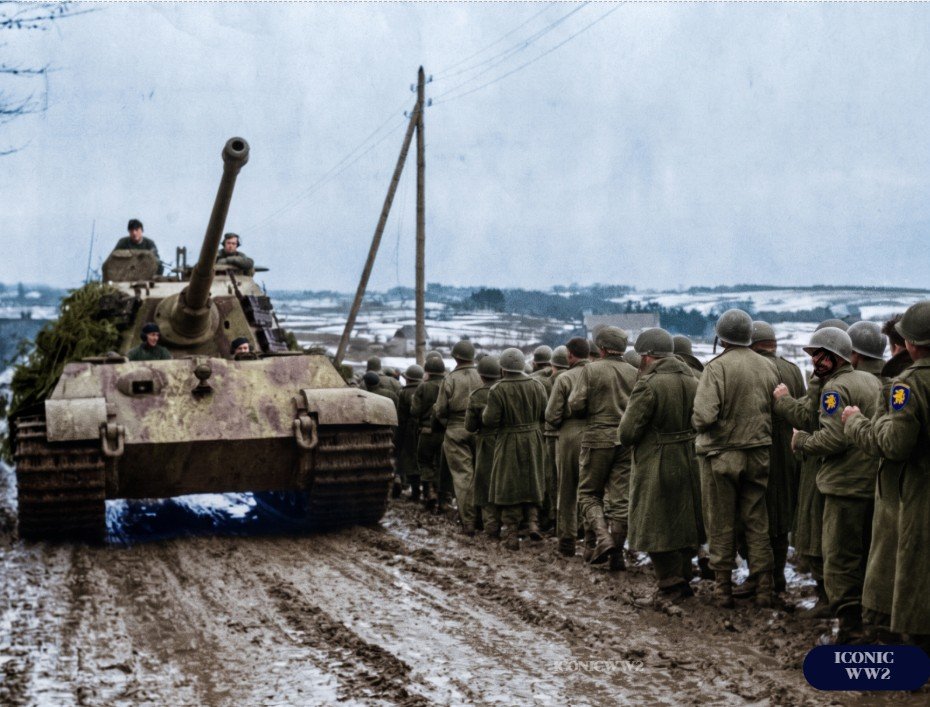
No tank of the war cast a longer shadow. So feared was the Tiger that Allied crews reported almost every German tank they met as one, whatever it actually was — a habit that hardened into a genuine tactical problem, sometimes called “Tiger fright”. Its reputation alone could stall an attack, and Allied doctrine and propaganda alike had to work hard to convince crews that the tank could, in fact, be killed.
In skilled hands the results could be extraordinary. The most famous episode came at Villers-Bocage on 13 June 1944, where a single Tiger commanded by Michael Wittmann tore into a stalled British armoured column and destroyed more than a dozen tanks and other vehicles in a matter of minutes. On the Eastern Front the leading Tiger aces — Kurt Knispel, credited with the war’s highest tank-kill tally, and Otto Carius, who wrote of the fighting in Tigers in the Mud — ran up scores of well over a hundred kills apiece, and the tank won a psychological dominance out of all proportion to its modest numbers.
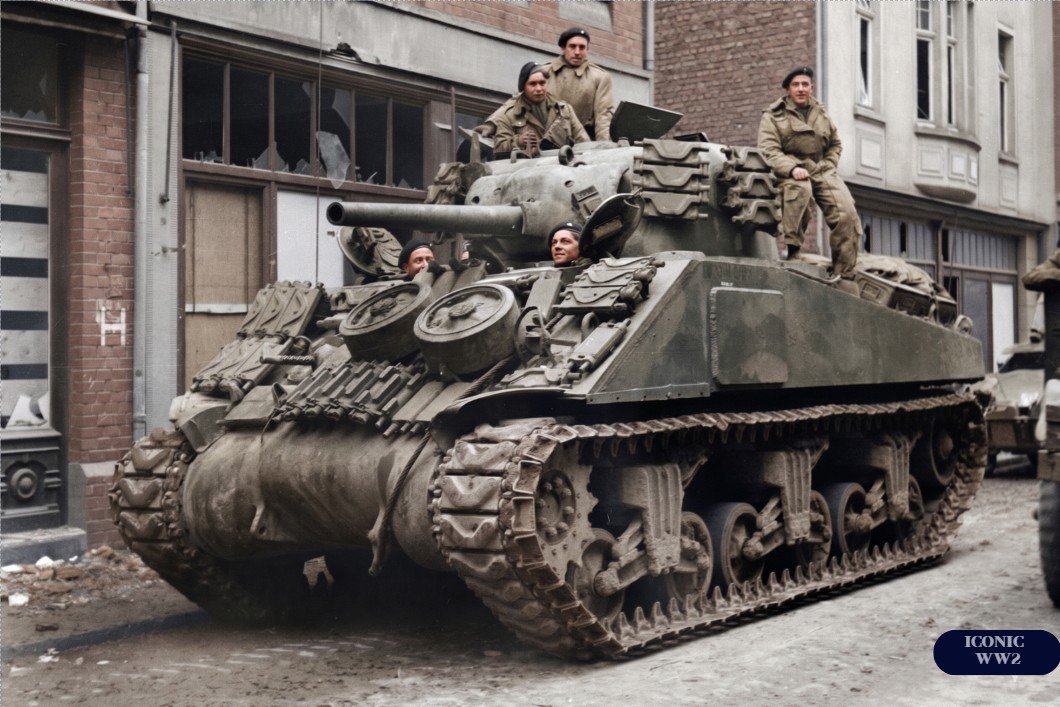
For all the dread it inspired, the Tiger could be killed, and the Allies learned how. Its frontal armour was formidable, but its flanks and rear were far thinner, and its slow turret traverse and great weight left it open to being outmanoeuvred. The standard answer became to fix a Tiger’s attention from the front and destroy it with fire from the side — often at the cost of the Sherman crews sent in to bait it. Sheer numbers did the rest: a Tiger might knock out five tanks and still be overwhelmed by the sixth.
New weapons closed the gap. The British 17-pounder, mounted in the Sherman Firefly, could defeat a Tiger frontally at real combat range, while on the Eastern Front the Soviets fielded dedicated “beast-killers” — the 122 mm gun of the IS-2 and the massive 152 mm of the ISU-152, whose shells could blow a Tiger’s turret clean off. Allied fighter-bombers harried the Tigers whenever they moved by day, and their own mechanical frailty finished many more: a Tiger that threw a track or drank its tank dry in the wrong place was as good as lost, for it could rarely be towed clear.
The Tiger I is the most famous tank of the Second World War, and in pure fighting power it deserved its reputation: for a time in 1942–43 it could outgun and out-armour anything it met, and a single well-handled Tiger could dominate a battlefield. Its name became a byword for German armoured might and a source of real dread among its enemies.
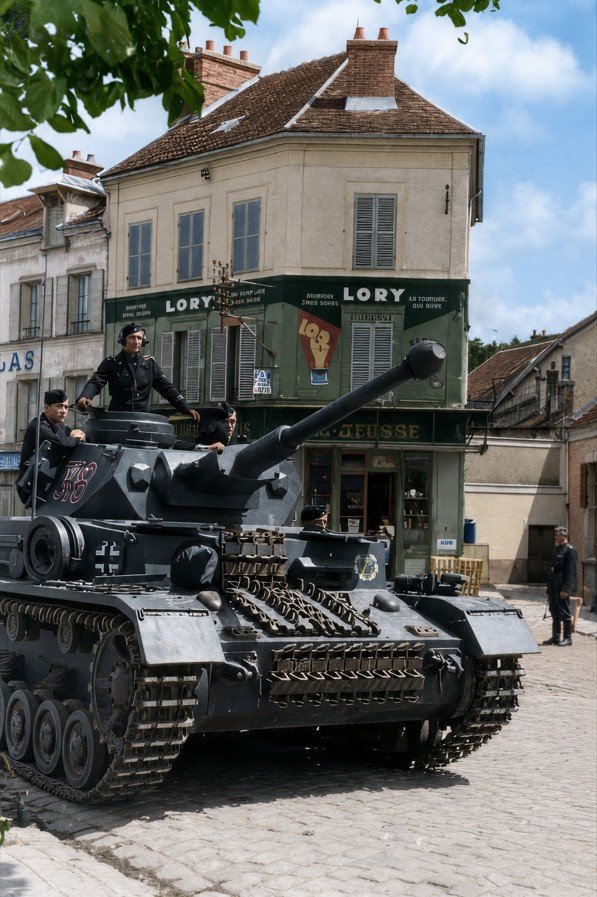
But as a weapon of war it was a flawed masterpiece. With only around 1,347 built, it was always too rare, too costly and too fragile to be decisive, and the steady, buildable Panzer IV did far more of Germany’s actual fighting. The Tiger is remembered for what it could do in a duel; the war, in the end, was decided by numbers it could never hope to match.
- Thomas L. Jentz & Hilary L. Doyle, Germany’s Tiger Tanks: D.W. to Tiger I (Schiffer, 2000) — the definitive technical study.
- Wolfgang Schneider, Tigers in Combat I (Stackpole, 2004).
- Otto Carius, Tigers in the Mud (Stackpole) — the memoir of a leading Tiger ace.
- The Tank Museum, Bovington — Tiger 131, the world’s only running Tiger I.
Iconic WW2 is free, ad-free and tracker-free — kept going only by the time it takes to research, restore and colorize each machine. If this profile was worth your read, you can help the archive grow.
| Manufacturer | Henschel (chassis) |
| Turret | Krupp |
| Nation | Germany |
| Role | Heavy tank |
| Designation | Sd.Kfz. 181 |
| Service Entry | 1942 |
| Crew | 5 (commander, gunner, loader, driver, radio/bow MG) |
| Units Built | ~1,347 |
| Engine (early) | Maybach HL 210 P45 |
| Engine (late) | Maybach HL 230 P45 |
| Type | V-12 petrol |
| Power | ~700 hp |
| Transmission | Maybach OLVAR 8-speed |
| Road Speed | ~38 km/h |
| Cross-country Speed | ~20 km/h |
| Range (road) | ~110 km |
| Range (cross-country) | ~70 km |
| Length (with gun) | 8.45 m |
| Hull Length | 6.32 m |
| Width | 3.56 m |
| Height | 3.00 m |
| Combat Weight | ~57 t |
| Main Gun | 8.8 cm KwK 36 L/56 |
| Secondary | 2× 7.92 mm MG 34 |
| Ammunition | ~92 rounds |
| Hull Front Armour | 100 mm |
| Turret Front Armour | 100–120 mm |
| Side / Rear Armour | 60–80 mm |