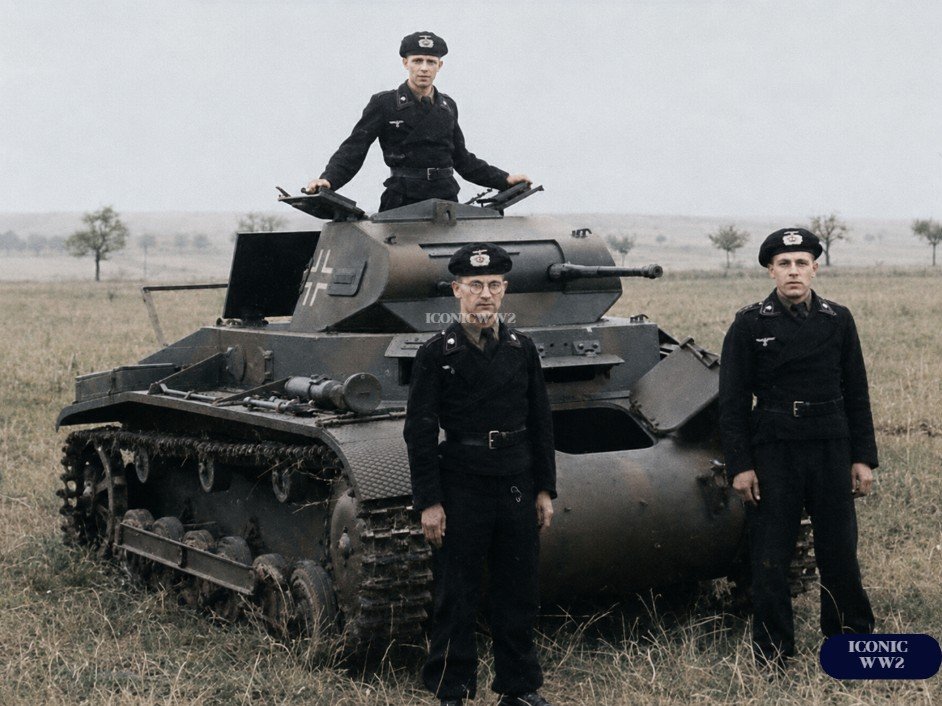
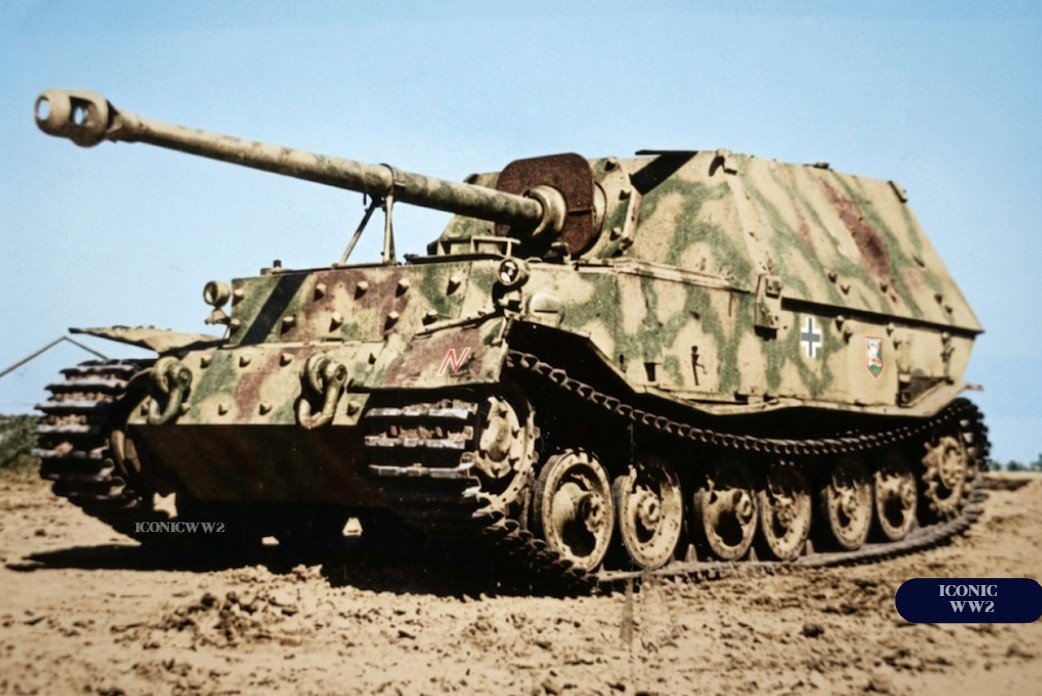
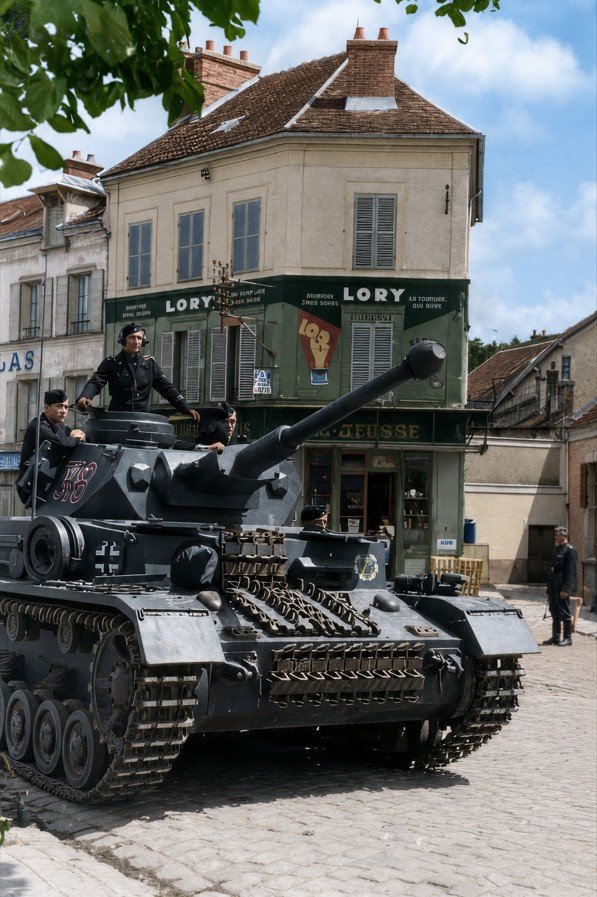
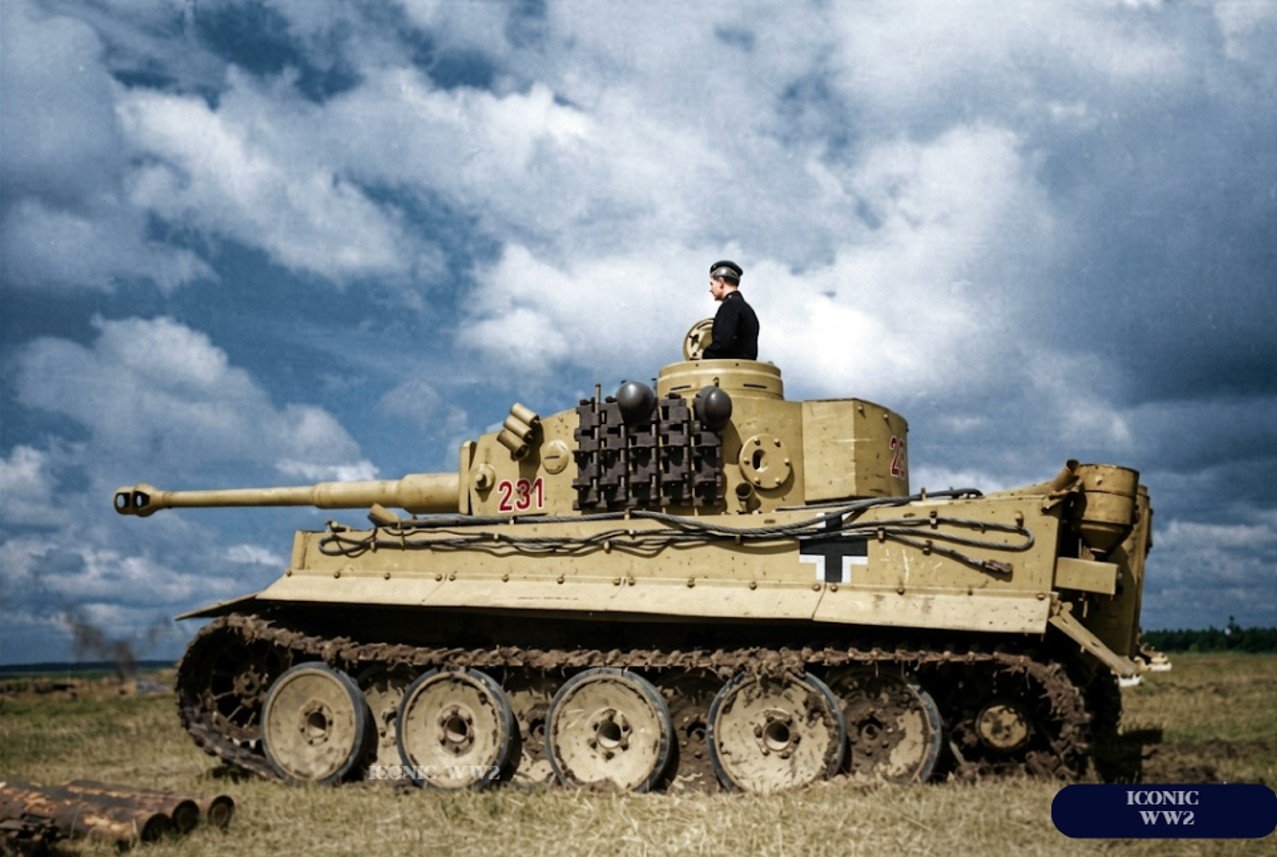
The Panzer 38(t) was not a German design at all. It began as the ČKD/Praga LT vz. 38, an excellent light tank developed in Czechoslovakia in the late 1930s and ordered by the Czech army — but none had been delivered when Germany occupied the country in March 1939.
The Germans seized the production line, and the manufacturer (renamed BMM in occupied Prague) continued building the tank for the Wehrmacht as the Panzerkampfwagen 38(t) — the 't' standing for tschechisch (Czech). It became one of the most important non-German tanks in the German inventory.
The 38(t) was armed with the Czech 37 mm Škoda A7 gun — comparable to the German 3.7 cm and able to defeat most light and medium tanks of 1939–40 — plus two 7.92 mm machine guns. It was a solid armament for its day, no worse than what the standard German medium tanks then carried.
Its protection, though, was old-fashioned: riveted armour around 25 mm on the front (later uparmoured to about 50 mm), with the well-known and dangerous drawback that a hit could shear the rivets and send them scything through the crew compartment even when the plate itself held. By 1941 the riveted hull and 37 mm gun were falling behind the pace of tank design.
What set the 38(t) apart was not its gun or armour but its reliability and ease of maintenance. A Praga EPA six-cylinder petrol engine of about 125 hp drove the 9.7 t tank to roughly 42 km/h, and its leaf-sprung suspension on four large road wheels was robust and simple to service in the field.
German crews rated it mechanically superior to their own early Panzer I and II, and it was that automotive soundness — not its firepower — that made it valuable. As a gun tank it would be obsolete against the T-34 and KV within two years; but a tough, dependable chassis was exactly what German industry could keep using long after the turret had had its day.
The 38(t)’s finest hour came in France in 1940 with the 7. Panzer-Division — Erwin Rommel’s “Ghost Division” — where Czech-built tanks made up around half of the division’s armour. Driving from the Meuse at Dinant to the Channel coast, and then south to Cherbourg, the division advanced faster and further than any formation in military history to that date.
The campaign made the point emphatically: what won in 1940 was not armour thickness or gun calibre — the 38(t) was modest in both — but mechanical reliability, radios in every tank and relentless tempo. In those currencies the little Czech tank was rich.
The Panzer 38(t) equipped several Panzer divisions through Poland (initially from captured stock), the campaign in the West in 1940 and the opening of Barbarossa in 1941 — where around 760 took part in the invasion, still a substantial part of the German armoured force. In the fast battles of 1940–41 its 37 mm gun and reliability made it a genuinely effective fighting tank.
Against the heavier Soviet tanks it was quickly outclassed, and from 1942 it was withdrawn from front-line tank units. As a gun tank its career was over — but the chassis beneath it was only halfway through its war.
As a tank the 38(t) ran through versions A through G, with around 1,400 built as gun tanks. Its true importance lies in what came after: the dependable chassis became one of the war’s great conversion platforms.
It was rebuilt into the Marder III series of self-propelled anti-tank guns (mounting 75 mm and captured Soviet 76.2 mm weapons), the Grille self-propelled 150 mm infantry gun, and a range of reconnaissance and flak vehicles. Its finest derivative was the Jagdpanzer 38(t) “Hetzer” of 1944 — a low, well-sloped, 75 mm-armed tank destroyer built in thousands. Gun-tank versions also served the armies of Slovakia, Hungary, Romania and Bulgaria, and production of the chassis continued in Czechoslovakia after the war.
The Panzer 38(t) is the classic example of a captured design serving its conqueror well. A sound, reliable Czech light tank, it filled out the German Panzer divisions at a critical moment and performed creditably in the Blitzkrieg years before its riveted armour and light gun made it obsolete.
Its enduring significance, though, is mechanical. The 38(t)'s excellent chassis became the foundation for the Marder, Grille and Hetzer, making it one of the most influential armoured platforms of the war — a tank remembered less for its own battles than for the long line of fighting vehicles it made possible.
- Peter Chamberlain & Hilary L. Doyle, Encyclopedia of German Tanks of World War Two (Arms & Armour Press).
- Steven J. Zaloga, Panzer 38(t) (Osprey, New Vanguard).
- Vladimír Francev & Charles K. Kliment, Praga LT vz. 38 / Panzer 38(t) (MBI).
Iconic WW2 is free, ad-free and tracker-free — kept going only by the time it takes to research, restore and colorize each machine. If this profile was worth your read, you can help the archive grow.
| Manufacturer | ČKD / BMM, Prague |
| Origin | Czechoslovakia (LT vz. 38) |
| User | Germany (Heer) |
| Role | Light tank |
| Service Entry | 1939 |
| Crew | 4 |
| Units Built (gun tanks) | ~1,400 |
| Marder III | SP anti-tank gun (75 / 76.2 mm) |
| Grille | SP 150 mm infantry gun |
| Jagdpanzer 38(t) | 'Hetzer' tank destroyer, 1944 |
| Recon / Flak | Aufklärer & Flakpanzer 38(t) |
| Engine | Praga EPA |
| Type | 6-cyl petrol |
| Power | ~125 hp |
| Combat Weight | ~9.7 t |
| Road Speed | ~42 km/h |
| Range (road) | ~250 km |
| Combat Weight | ~9.7 t |
| Length | 4.61 m |
| Width | 2.14 m |
| Height | 2.25 m |
| Combat Weight | ~9.7 t |
| Main Gun | 37 mm Škoda A7 (KwK 38(t)) |
| Secondary | 2× 7.92 mm MG 37(t) |
| Ammunition | ~90 rounds |
| Front Armour | 25 mm riveted (later ~50 mm) |
| Construction | Riveted (rivet spalling risk) |